The Powers of Hanoi

There was a watery feel to the first day in Vietnam’s capital – unfortunately, most of it was on us.

We arrived at lunchtime after a four hour bus ride from Ha Long Bay, and we knew it was another huge changeover stop. For most of the group, Hanoi was their last stop, including Colin and Sarah who had become really good friends.

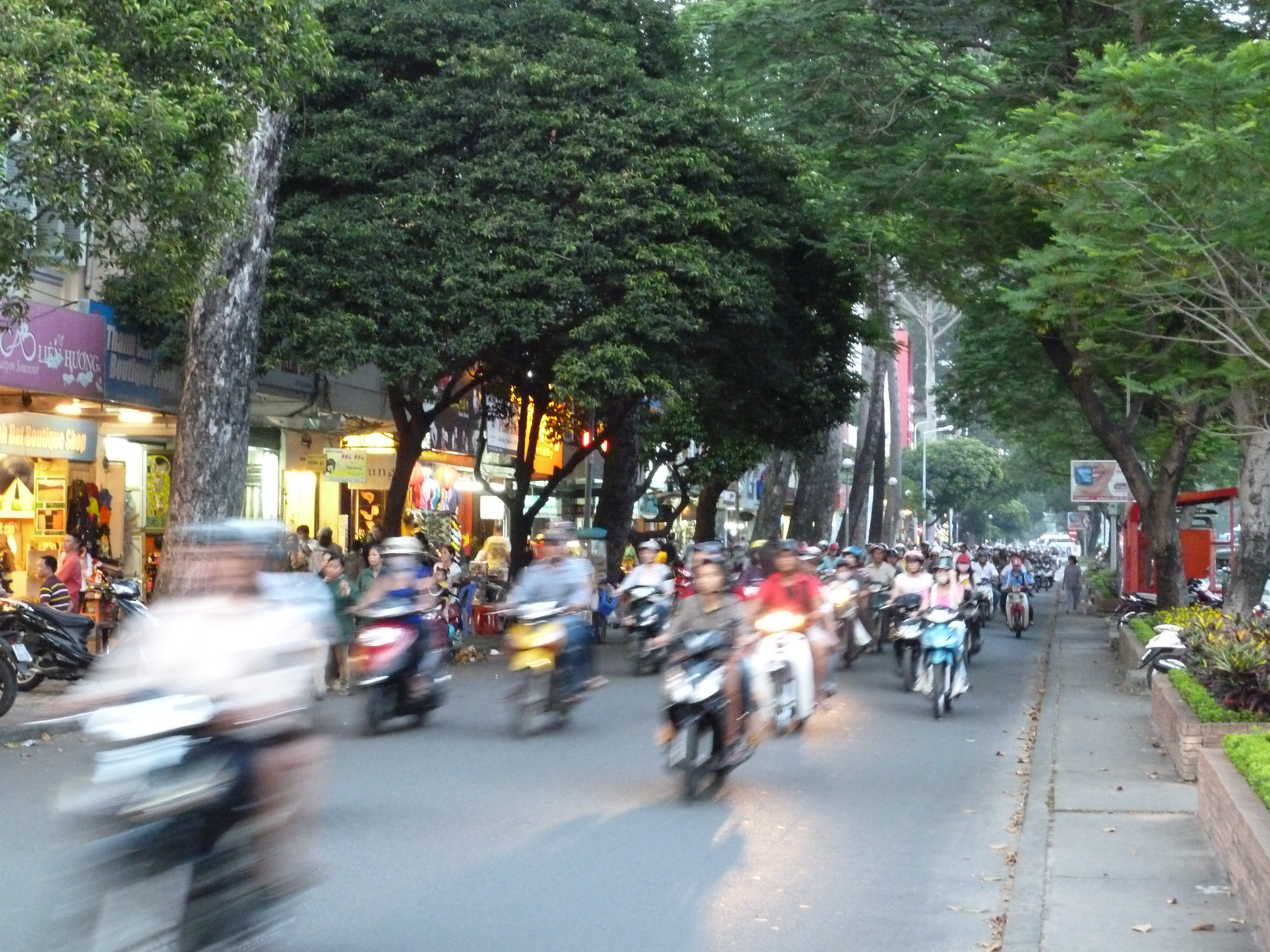
After dumping our bags in the room, we walked through the bustling streets. The first thing we noticed was the noise – motorbikes, horns, people yelling from the various stalls. If this was back home, Environmental Health would be imposing a hearing health warning on the place, but it definitely had a lot of character.
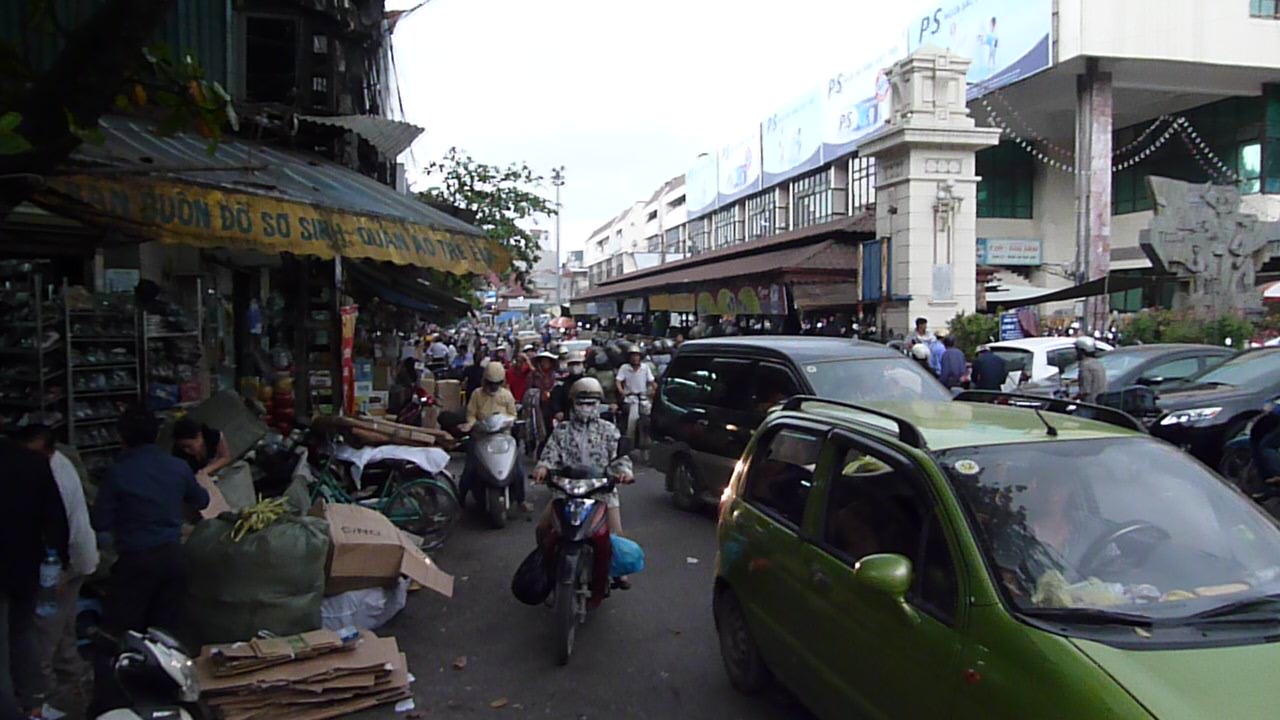
More chaos crossing the roads

We were walking through the streets, heading for our recommended lunch spot, when there was suddenly a few spots of rain. Then there were a few more – those really big splodges that seem to drench you in one hit. And then suddenly there was a wall of them.

We all dived for cover under the various stalls and canopies, other tourists scattered down the street looking for a place to shelter, dozens of moped and scooter riders immediately pulled over and donned ponchos in a whole spectrum of colours, stall holders were frantically trying to pull their t-shirts, noodles and barbecuing fish indoors. The ever enterprising street hawkers suddenly acquired armfuls of umbrellas to thrust in our faces.

In t-shirts and shorts, the torrential rain wasn’t much fun, while the lack of grip from my flip-flops meant I was pretty much skating my way to wherever our tour leader was intent on taking us. In the end I went barefoot – the street muck and gubbins was already washing over my feet as rivers of rainwater made their way to various blocked-up drains, and we arrived at the restaurant wet, bedraggled and in need of a beer.
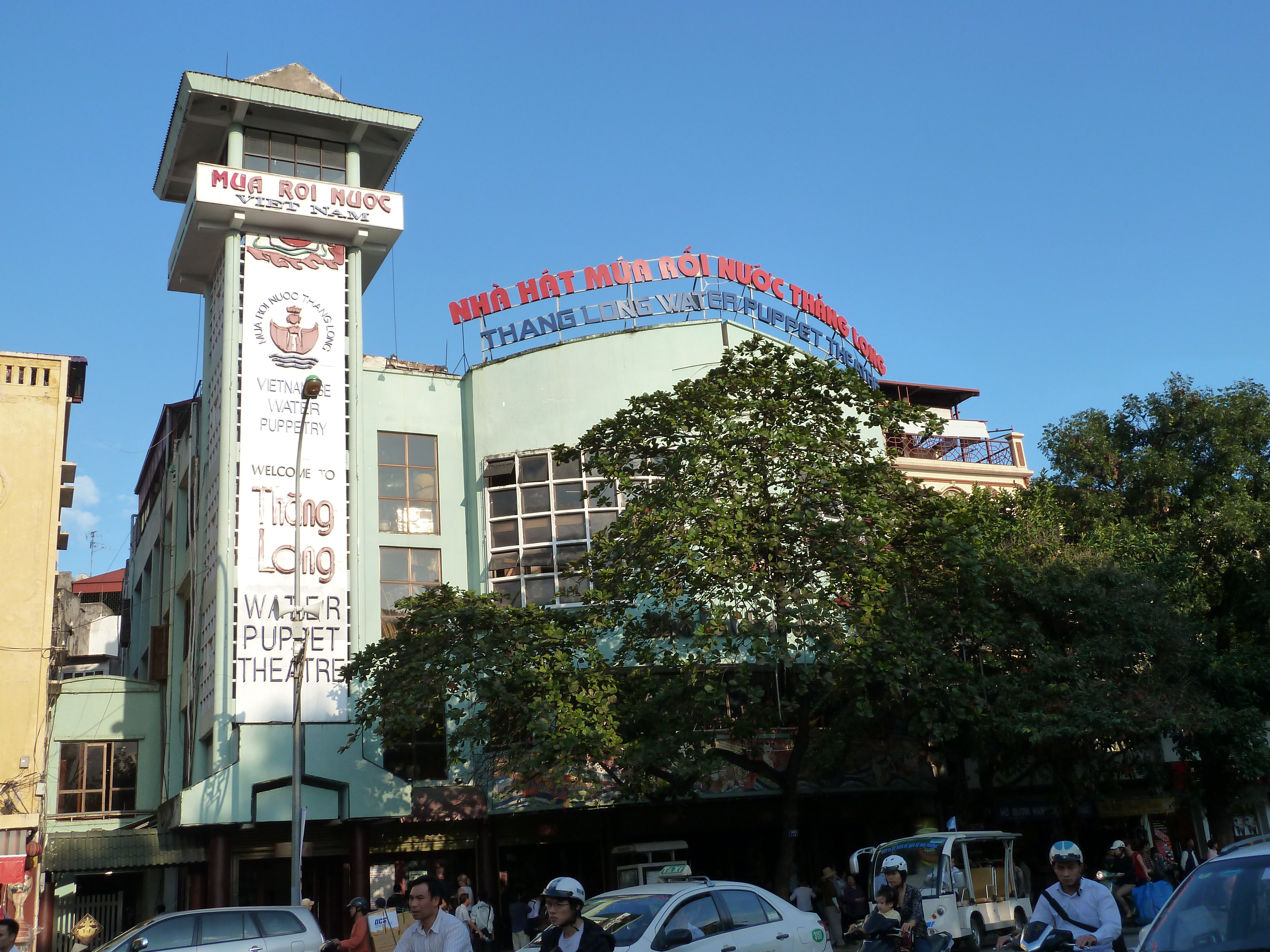
The puppet theatre (the day after the rain!)

Thankfully lunch gave us time to dry out, and the rain stopped. We walked to Hoan Kiem Lake, the centre of the city, where we came across the Thang Long Water Puppet theatre, home to a famous water puppetry show. I’d read about it briefly, and as it was only an hour long, was fairly keen to go. The group was split though – some wanted to go, some didn’t; some wanted to go the next day, some didn’t; even couples like Colin and Sarah couldn’t agree – Sarah wanted to go, Colin absolutely didn’t!

In the end, after a lot of faffing around and ‘umming and ahhing’ outside the box office, I decided to put an end to it by buying a ticket for Ricky and I. Everyone else followed suit, but the second class seats ran out so we plumped for the 100,000 Dong first class positions.

Inside the theatre

Inside the theatre has wings like any other theatre, but a pool of water instead of a stage. It was a full house, complete with a reluctant Colin who somehow bagged some of the best seats at the front of the stalls, and before long the lights dimmed, a strange oversize human puppet banged on a gong, and the theatre was filled with traditional Vietnamese music and singing.

The art form was born many years ago in the paddy fields around Vietnam, a way for farmers and villagers to entertain themselves amid the watery land. The illusion is the puppets aren’t connected to anything, as all the controls run under the water, and this was no different.
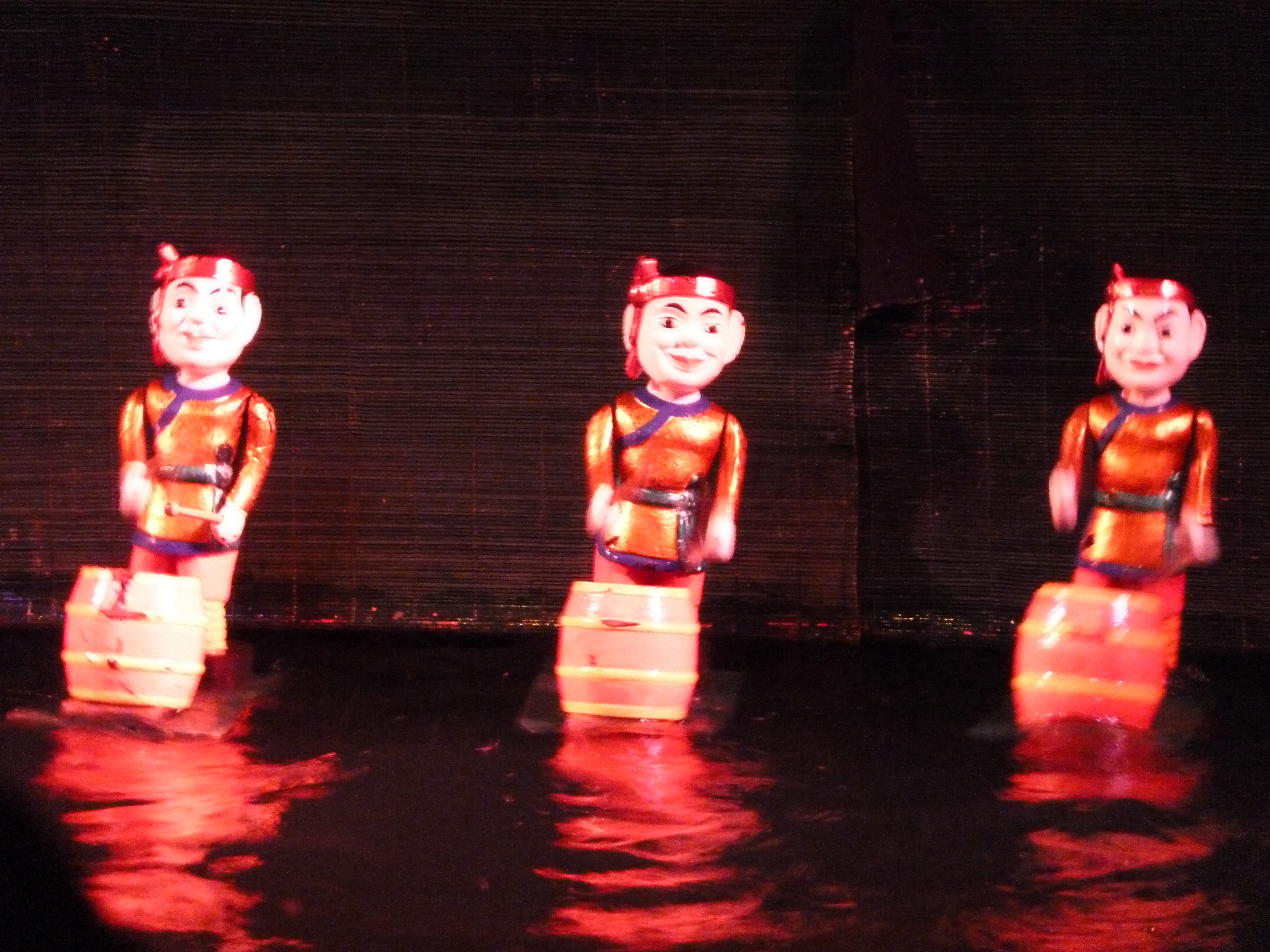
Water puppets!

As it was all in Vietnamese, I had no idea what on earth was happening. Puppets appeared from behind a screen, swished around in the water for a bit, chased dragons, had fights with water buffalos and climbed trees to collect coconuts. The music was good, and there’s no denying it’s a great spectacle – it’s by no means a West End production (Her Majesty’s Theatre would at least clean all the melted candle wax off the top of the puppets heads after each show!) but it was good fun.
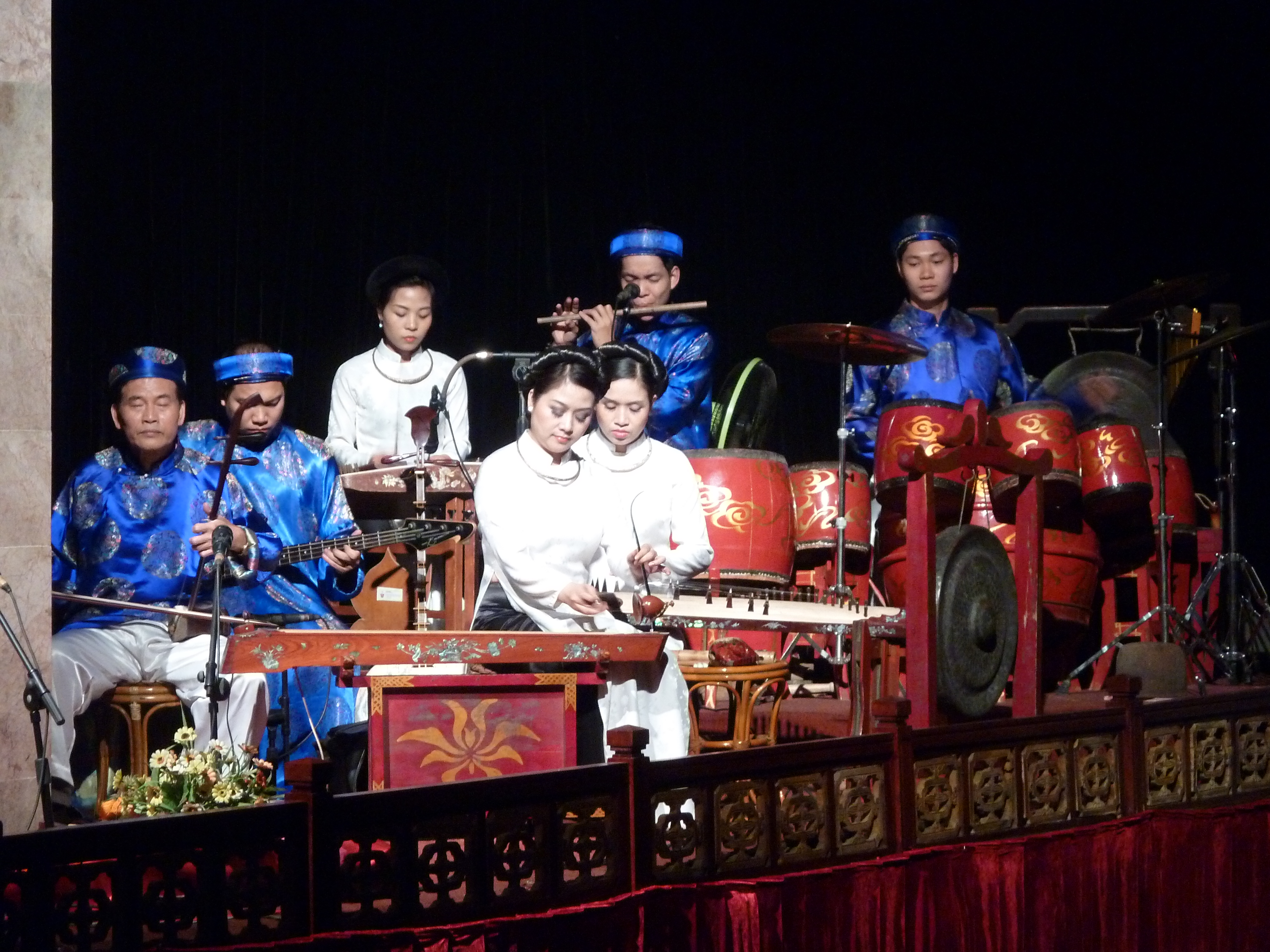
Singers and Vietnamese band

The finale was particularly special when a fish somehow flapped around in and out of the water and then magically got turned into a dragon, which with the help of a bit of UV light, flew through the air and into the wings. Sadly, the illusion was foiled when it slid back down its wire in full view of the audience, but it was a nice try – and then all the puppeteers waded round to the front with another dragon to take their bow.

The final bow - and a dragon

“It was pathetic,” spat Colin as I walked past him on the way out, with a few stronger words thrown in for good measure. Sarah giggled next to him, knowing he hated every minute but secretly enjoying it herself, while others agreed the music had been a highlight. For the sake of a few quid, it was a bit of history and culture and I think, perhaps secretly, everyone had a smile or two as a result.
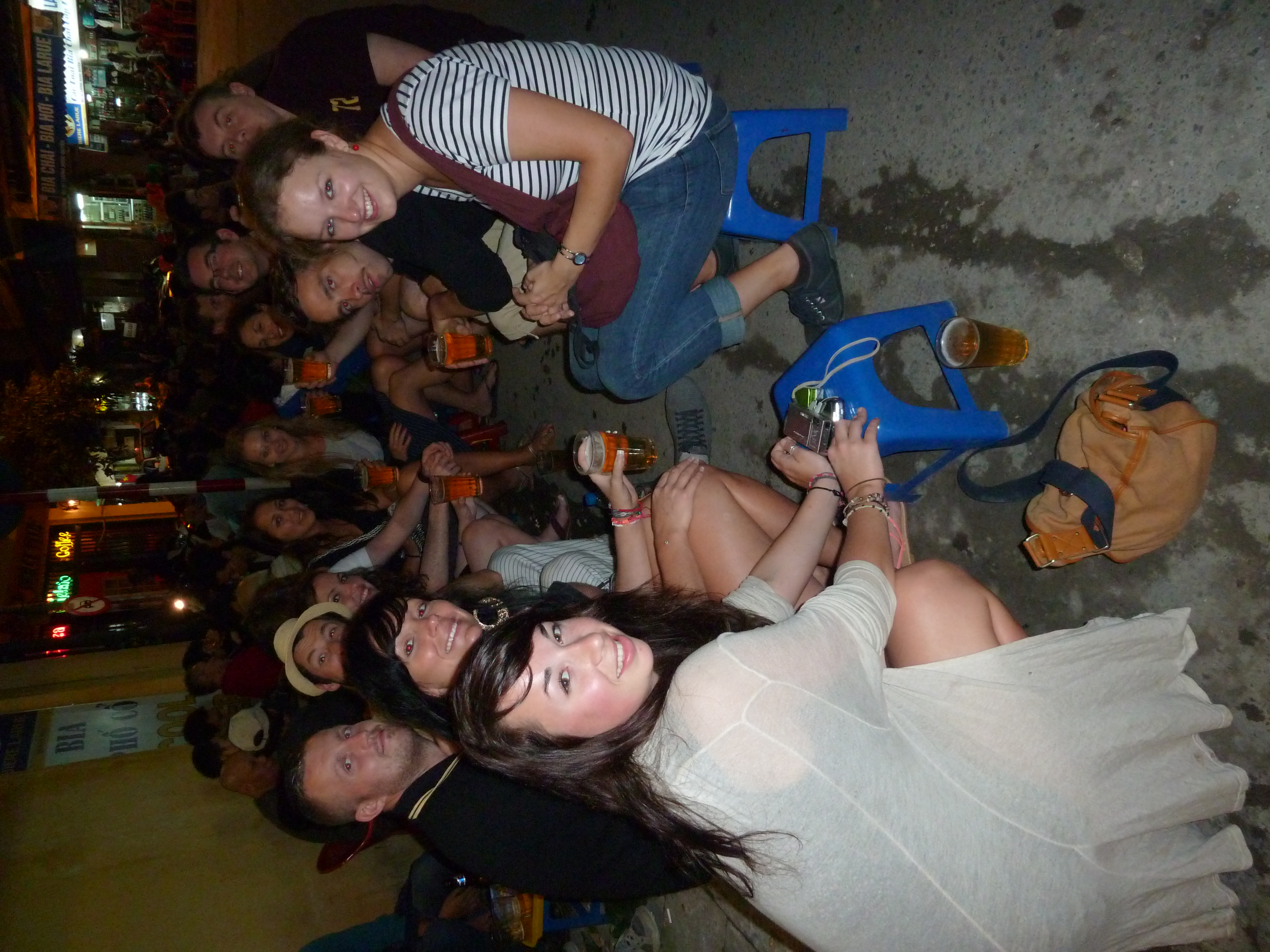
Cheap street drinking

After dinner that night, it was send-off time for a large chunk of the tour group, including many of those who had been with us since leaving Bangkok three weeks ago. We tried the local brew, Bia Hoi, which costs just 15p a glass, and is consumed on tiny chairs in the street. We ended up in a dive of a place called Bucket Bar, which specialised in the much-loved south east Asia drinking tradition of sticking various spirits into a sandcastle bucket and then adding a dash of Coke. I had a bit of an uneasy feeling about the place, especially when the shutters came down and the door was closed with everyone still inside – apparently its to avoid the Vietnamese ‘fun police’ who go around shutting places at midnight. Had we gone to the bar at the end of the night, I might have enjoyed it a bit more, but a few of us called it a day early and instead decided to have a clear head for a full day of sightseeing the following day, starting off with seeing a dead body – never good with a hangover.

It turned out my feelings about the place were proven right. German Dirk, famous for never taking off his typically Bavarian hat and who’s becoming a bit of a character in the group now we’ve learnt we can take the mickey out of him, managed to have his camera stolen. It happened to be nicked by people who work at the bar – a bit of an inside job- and Dirk had somehow worked it out. He offered two million Dong (about £65) to those who had taken it so that he could get it, and his photos, back.

Dirk, minus his hat

The fee was agreed, and he took a taxi to a cash machine to get the money. Unfortunately for Dirk, three men on motorbikes then followed him in the taxi to the cashpoint. With the money in his hand, he agreed to hand it over once he had the camera back in his possession. He was given the camera, but then decided to ‘amend’ the deal by handing over a single 500,000 Dong note and jumping back into the taxi and telling the driver to move it.

I can only imagine his horror when the driver instead turned off the engine and took the keys out of the ignition, before telling him it was the Vietnamese mafia.

Outside the taxi, one of the men was now on a mobile phone. Justifiably worried, Dirk handed the remaining 1,500,000 through a gap in the window, before the taxi driver then decided to drive off with him still in the car. He’d now realised the taxi driver was also in on the conspiracy, and was probably about to drive the hapless European out of the city and to some warehouse for an unscheduled meeting with ‘the boss’.

Fearing an additional unscheduled meeting with a meat cleaver, he somehow made a James Bond-style escape from the moving taxi near some traffic lights, and took to his heels through the back streets of Hanoi.

“I had Dirk cowering in my bathroom last night,” said Steven.

“He was asking ‘what is going on, what is going on, this world is cwayzee (Dirkism)’, proper panicking thinking the mafia were also in the hotel,” he added, in his finest Sunderland accent.

It had cost him 60 quid, but amazingly Dirk got all his photos and his camera back, and somehow has a great tale of how he defeated – or should I say evaded – the Vietnamese mafia. Its not a pastime I intend to take up anytime soon.

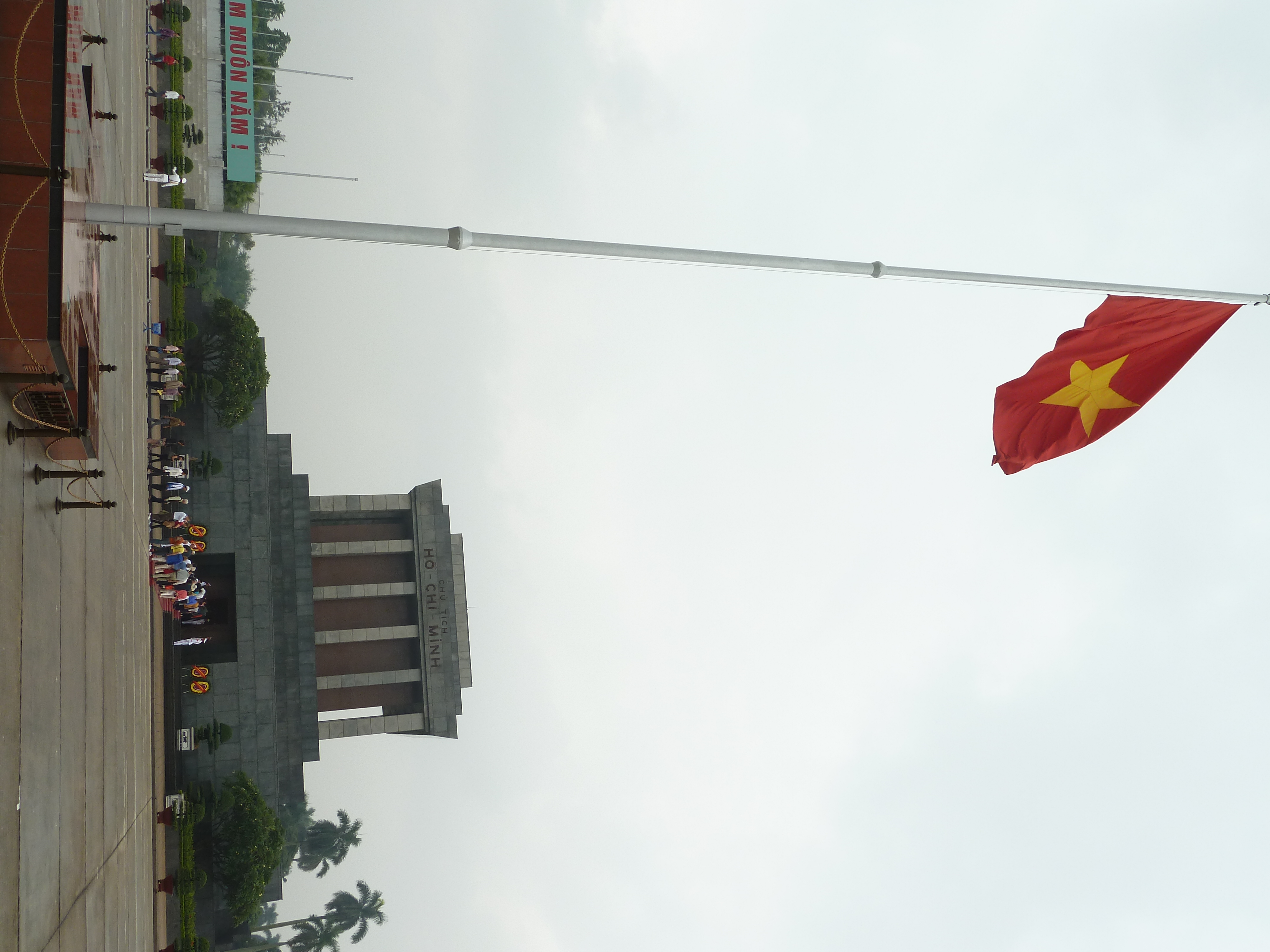
Ho Chi Minh Mausoleum

The next morning I was up early to look at a corpse. Thankfully, it wasn’t Dirk’s, but of Ho Chi Minh, the man seen by the Vietnamese to have saved the nation. Ho Chi Minh’s mausoleum is only open in the mornings, and there are stories about how you can be queuing for hours to get a glimpse of him. Fon, our leader, said we’d meet at 8am in the hotel reception. Unfortunately, my room mate Ricky, who stumbled in during the early hours, decided to switch off my alarm clock, and I woke up bang on 8am. After getting ready, Fon had already left, so I jumped in a taxi and made my own way there.

It turned out to be one of the best things I’d done – it gave me the entire day to wander around wherever I wanted, free from any time pressures. The tour I’m on has been brilliant, but every day is fairly structured with set times and places to meet for dinner. It was nice to just be out in the city and look around for myself. Taking a taxi, rather than walking with the group, also meant I was at the mausoleum really early, and was one of the first people to visit ‘Uncle Ho’ that day.

Ho Chi Minh

Rather like Mao, who I saw in Beijing, Ho Chi Minh is still very highly regarded here, even in death. He declared Vietnam independent of the French and Japanese in 1945, but that was short lived. America supported the French and helped transport troops to the country, so Ho Chi Minh led Vietnamese guerrilla warfare against the occupiers in 30 years of war. In 1954, he defeated the French at the battle of Dien Bien Phu, but it ended up leaving the country divided in the north and south. Along came America for the Vietnam campaign, and after years of fighting, and the US conceding it could never win the war, he oversaw the reunification of Vietnam in 1975.

Saigon was renamed Ho Chi Minh City in his honour, and after his death his body was embalmed and laid on public view at the Mausoleum in Ba Dinh Square, where he once addressed half a million of his countrymen with his independence speech in 1945. Now it’s a shrine and pilgrimage site, heavily secured with armed guards and soldiers, and as I walked into the mausoleum, everything fell silent. Vietnamese joined with tourists to silently walk around the body of one of the world’s most historic figures. The room was softly lit, and his body was in a triangular shaped glass coffin, filled with more soft lighting which highlighted his face and hands. His famous wispy beard was very noticeable, and he looked at complete peace, almost with a smile on his face as if his work on this world was done.
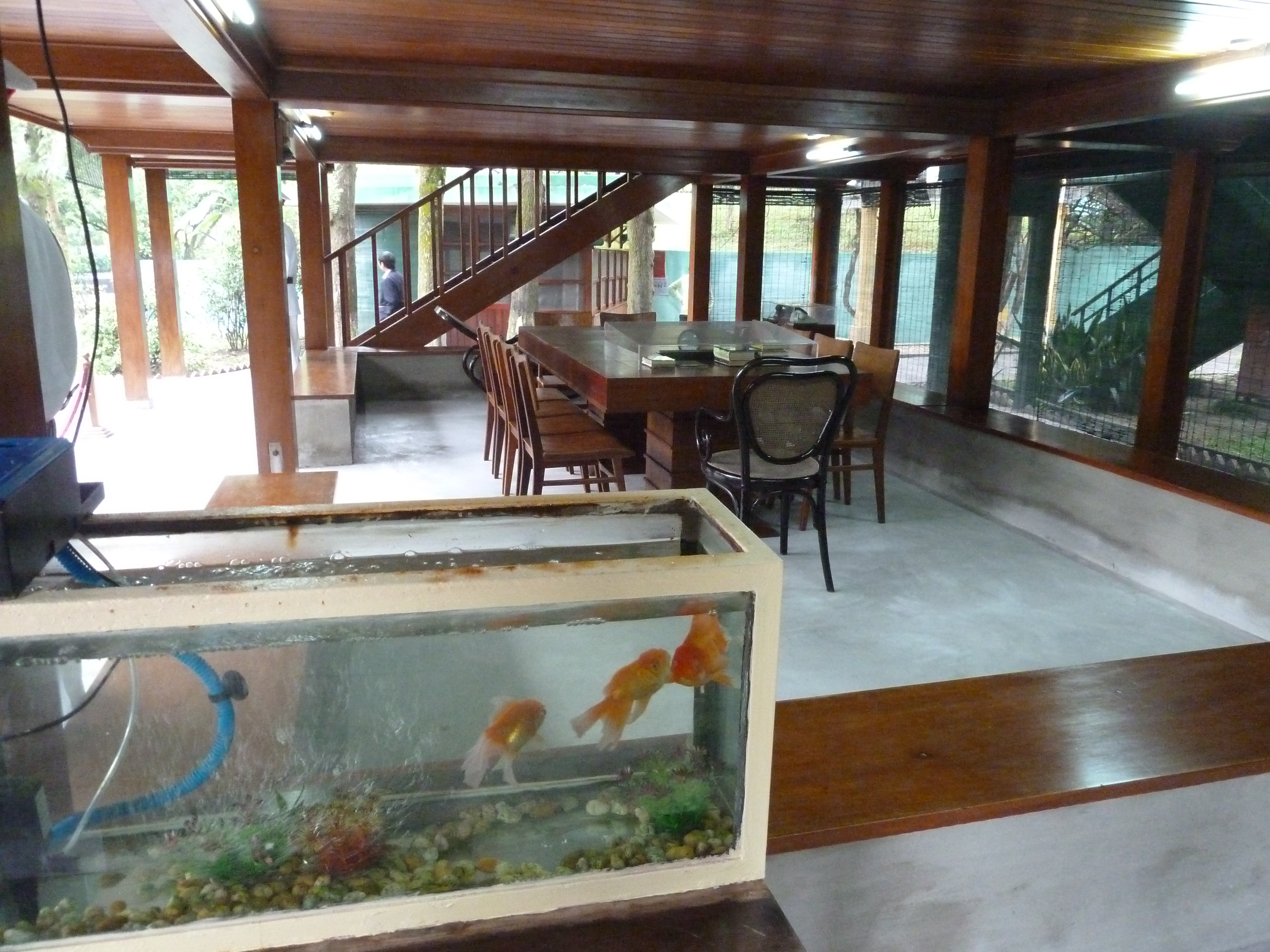
I moved on from the mausoleum to walk around the grounds where Ho Chi Minh lived and worked. He embraced a very simple standard of living, turning his back on the presidential palace and instead living in a very basic stilt house overlooking a lake nearby.

Ho Chi Minh's house on stilts

He apparently insisted the palace belonged to the people, and chose to live in the small rooms that are still preserved as he left them. Beneath the rooms and amid the stilts is a large desk where he would work in the shade and meet dignitaries. Nearby is a goldfish tank, complete with fish, in the same place where his own would once swim.
The nearby museum documented his life, revealing why he is so affectionately known as ‘Uncle Ho’ by his people, and telling the story of how he travelled the world in his younger years, broadening his mind and giving him ideas on how he could lead his country in later life.

Ho Chi Minh museum

Surprisingly, it included photos and documents of the time he lived in England, staying in Southampton close to where I lived at university, and working in London’s West End. As ever, the photography in the exhibitions was impressive, using press images taken by snappers who would embed themselves with the leader for years. There was a huge contrast between those showing him in his khaki uniform on the battlefields, lining up anti-aircraft guns with his soldiers, and those showing him as the kind, caring, ‘man of the people’ that he is so well remembered for. Its easy to see why his photo and image adorns everything from the Vietnamese Dong banknotes to posters in the street, and even a t-shirt worn by Colin.

After a full morning of learning about the man, I was a bit Ho Chi Minh’ed out, so had some lunch at a café I found near a museum with a Mig jet in the grounds. It turned out to be the Vietnamese military museum, but didn’t open for another hour, so after a very Western sandwich and chips I had a sit down in a nearby park and did a bit of people watching.

Mig fighter

The museum turned out to be one of my highlights in Vietnam, mainly because everything was so easy to understand about all the past conflicts, but also because there were some fascinating things to look at – including a huge pile of smashed up American aircraft parts retrieved from crash sites.

US Aircraft piece being removed after being shot down
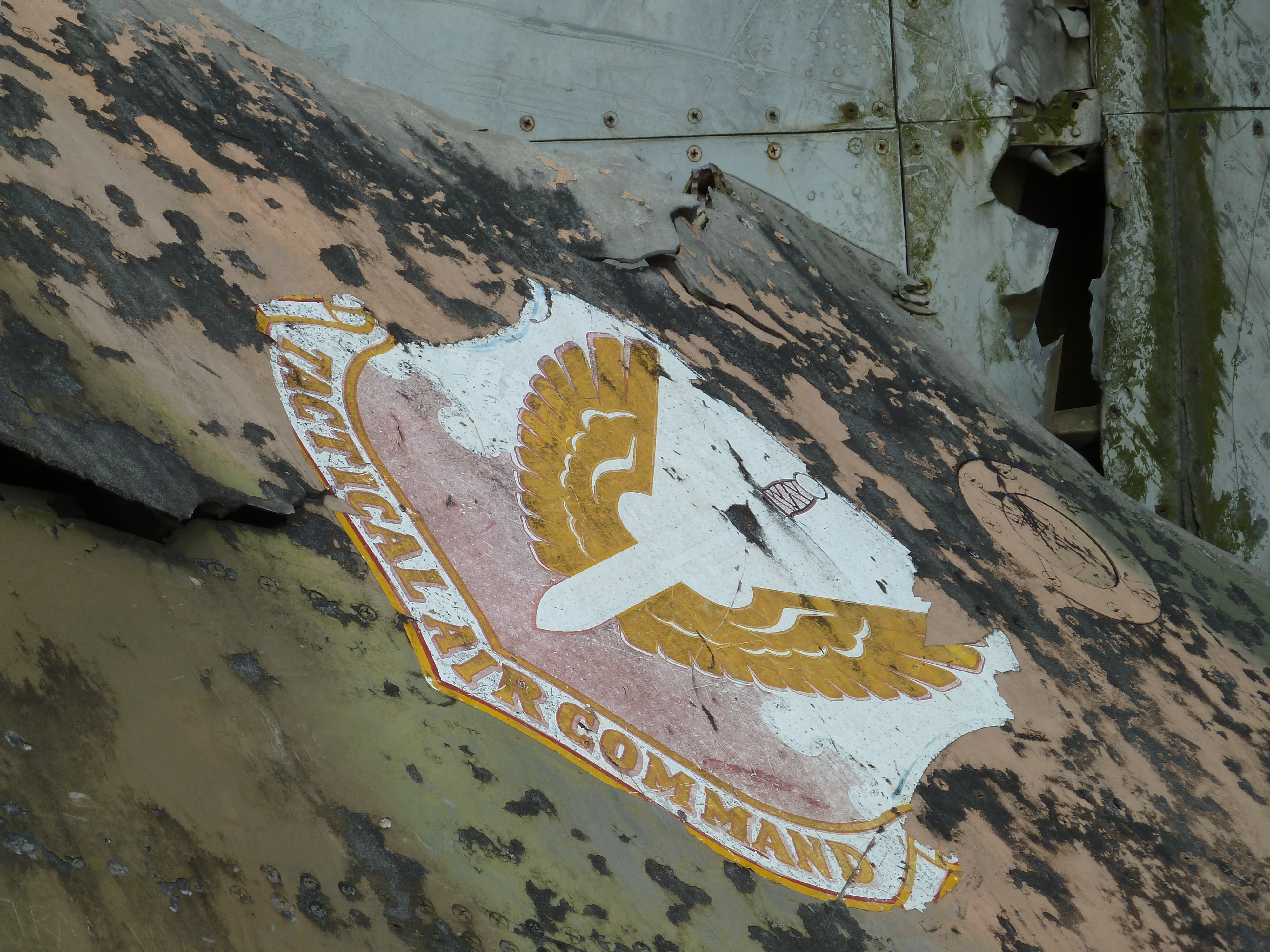
The same piece of wreckage today

The museum started out with primitive weapons such as spears, cannon balls and bamboo spikes that would be left in holes in the ground as a painful, and lethal, trap.
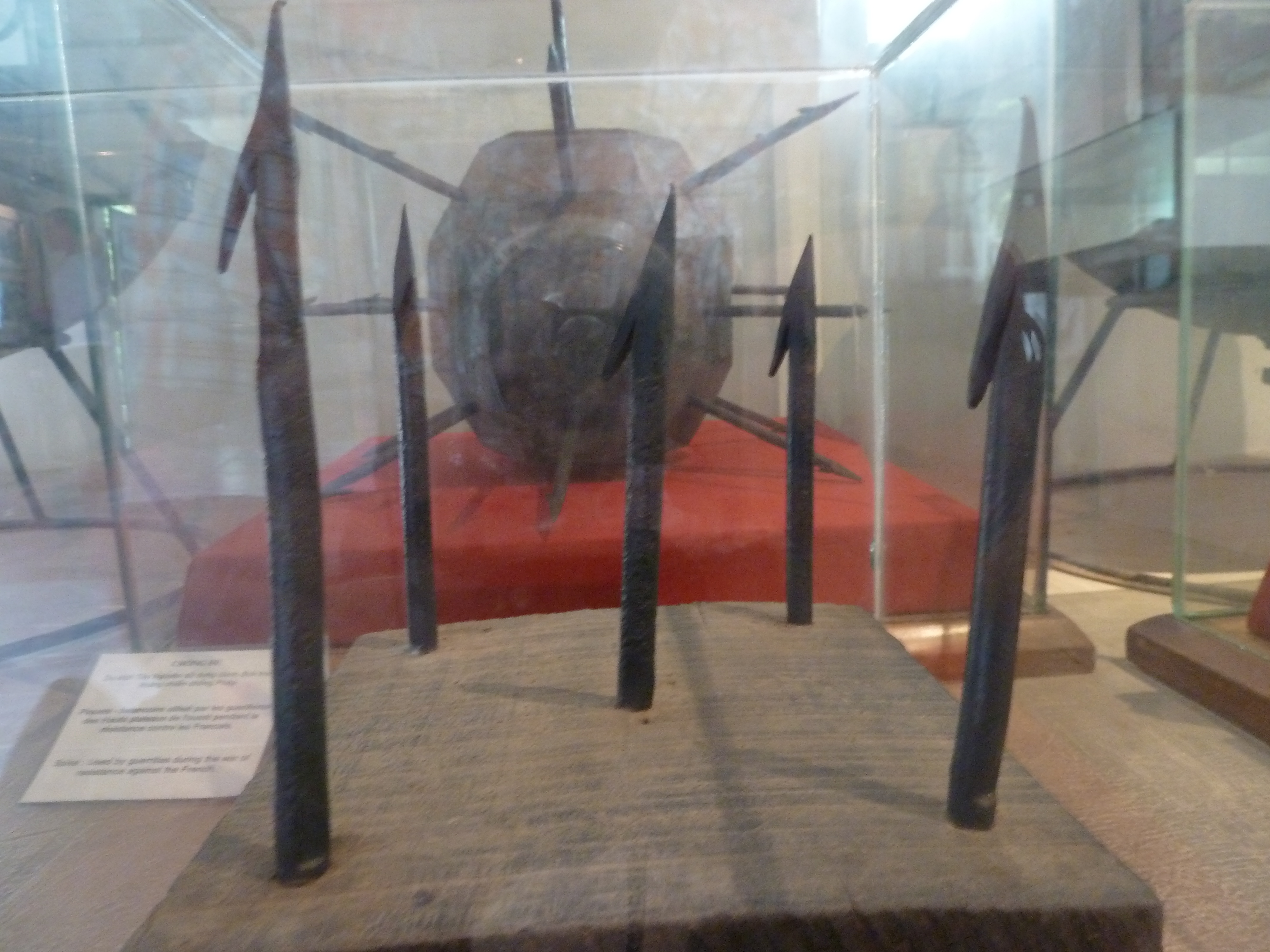
A painful trap

Through the various buildings it told how the Vietnamese managed to outwit and outfight both the French and American armies, with exhibits including a shrapnel-torn French helmet, a full US airman’s flying suit, weapons from all sides involved in war and various bombs and grenades, complete with descriptions of how they work and the devastating impact they have on those unlucky enough to find themselves on the receiving end.

Seen better days

I spent a good hour though looking at the captured aircraft and vehicles left behind by the Americans, including a Chinook helicopter, various fighter jets, Jeeps and missiles.
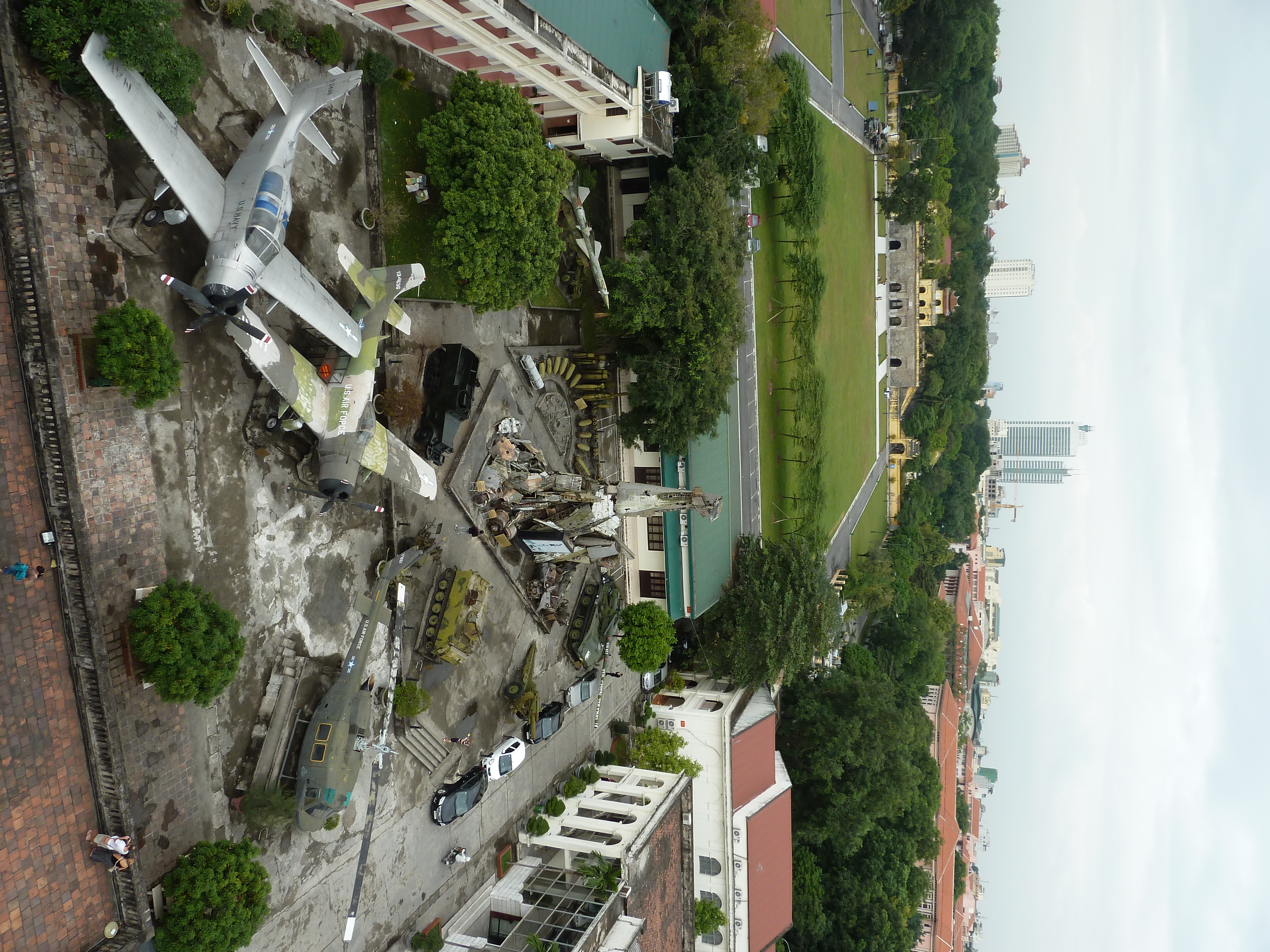
Captured aircraft and wreckage

There was also a selection of Vietnamese fighter jets that had been put on display in celebration of their achievements. It included a MiG 21 fighter that on one night in 1972, shot down five US aircraft, including a huge B52 bomber, in one mission. The museum and nation is clearly still proud of its achievements, and steps placed next to the jet mean you can have a good look inside the cockpit.
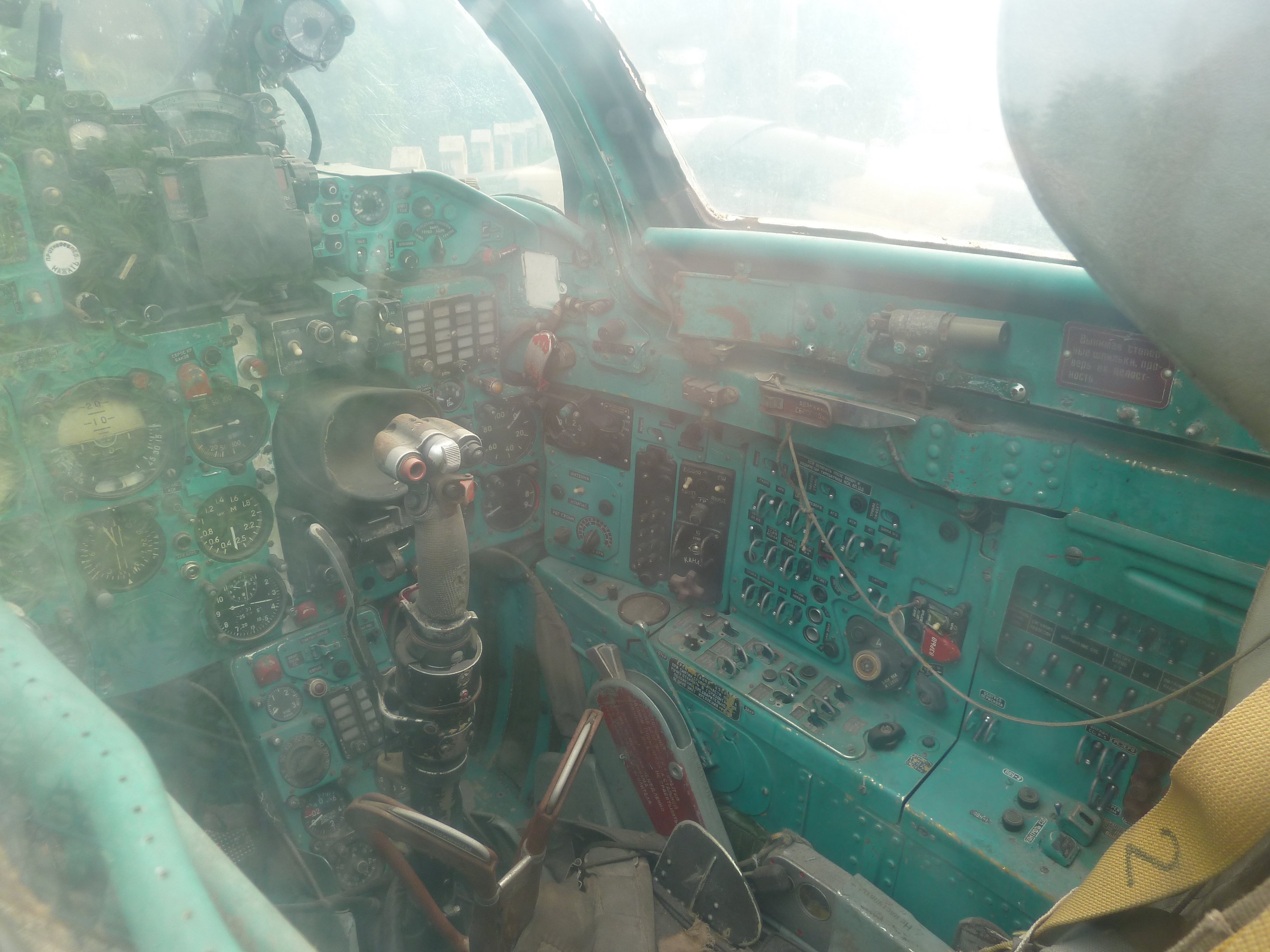
Inside the Mig cockpit

Its was strange to look at the controls and imagine what went on in there on December 27 that year with pilot Pham Tuam in the seat. The trigger button on the control stick for the missiles has been left visible, probably on purpose, and it’s a weird feeling to know exactly what happened with a few presses of that button.

The end result is just a few paces away, with a number of B52 engines, many smashed to smithereens, parts of a fuselage and wings all gathered together as a form of triumphant trophy.

Broken warplanes

As a Westerner, you get so used to seeing and hearing stories of American victories on the battleground, of watching films which show the US armed forces celebrating as they beat the enemy in a whole ‘good over evil’ manner.

When the shoe is on the other foot, it’s slightly surreal to see the proud US Army or US Air Force logos and battle markings in tatters on crumpled heaps of metal, and the American patent numbers and part instructions stamped or engraved on engine parts twisted and mangled by the force of impact – a reminder that once it all used to be a part of a huge fighting machine that had flown from somewhere so familiar as a friend to us all.
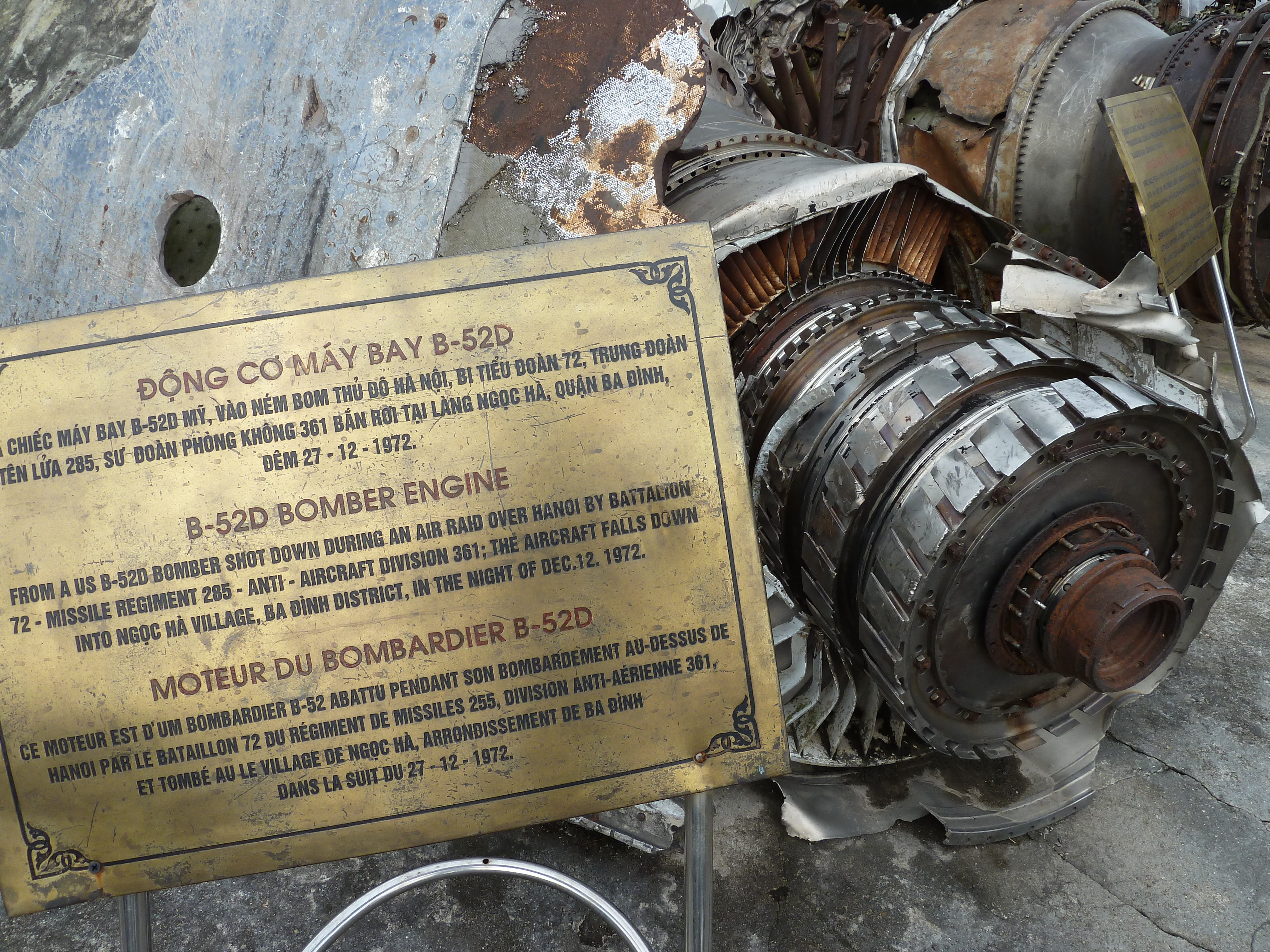
Shot down B52 engine

While at the museum I climbed the steps to the top of the flag tower, giving a great view over the city, before making my way through the old quarter to take in the atmosphere.

Back streets of Hanoi

Like Ho Chi Minh City, Hanoi is very much a motorcycle city – everyone seems to have one, and every road is a challenge to cross. I’m getting used to it now though, with the whole ‘head down and walk’ technique proving quite useful. The narrower old streets are a bit unnerving, and every minute someone else seems to beep at you, but its all part of the fun!

On street corners, budgerigars chirp away amid the handicrafts and clothes hanging from almost every shop. The smell of incense fills the air as the sticks slowly smoulder away in doorways. There’s a real ‘local life’ feel about the place, tonnes of character and commerce blending together under the hot sun. The street names even follow what you’ll find for sale – Silk Street, Paper Street, Basket Street. It was a wonderful area to meander through on my way towards the main lake and its island temple, where yet again a few tourists stopped me to have a photograph with the tall white bloke from a foreign land!
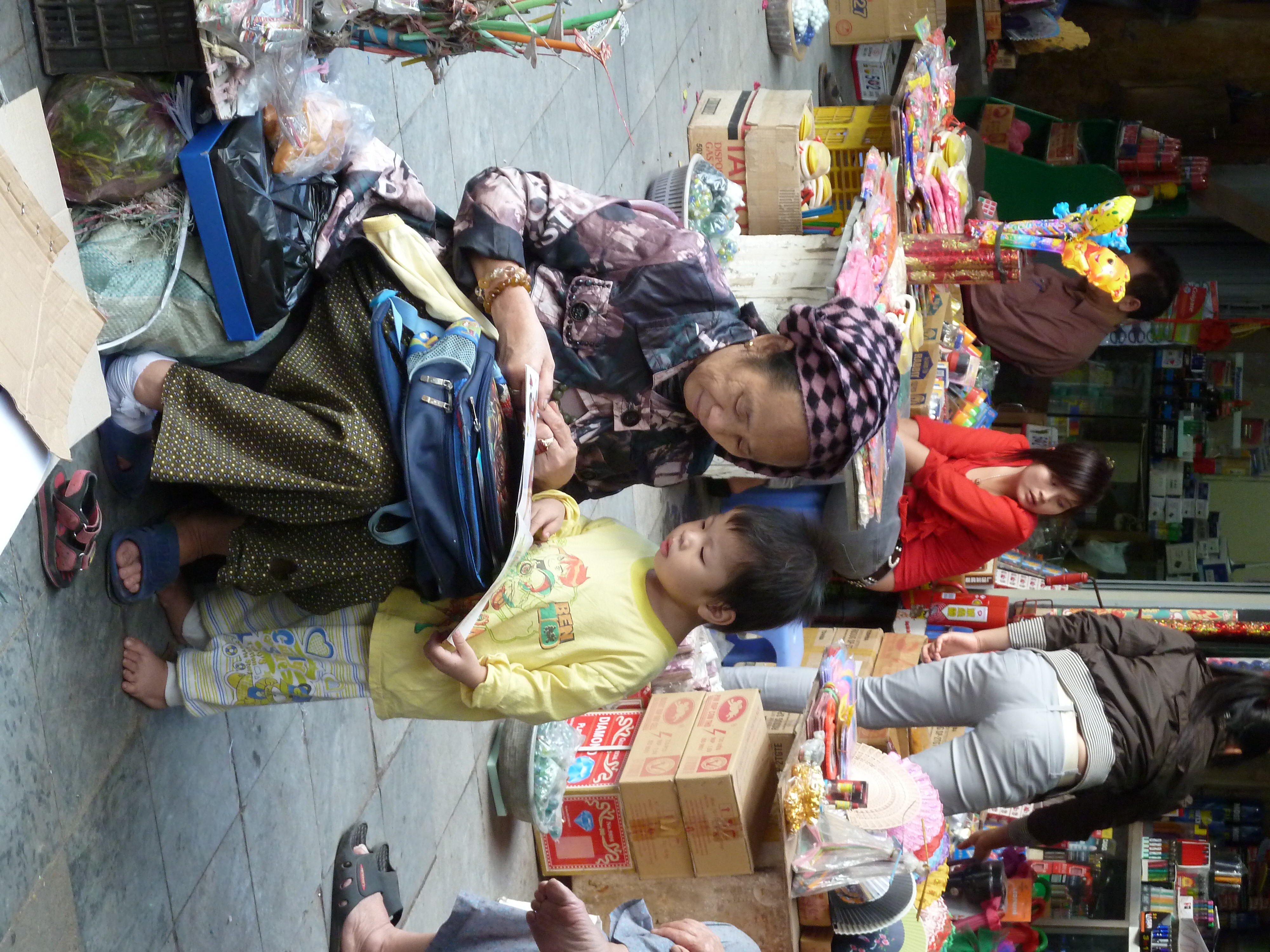
Helping out

I bumped into Colin and Sarah on the walk back to the hotel, and we walked together, buying an obligatory ‘Good Morning Vietnam’ t-shirt on the way. That night we had our final meal together as a large group in a restaurant called Gecko. The food wasn’t great, but the dessert list was topped with a famous brand of ice cream over here, that needless to say, caused Colin a great deal of amusement throughout the trip.
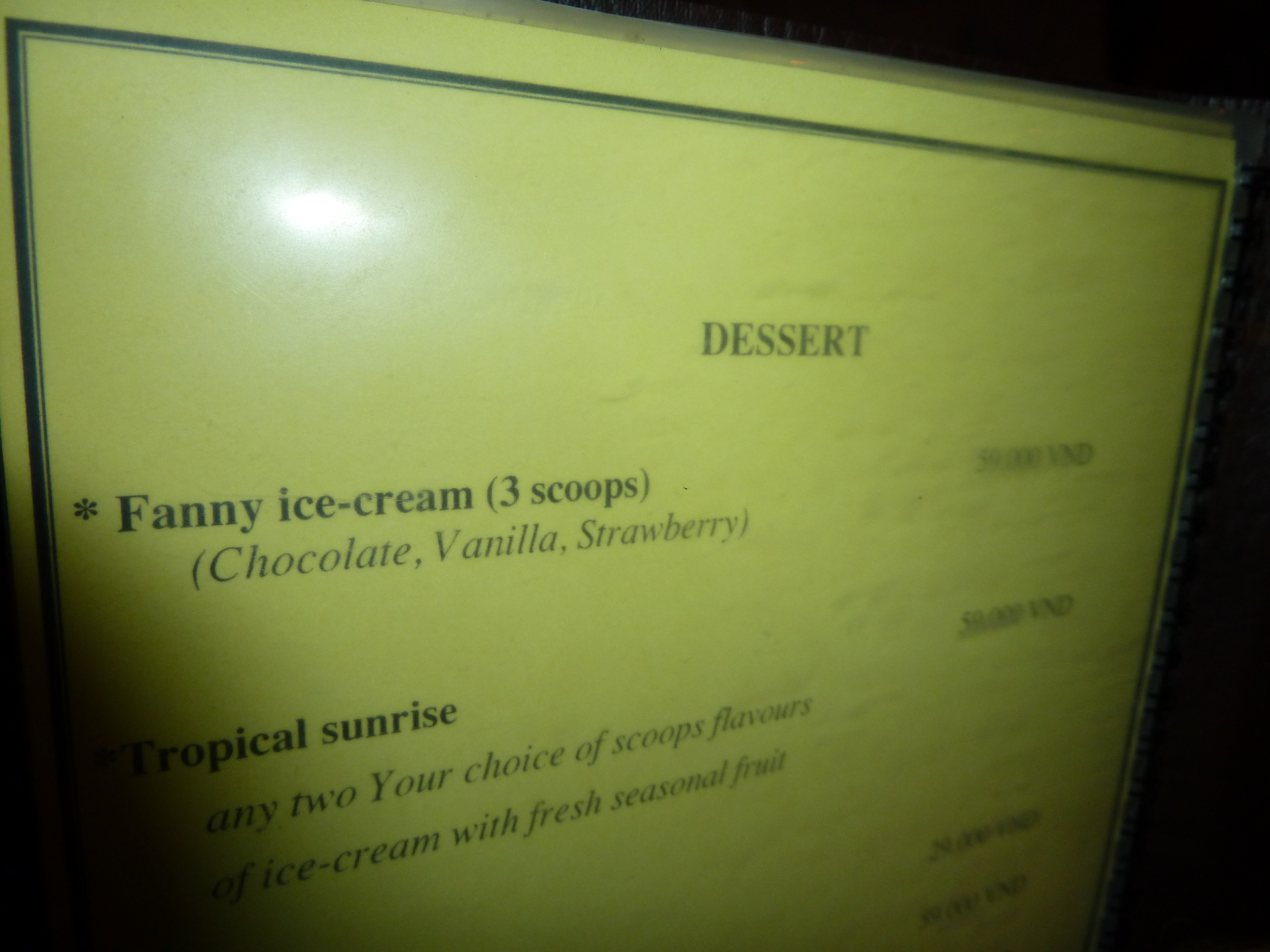
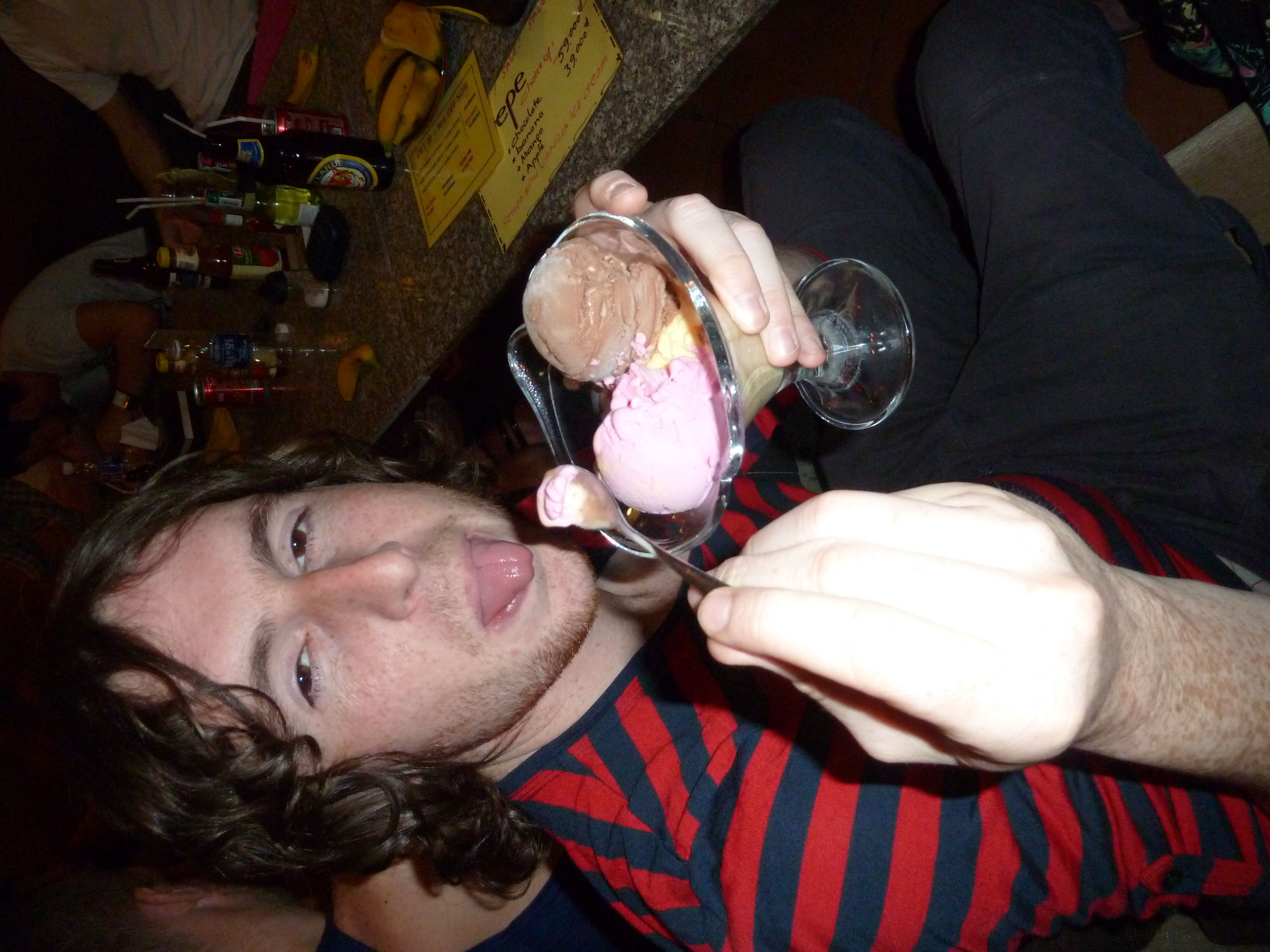
Naturally, he had to have one.
Early the next morning, we had to say goodbye to so many people who had become such good friends. The lovely Verena from Germany, who made us smile so many times when she reached for her Super Mario German to English dictionary to help with conversations, my first roommate Malcolm who is returning home to run the Fleet Service Station on the M3, the Welsh girls Emma and Megan, the former who had provided so much entertainment with her dancing prowess in Hue, and Australians Tamsin and Victoria.

Changeover night

But there was a couple I was gutted were leaving: Colin and Sarah. Over the three weeks we had become such good friends – they make such an amazing couple together, both bouncing off each other with their cheeky wit and laughter, always bubbly, happy and lifting the mood around them.

I don’t think any of us will forget one of Colin’s finest moments on the trip, at a service station somewhere in Cambodia, where we were all incredibly hungry. Scanning the menus, and looking for something filling, American Assata piped up that “perhaps we should just get a few dishes and share them on the table, ‘family style’,”

The suggestion went down about as well as pork scratchings at a Bar Mitzvah, but nobody wanted to speak out. Apart from Colin, who in one move, summed up exactly everyone’s thoughts. With his hand raised, elbow banging slightly down on the table as if he was making a suggestion, he simply said “er. No.” before putting his hand back down and burying his head in the menu.

Nobody said a word at the time, and it fell silent, but afterwards we’ve all laughed so much at that moment.

With Colin and Sarah

Colin and Sarah are both individuals who even if they were not together as a couple, I would have become really good friends with anyway, and I know we’ll definitely stay in touch and meet up back home. They have another week in Thailand together before returning to Nottingham and their jobs; Colin as a tax man, Sarah as a PE teacher, and I know that we’ll stay good friends when all these travelling days are over.

There were a few tears from Sarah as we all said goodbye at 6am, before their taxi disappeared down the road. Soon after we collected our bags and jumped on our bus that is taking us on towards Laos. There’s just the small matter of a 10-hour journey to the border before then!

Hue and Ha Long Bay, Vietnam

Me' Hearties on a junk at Ha Long Bay!

I’d love to be able to write about how amazing Hue is as a city, about all its culture and history, about how its Forbidden City was just as good to look around as the one in Beijing – but I can’t.

That’s mainly because there was only one bit of Hue a large group of us saw – a bar named DMZ. Located a few blocks away from the hotel, it was where we headed during a brief respite in the rain to get some lunch. The only problem was, they had a special offer from 4pm where you get a free bucket of vodka and lemonade. Well, it would be rude to turn it down!
A flaming B52 - and so the sightseeing problems began

Colin, Sarah, Ricky, Malcolm and I had every intention of taking in a bit of culture. Instead, we took in far more Flaming Dr Pepper, Double Flaming B52, Flaming Jagerbombs and delicious Skittle Bombs (Cointreau and Red Bull – try it and taste the rainbow!) than we really ever should do in the early evening.

It was accompanied by more pool, and a particularly shocking game where I was seven-balled for the first time ever, much to the delight of everyone who saw it, by our resident tour pool shark Ricky, and after a few more cocktails we decided to head back to the hotel to meet everyone for dinner.

He did me twice in the end...

Twenty minutes later, we were on our way back to the same place – its where Fon our guide had booked a table for the night, so with more free buckets of vodka and lemonade, we were well on our way for a big night.

Feeding time

I somehow managed to regain a bit of form on the pool table later in the night, with a six game unbeaten streak and knocking everyone from Aussies, Kiwis and locals off the table, as well as Malcolm who managed to pot the black on about his second shot, but by far the strangest incident while I was at the table was a bit of rough justice by the bar staff on a Vietnamese bloke who didn’t want to pay his bill.

Dragged off a chair, and making a failed bid to grab a pool ball, he was promptly thrown flip-flop-less into the street and whacked with another pool cue a bouncer had grabbed from behind the bar. Something told me its not the first time they’d dealt with unpaid bills in this manner – and a few of us made sure we kept paying for drinks as we ordered as a result!

With departure not until mid afternoon the following day, Ricky was intent on carrying on after DMZ. It wasn’t long before Emma from Wales, who joined the tour in Saigon, signalled the end of our stay there by collapsing on a table and ending up in a heap in the corner. Undeterred, she managed to stay with us as we all ended up finding a late night bar called Brown Eyed Girl – it was a bit of a dive, but the beer was cheap.

Ricky drove but still had to pay

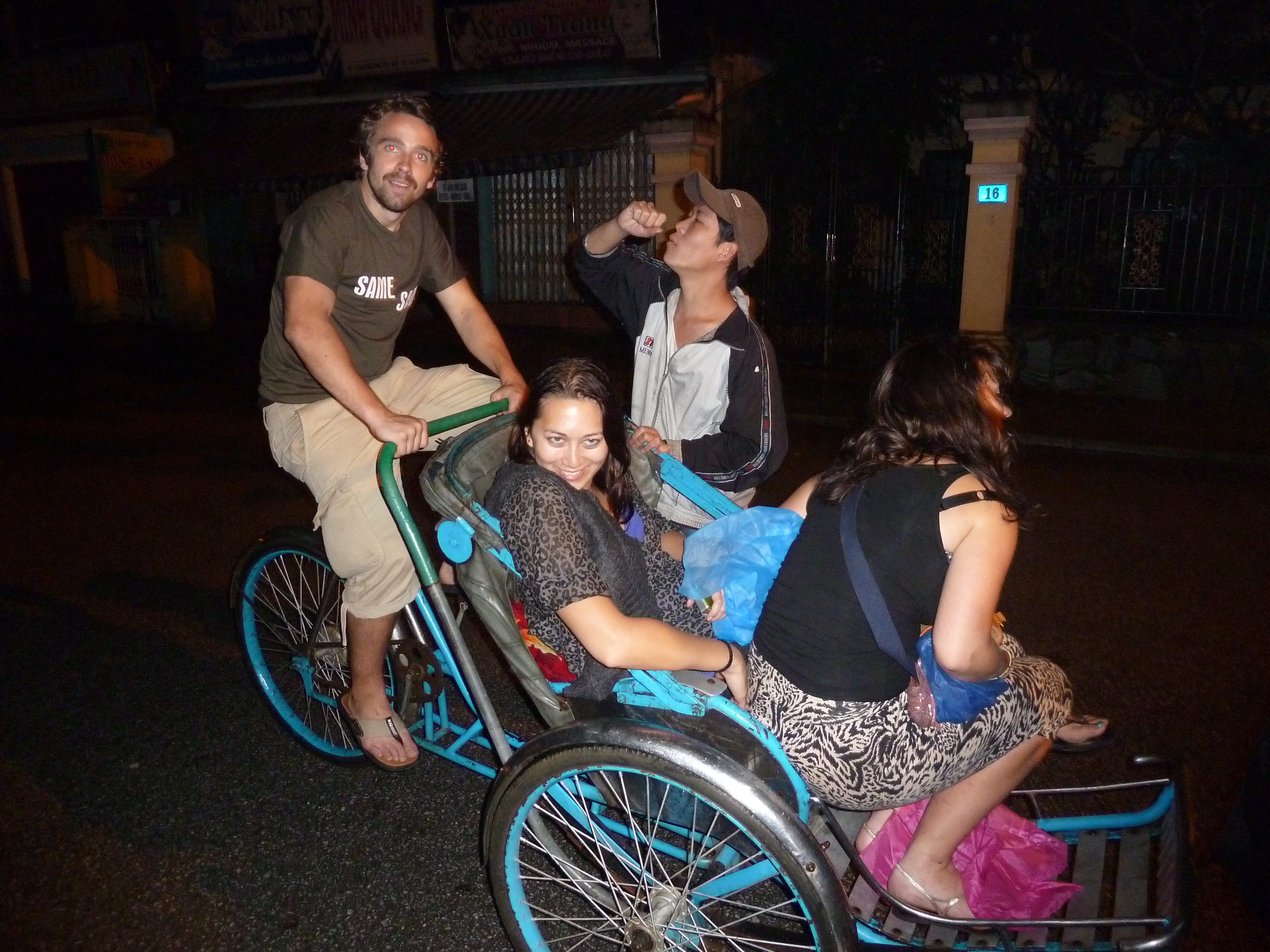
It had gone 4am by the time we stumbled out and into the basket of a local cyclo rider, while Malcolm and I got a lift on the back of a motorbike taxi. Back at the hotel, Malcolm decided he was sober enough to ride the motorbike, and stupidly the taxi man let him. He promptly fell off and had to pay up for the damage. I had a less eventful but enjoyable chat with my parents and nanna on Skype until around 5.30am, when it was definitely time for bed!

The next day most of us woke up just before the midday checkout, and unsurprisingly headed straight back to the DMZ bar for lunch. Ricky and I demolished both a pizza and a burger meal, while everyone else filled up ahead of the overnight train ride to Hanoi.

Heading north

The transfer to the station took us past the Forbidden City, so at least we saw a bit of it. Our guide Fon was laughing – she knew very few of us had seen anything of the city, but I think she knew we also needed to let our hair down a bit, especially with all the rain. Without getting wet, there wasn’t much else we could do apart from camp out in a pub!

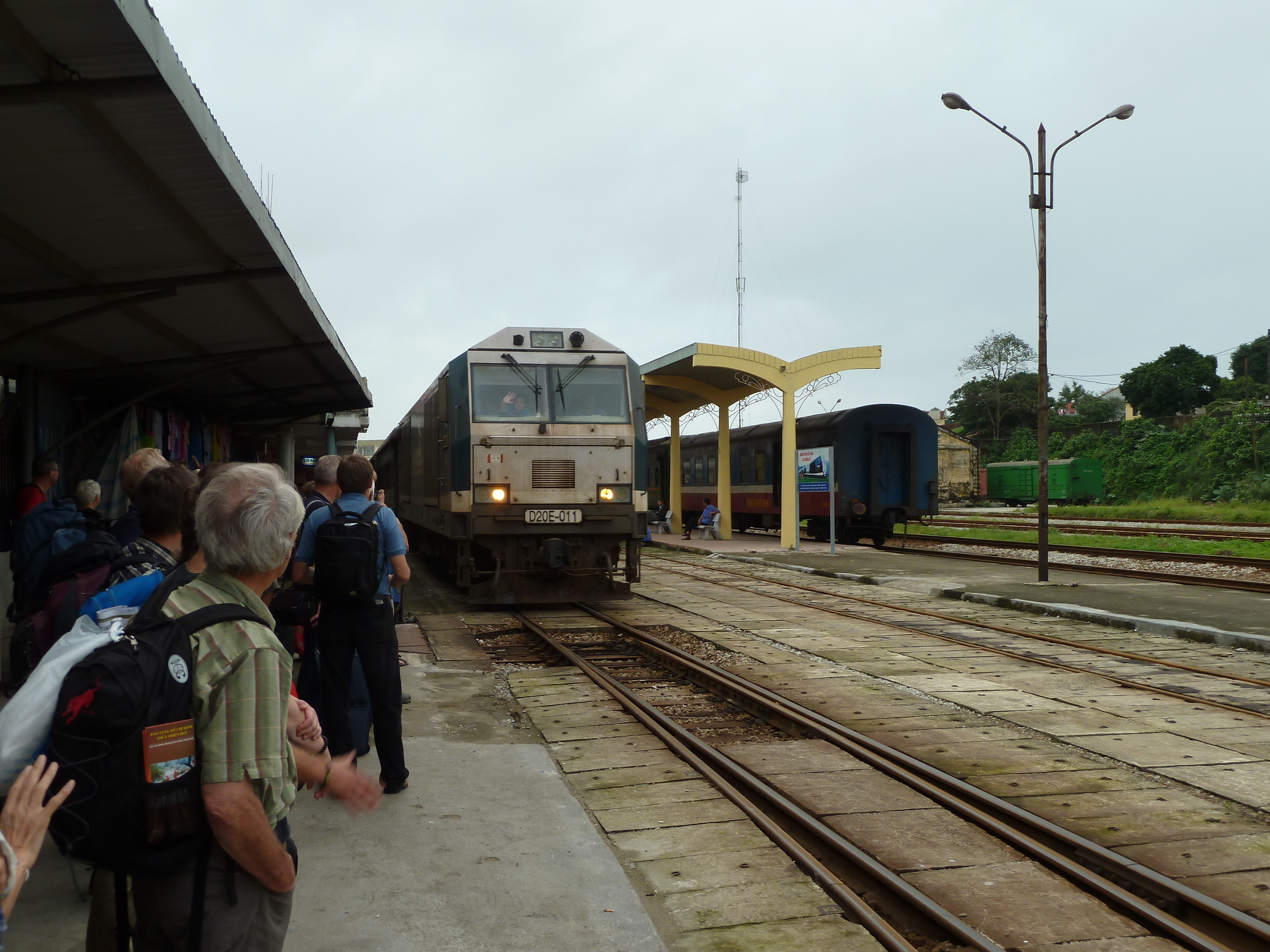
The train to Hanoi was scheduled to leave at 2.43pm, but as could be expected, it was running an hour late. A few of us had planned an evening of poker onboard, so we were hunting for poker chips at the local stalls. Unsurprisingly, there were none to be found, so having weighed up the ideas of playing with boiled sweets, peanuts or Bombay Mix, I spotted something hidden away at the back – cotton buds.

Everyone agreed, and £1 down and two packs of cotton buds later, we were waiting on the platform for the train. There were a lot of locals waiting too, while others walked towards us along the tracks, using the rails as a convenient cut-through.

Railway children

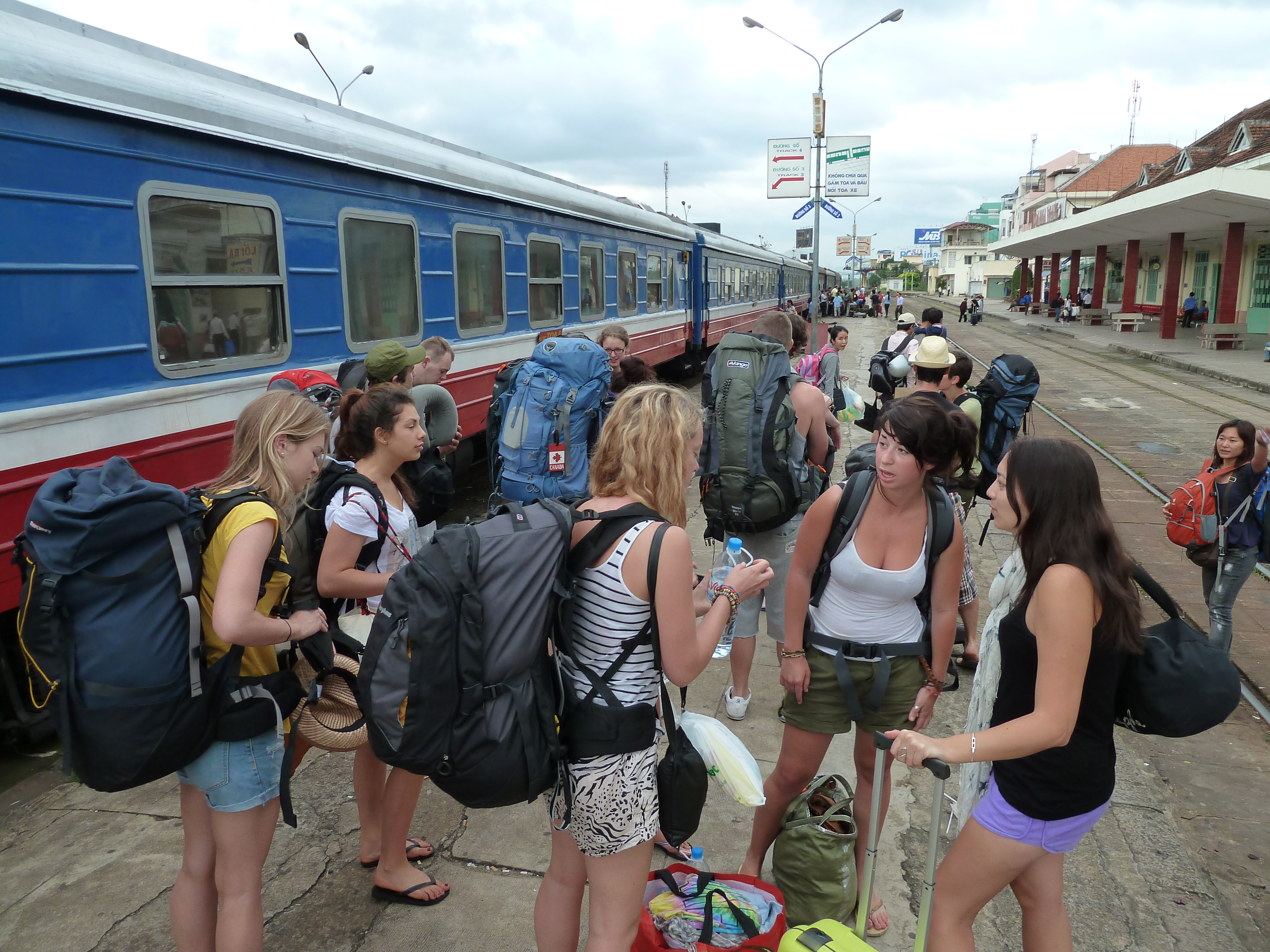
A group of Dutch tourists were also waiting alongside us, who then caused problems when the train finally arrived by clogging up the narrow corridor in the carriage. A few of us were stranded outside, being beckoned on by the train crew desperately wanting to make up time, but we were stuck as there was no room inside the doorway for 10 people and all our bags.

The train arrives, the Dutch prepare to annoy us

One train guard ushered me into a second class carriage, but there was then no way for me to turn round. As I shuffled down the carriage to a doorway, so I could back my rucksack in and turn around, I then got yelled at by another railway worker who must have thought I was heading to the wrong carriage. It was all a bit of a mess, but eventually I found my way to my bunk.

Poker fun on the overnight train

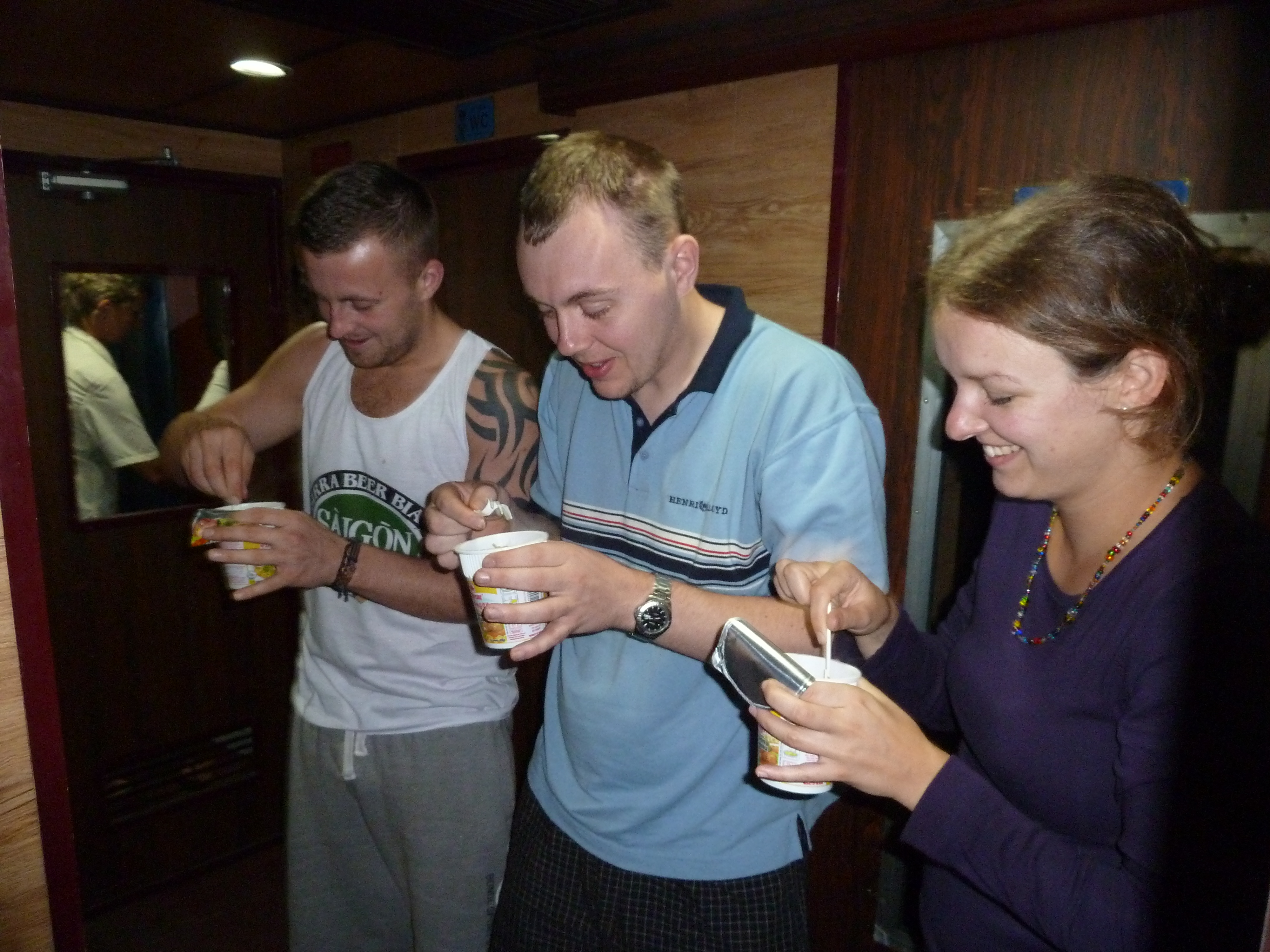
The journey was a lot of fun – it’s a very comfortable train, and I have to say much nicer than any of the Russian and Chinese ones I travelled in across Siberia. We even got given free water, a freshening towel, and – a pot noodle!

The only problem was our poker plan hit a snag when the table was deemed to be too small – a rack was screwed into it for water and snacks. It soon came off with the help of a screwdriver in my multi-tool kit, and play was underway. With a 50,000 Vietnamese Dong buy-in (about £1.50, so by no means mega money!) it’s amazing what you can improvise with. The dealer button for the night was one side of an Oreo biscuit being passed around the table, while the cotton buds were carefully cut in half and became worth 2,000 Dong each.

Cotton bud chips, half an Oreo as dealer button. Vegas would be proud!

With a few beers and a pot noodle, the time flew by as we had plenty of banter and laughs as the sun set and we rattled our way through the countryside and north to the Vietnamese capital. It started to get late, and the game was ended with a crazy round of pre-flop raising and betting which saw me all in with Ace Jack. I was quietly confident with the hand, but Ricky ended up taking my chips, and second-place Stephen’s too.

Steven, Malcolm and Verena with Pot Noodles at the ready!

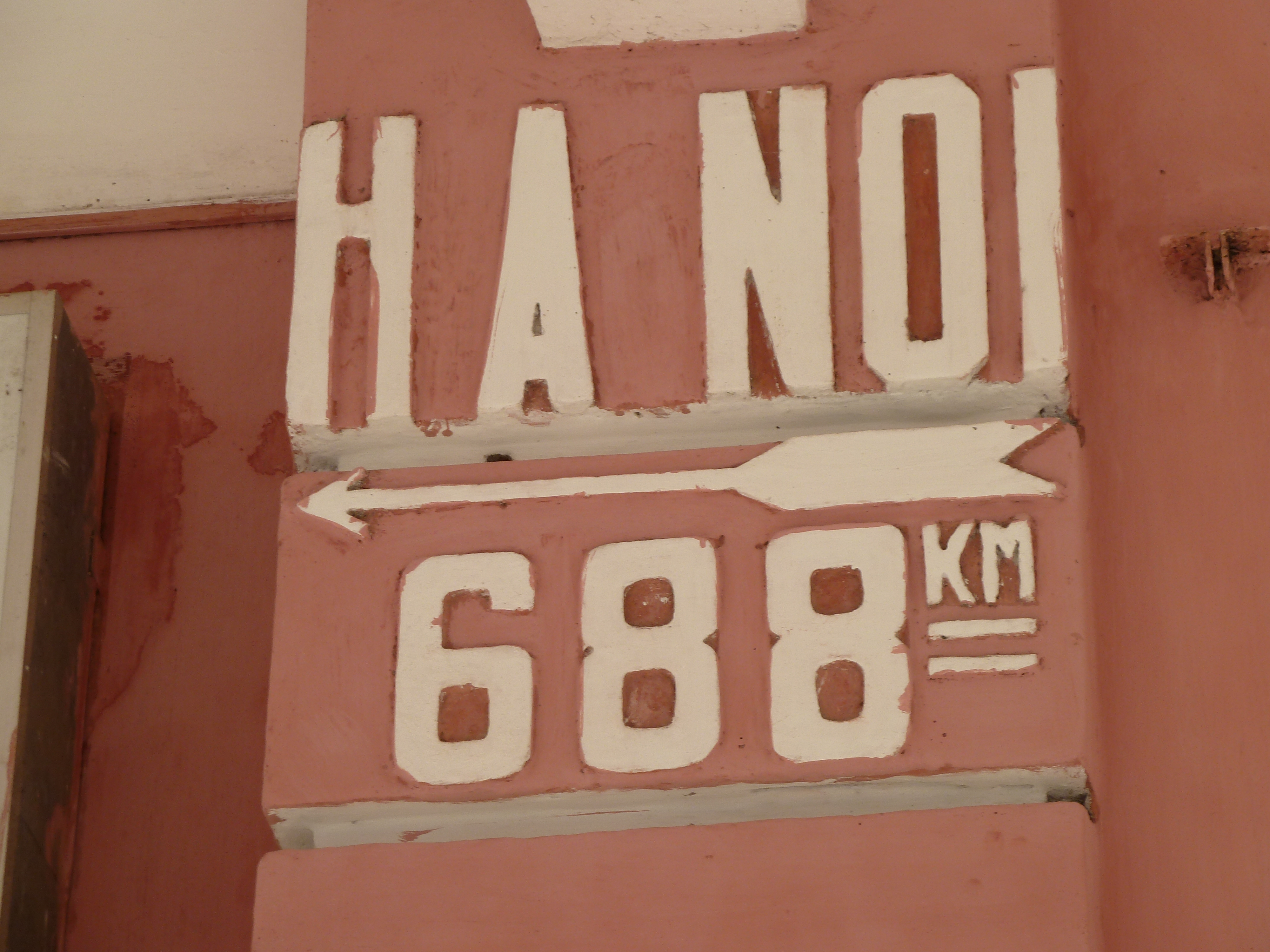
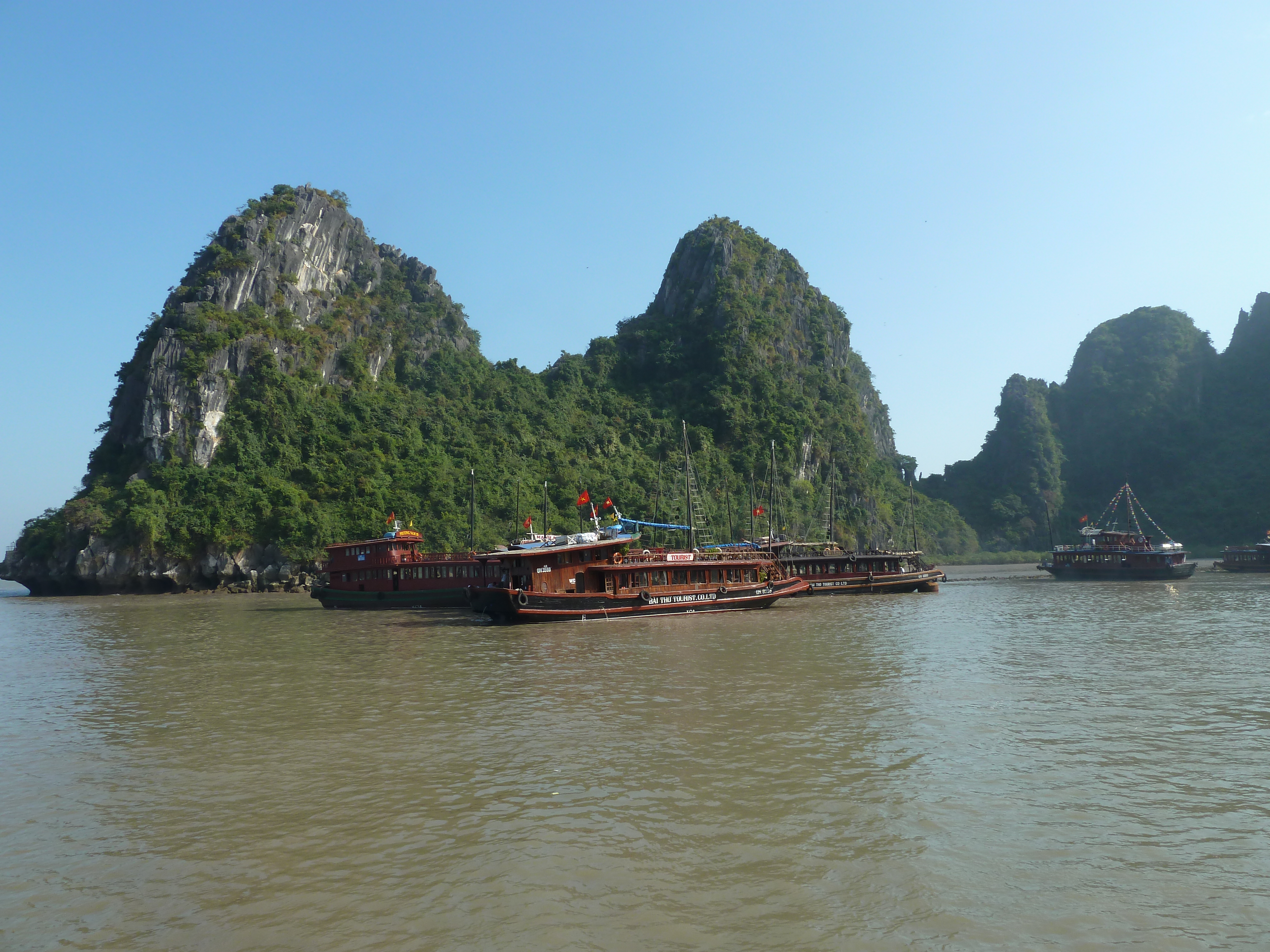
It was 4.30am when we arrived in Hanoi, and we were immediately on a bus for the four hour trip to Ha Long Bay, a beautiful stretch of coastline to the east of the capital and a Unesco world heritage site.

Cliffs at Ha Long Bay

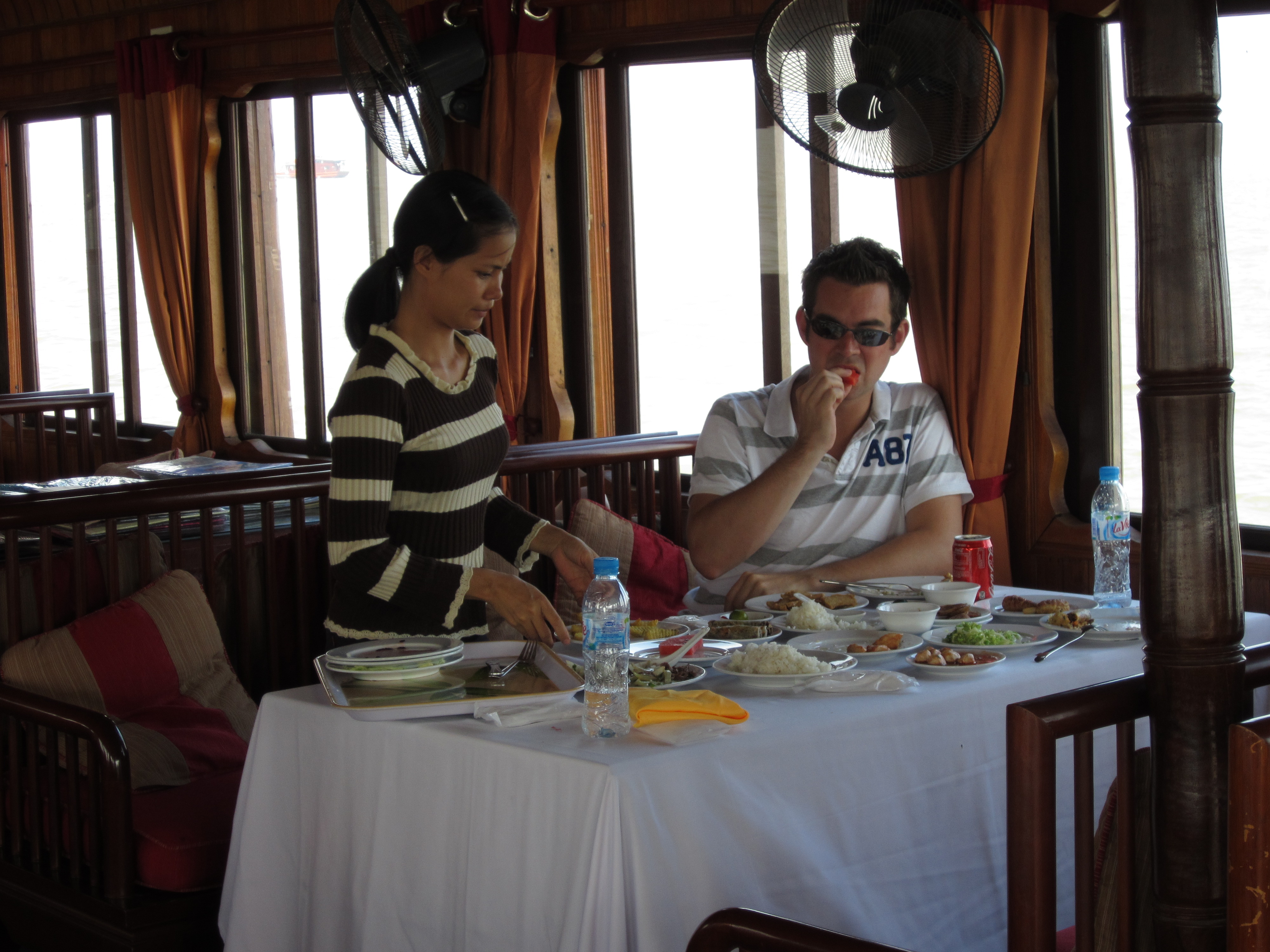
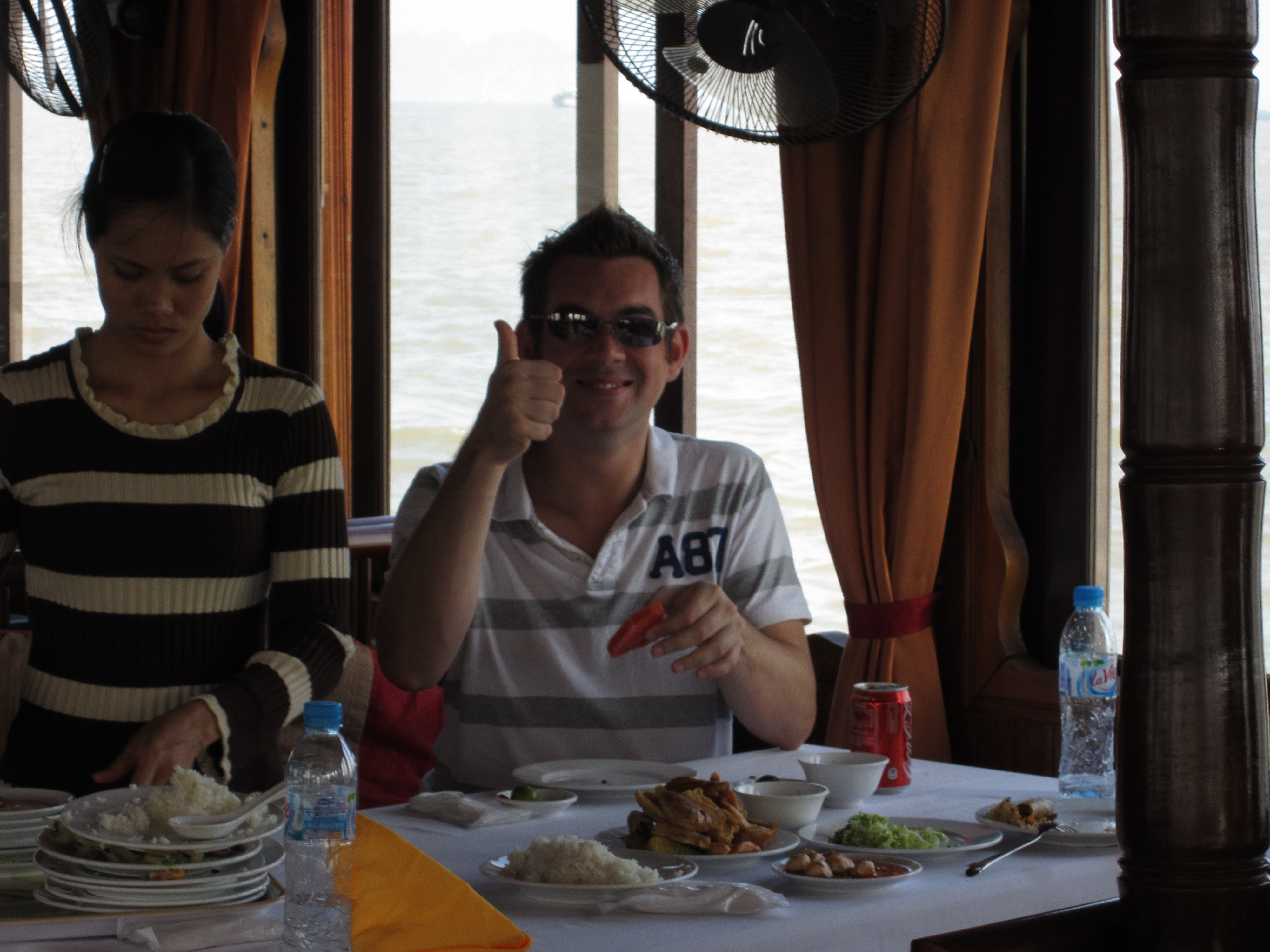
It was nice to see and feel the sun shining on us again as we set off for lunch on a traditional junk. We’d been asked if any of us didn’t want seafood, so of course I opted for the non-seafood option. There was everything from barbecued pork, chicken, beef stir fry, vegetables and chips. Between four of us, one of whom is vegetarian, there was plenty to go at, summed up by a series of photographs secretly taken by Alissa which made it look like I’d enjoyed some sort of private dining experience!

Hmmm, quite nice...

'Would sir like some more spring rolls?'

I'll try some of that over there?

Rumbled!

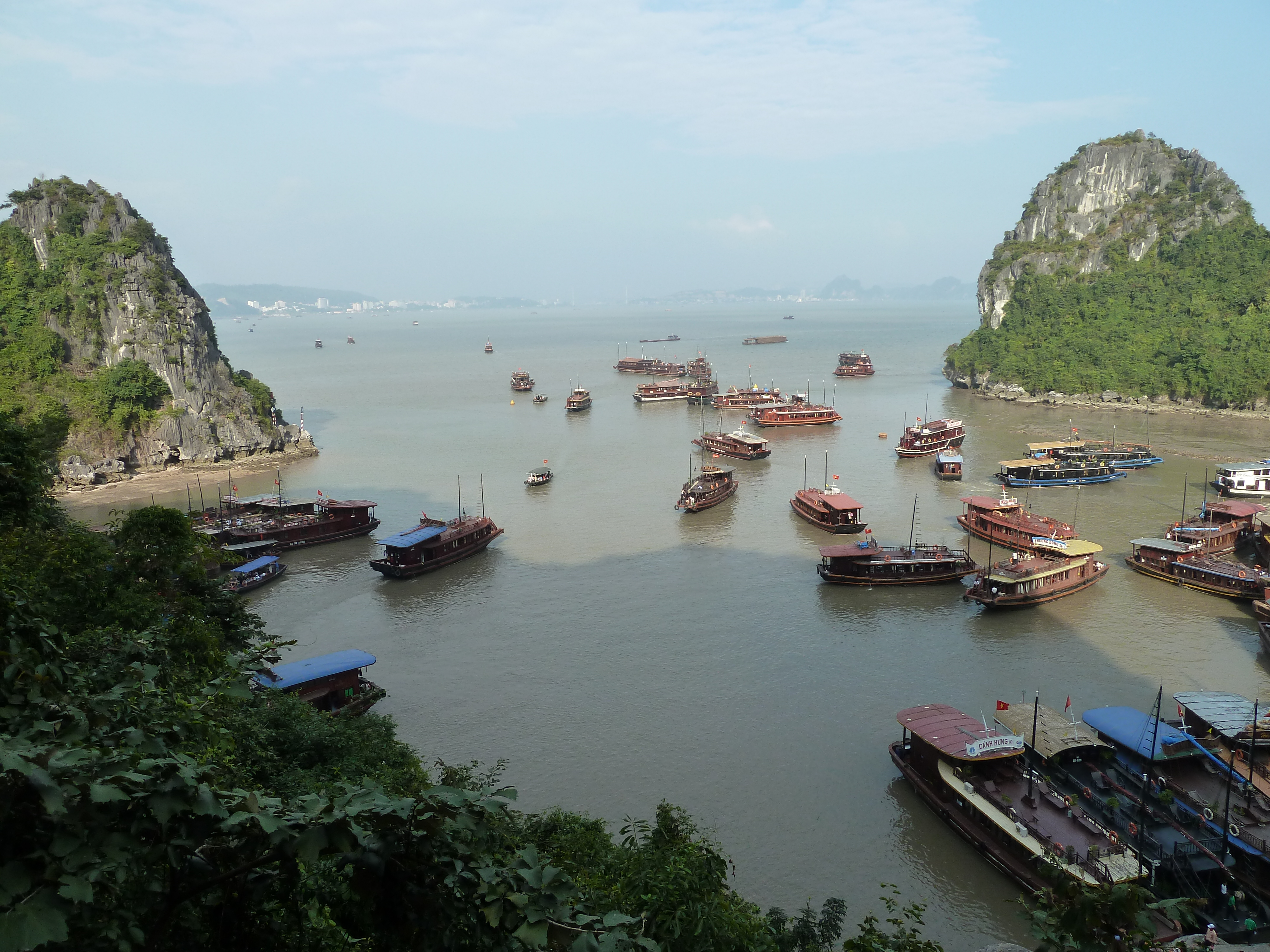
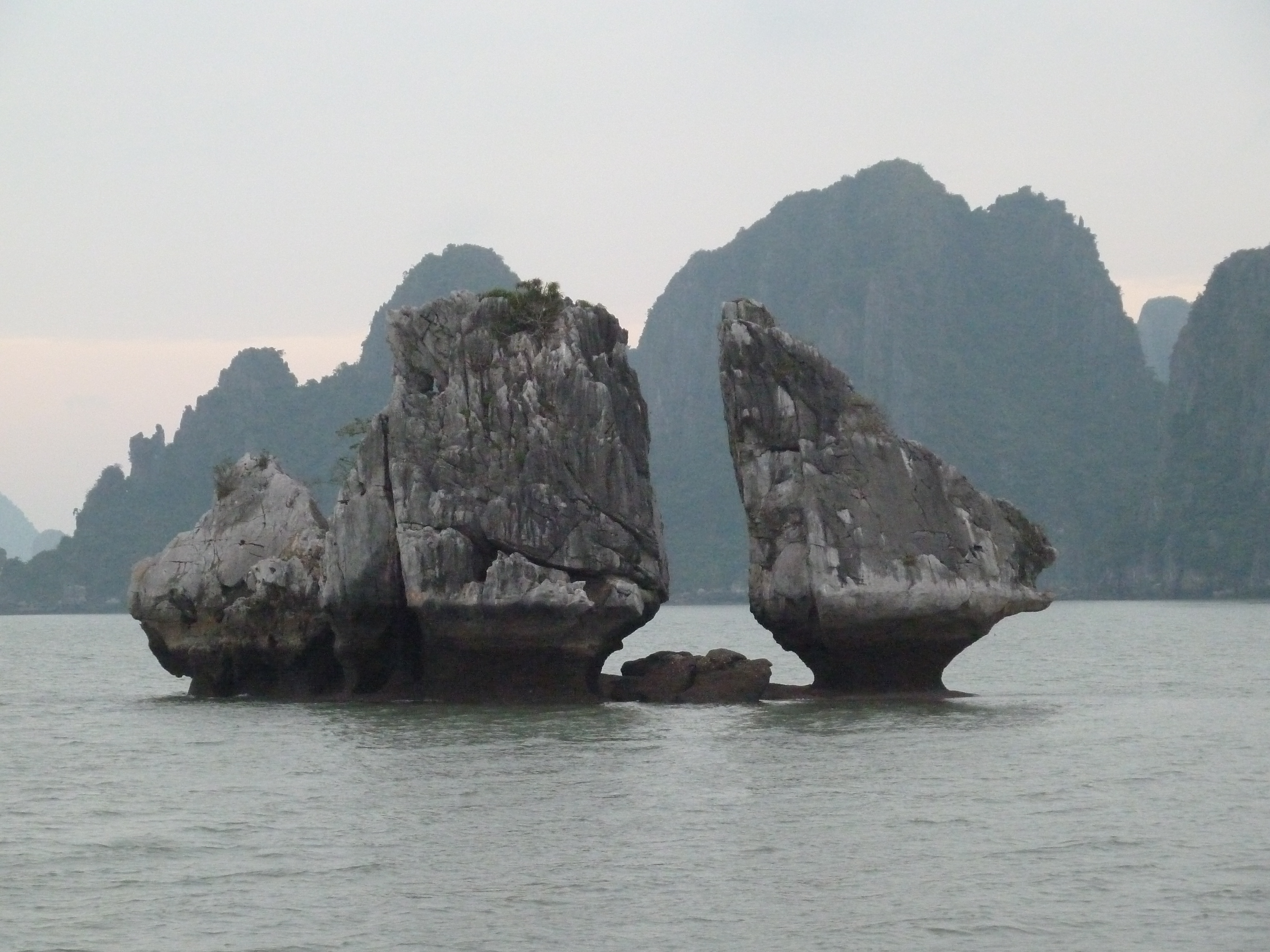
By the end of lunch, we were approaching the spectacular limestone cliffs that rise so impressively out of the sea. There seems to be hundreds of them, everywhere you look, each covered in greenery.

The bay

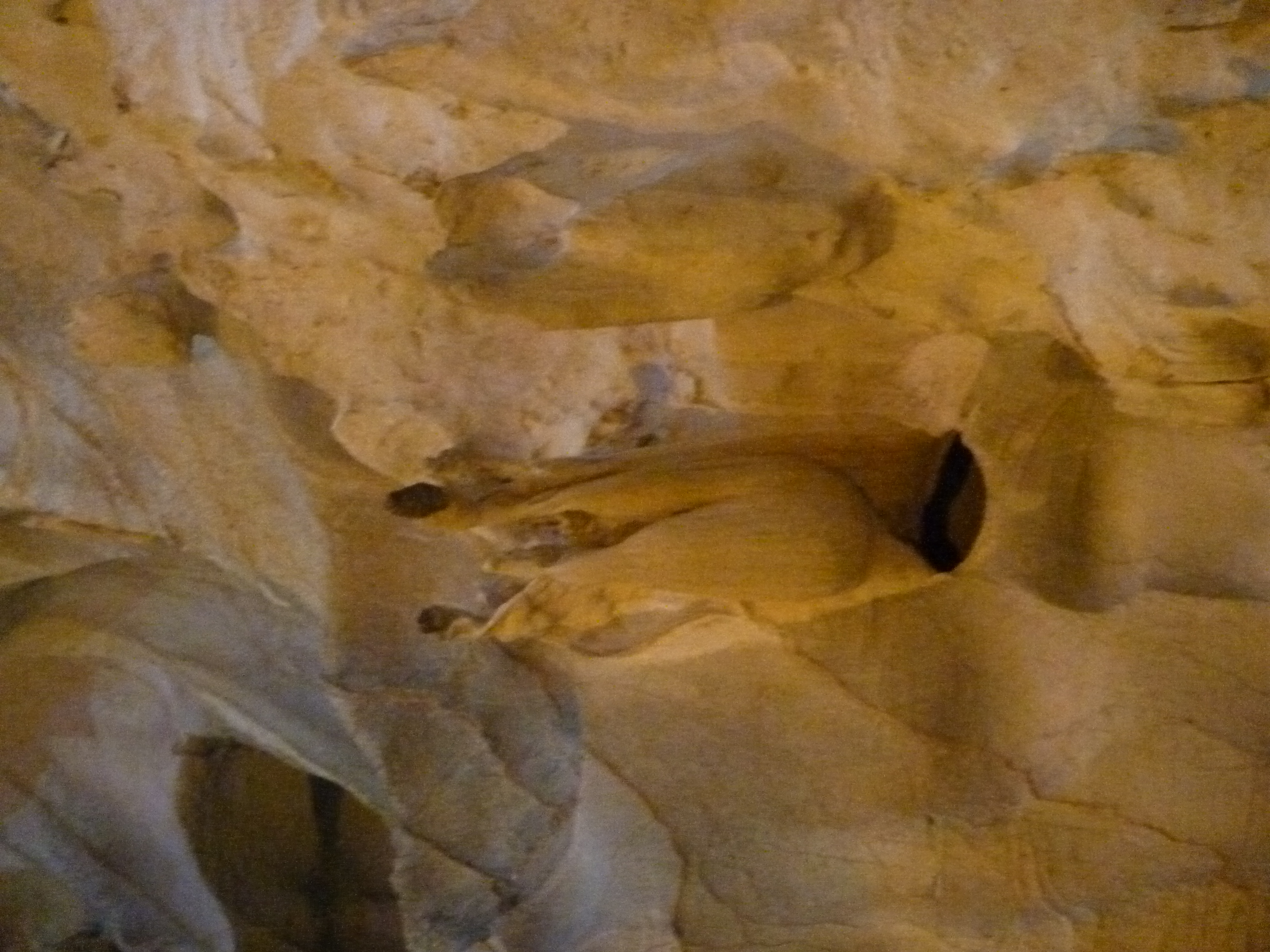
We stopped at one and were taken inside a cave, where apparently the stalactites and stalagmites form the outlines of animals, according to our guide. There was one that looked a bit like a dolphin, but I think much of the experience relied on an active imagination.

In the cave, or a 'Kip' as our guide called it

Colin had by far the best spot of the day however-  high above us he’d noticed what looked like the back end of a horse hanging from the ceiling. Strangely, that wasn’t mentioned in the official tour.

The Colin Craig 'Horse bum from ceiling' discovery

Back on the boat we sailed around the cliffs to a spot where we could hire a kayak canoe.

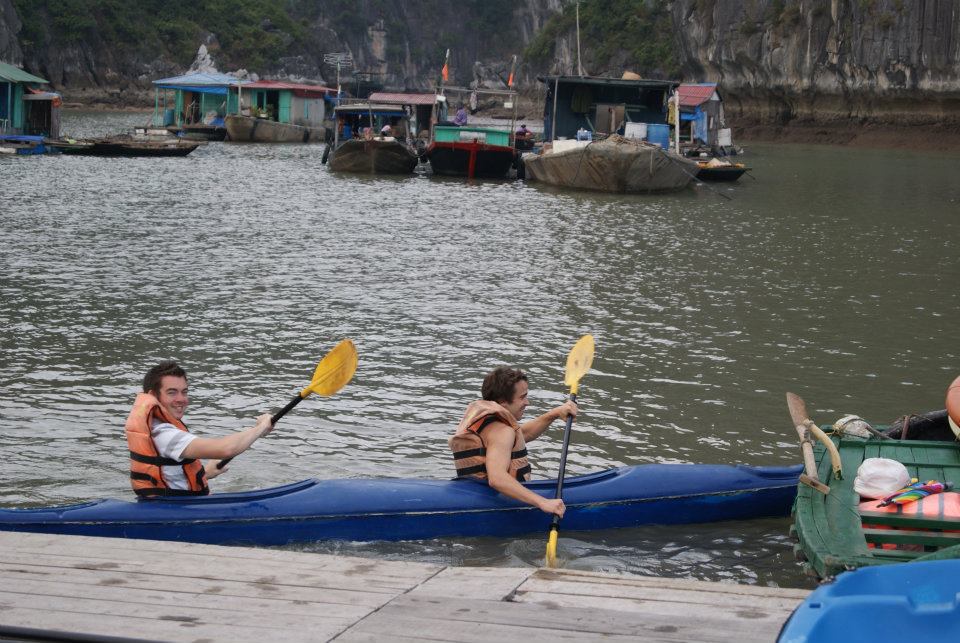
Ricky and I agreed to hire one, and off we went paddling through limestone gaps and tunnels, venturing out into the choppy sea and around some of the rocky islands.

Ha Long Bay

Emma and Megan spent much of their time trying to keep up with us, so we towed them along for a while, and at one point a fish managed to jump out of the water and into their canoe, sparking panic. It was only a tiny thing, but nonetheless we had to do the manly thing and save them from the stickleback that was harmlessly flapping about in a puddle of water at the bottom of the boat. He swam off in the sea without a care in the world.

With a few beers and photos on the sun deck as darkness fell, it was a very relaxing journey back to the port.

Sailing to shore

Dinner was at a recommended place called Bamboo Bar, which managed to serve up not only the worst meal of the tour so far, but a good dose of unintentional comedy too. They didn’t have enough chairs, so were were all perched on top of incredibly tall bar stools around tables that you couldn’t get legs under, while the swarms of staff looked like they’d never had more than three customers in at once. I had a fake bamboo tree next to me, meaning the only way I could get comfortable was by angling myself away from others. There were just six menus in the whole place, the staff lost track of who had ordered, food was arriving while orders were still being taken, Dirk was arguing because they’d asked him to pay before the food arrived, and European-style techno music was blaring almost full blast from the speakers.

I ordered a chicken club sandwich, which arrived with one tiny sliver of chicken in it, while Colin seemed to wait an age for his sandwich. At one point, a man walked through the place with two loaves of bread, quite obviously for our orders, while Ricky was left so hungry from the measly portion he tried to order another dish. Except despite being one of the world’s largest exporters of the stuff, the restaurant had managed to run out of rice. It was almost farcical, and with little else to do in the area, many of us went to bed early.

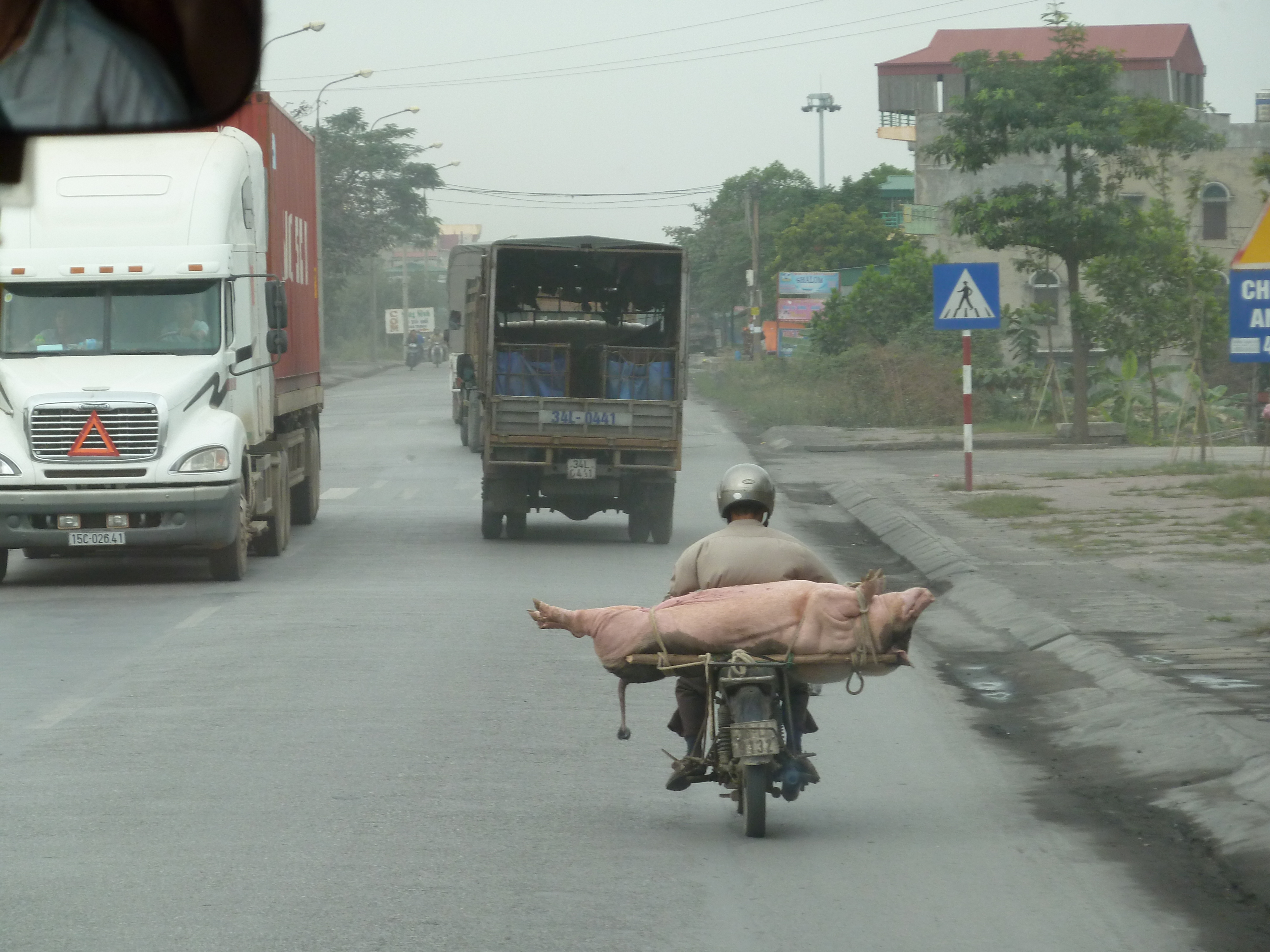
Road hog

The next day we headed back to Hanoi, with the usual game of ‘what’s on the moped’ from the bus throwing up this little beauty. Sausages for tea?

This little piggy went to market...

Rides, slides, silks and suits…

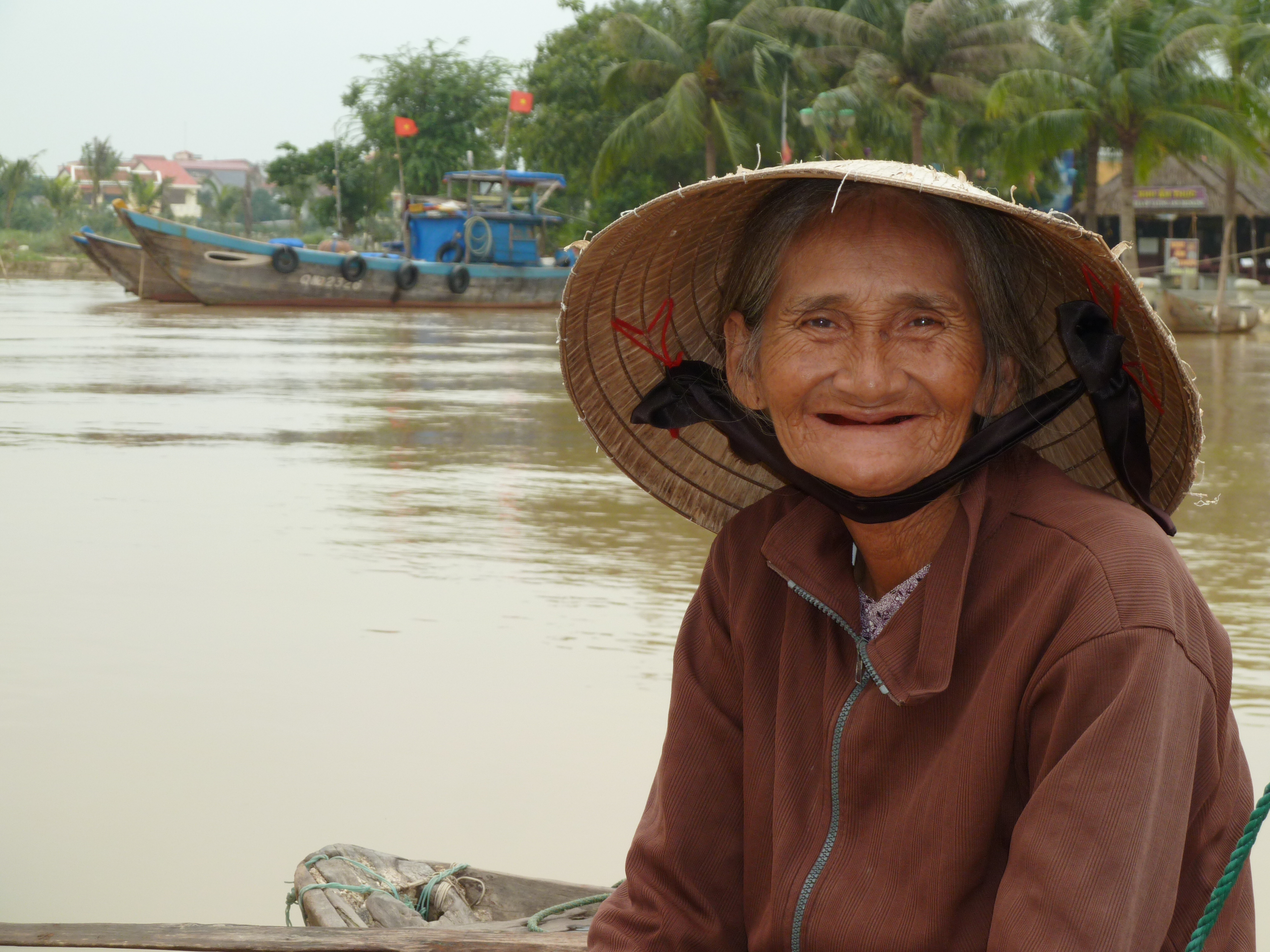
A smile from a local in Hoi An

Nha Trang, in the south east of Vietnam, gave us a lot of fun. We arrived tired off the overnight train, but there had been mention of a waterpark nearby. Little did we know it would be one of the biggest water theme parks in Asia!

Arriving at Nha Trang

It had been played down a little by Fon, who told us there was only one slide, and instead was trying to recommend various boat trips. After a bit of searching on the internet, I found the website for Vinpearl resort, complete with all its photographs of waterpark heaven.

It was a bit pricey – about £11 – but it didn’t take long to convince people, and soon there was eleven of us following my slightly childish love of slides and heading to a taxi.

The ski lift to the waterpark

To reach the resort, which is located on an island, you have to take the special chairlift. It’s a familiar design – its actually a Poma ski gondola, but it turns out its also the longest chairlift crossing over water in the world.

A huge cruise ship was parked up in the blue waters nearby, but the theme park was incredibly empty. It meant we could ride and slide to our heart’s content – particular favourites being the huge family raft tube which almost threw us off the side, a kamikaze style steep slide which had cheese-grater style joints which deprived your back of a few layers of skin, and a fairground-style ride that spins you round and upside down.

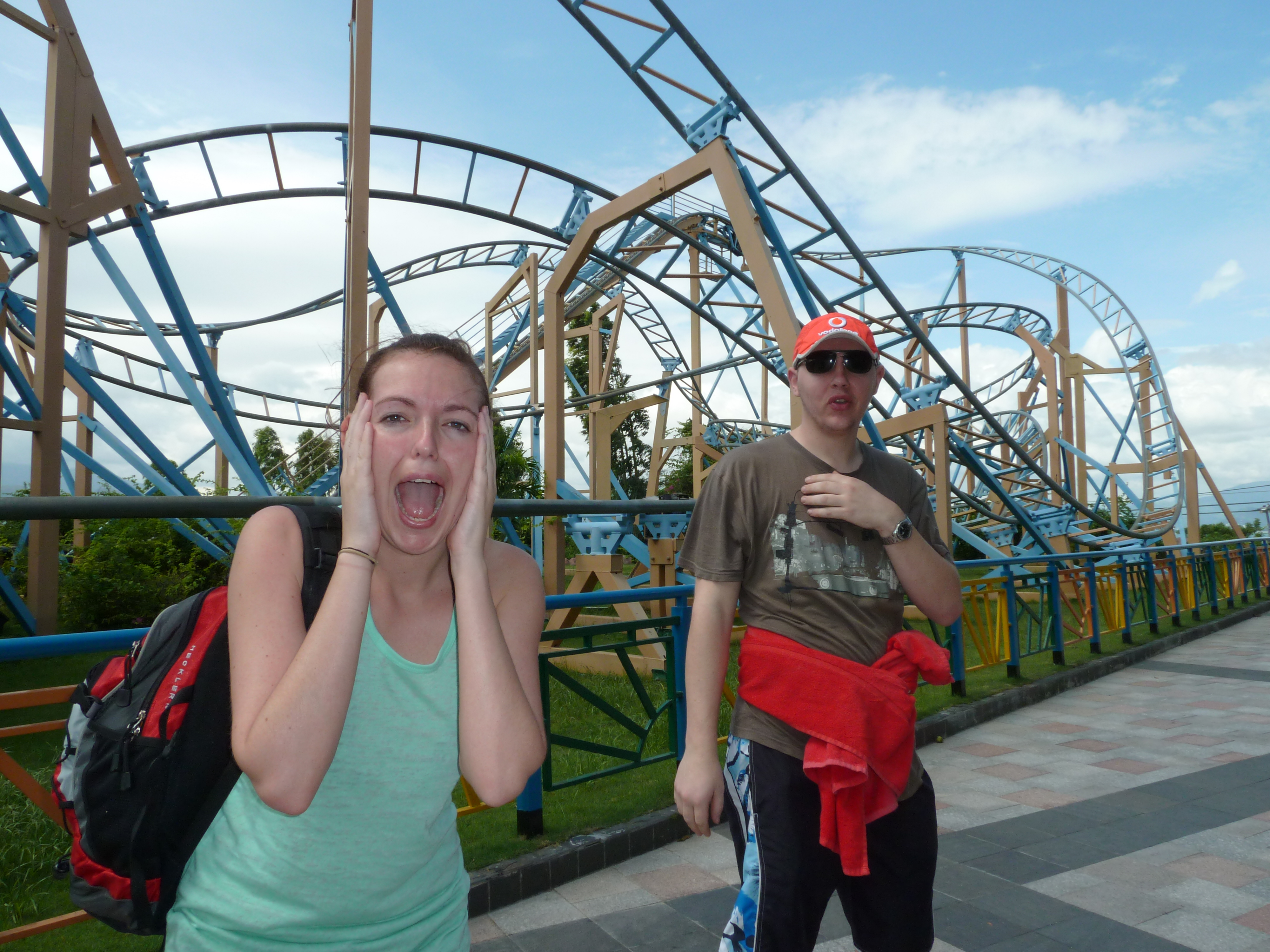
Scary stuff. The rides were frightening too

A few of the lads had discovered the ride just after lunch, thinking it would be fairly tame. It gave us a bit of a shock – partly as every now and again, while you were barely held in upside down, there was a worrying jolt and a metallic sound which didn’t sound too healthy. It spun you around upside down until most of your blood was in your head, far longer than anything back home, and eventually it brought you back down to earth.

I love theme park rides, and Hull Fair is one of my highlights every year, but there was something about that ride that just did not feel safe. Everyone felt the same, but we decided we’d tell the girls that it was good fun and get them on it at the end of the day.

Potential death trap

It was a decision which could have backfired – it meant we’d have to put our lives in the hands of some dodgy Vietnamese ride technology yet again, but it could also mean we’d lose quite a few friends. As it happens, they all seemed to enjoy it far more than us – Fon our tour leader even shouting for the ride operator to send us up again for another dose!

Thankfully we didn’t, but after a full day of swimming, sliding and a bit of volleyball on the beach, everyone was shattered. We had a few beers at a nearby bar, and then tried, unsuccessfully, to find a late bar, before ending up in a sidestreet place being beckoned in by a big burly Australian.

He told us how he’d moved there having met the love of his life – a picture of him and his Vietnamese wife on their wedding day hangs on the wall – and that while he didn’t make any money, he loved the country and decided to stay. There was a gaggle of older blokes outside, each with their own Vietnamese ‘love of their life’ hanging off their arm. Ricky decided he would tell everyone he was Russian, and occasionally changed from his Yorkshire accent mid way through a sentence while talking to a French bloke. It was amusing, but all a bit odd, and we went for bed.

The next day was spent feeling quite ill. Having been out the night previous, I’d missed taking my anti-malaria tablet so thought it would be a good idea to take it as soon as I remembered the next morning. Big mistake! An hour later, just as I reached a restaurant for brunch, I broke out in a fever and sweats with one of the worst headaches and sickness. It left me feeling washed out for much of the day.

A pretty horrendous journey on an overnight bus (see my previous post!) took us to Hoi An, the silk and tailoring capital of Vietnam.

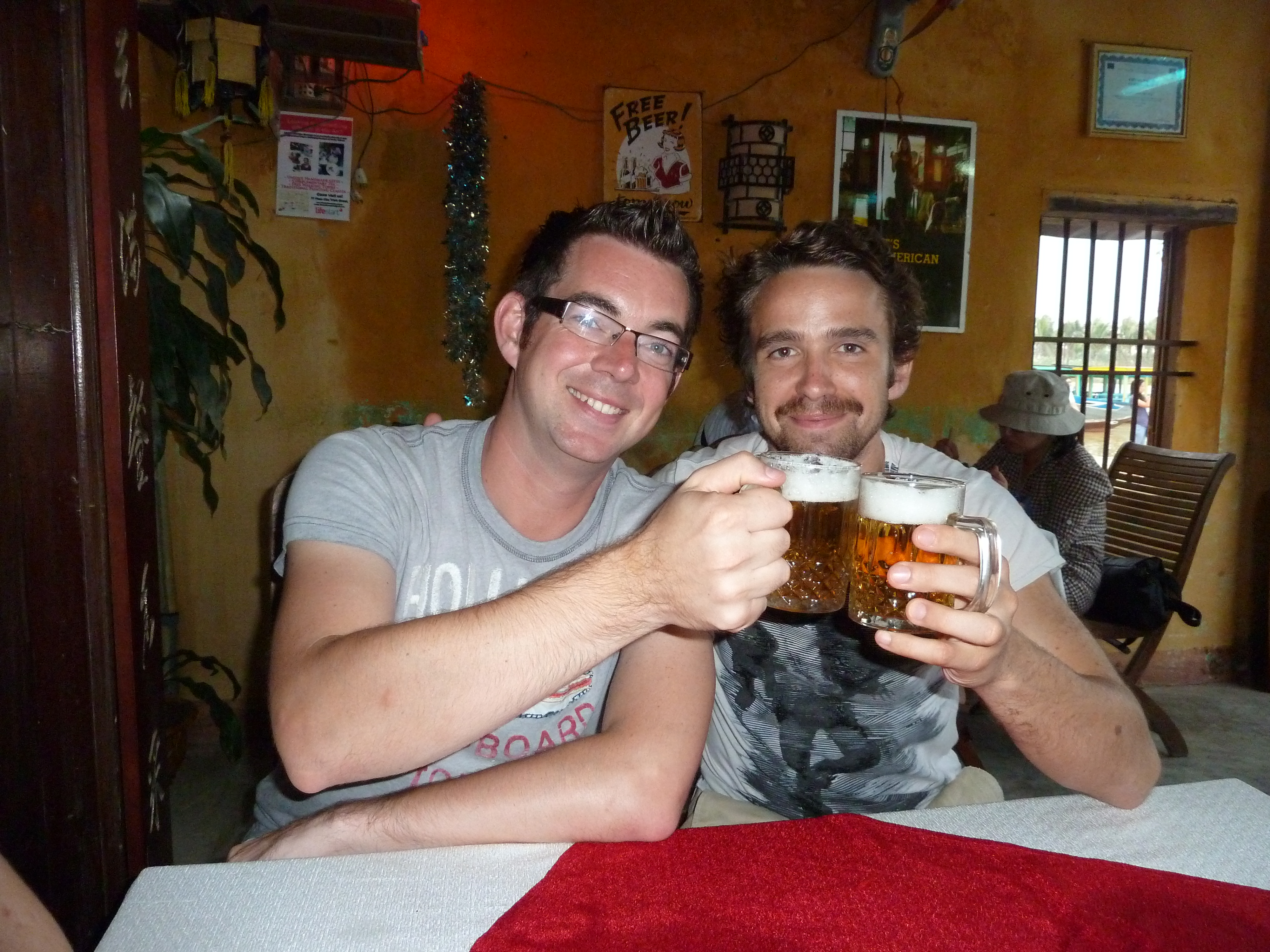
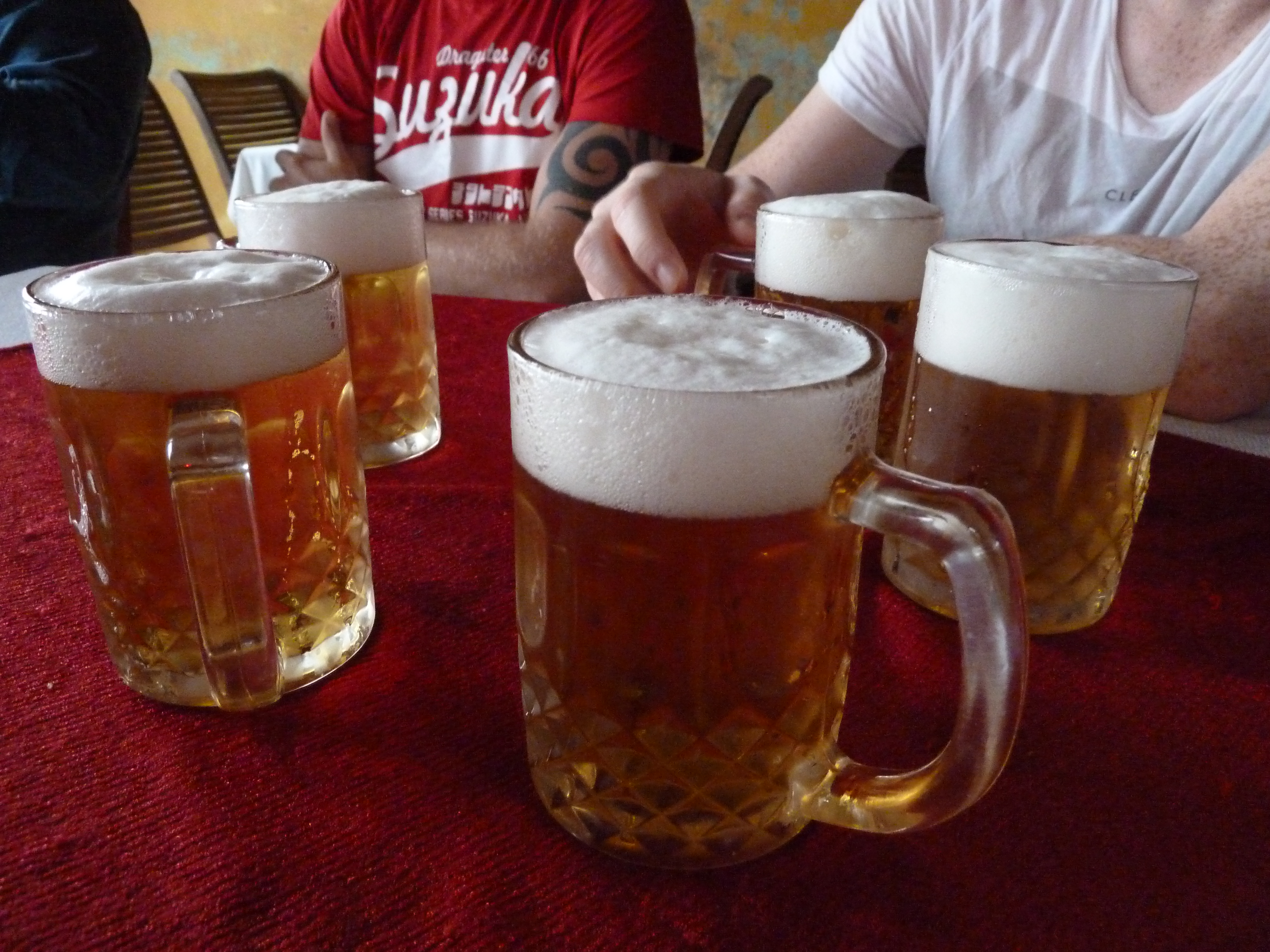
Cheapest beers ever!

It’s a historic port city, with huge Chinese and French influences and a great deal of history. Its built up around a river, along which boasts some of the cheapest beer in the world. At the equivalent of just 15p, it was rude not to indulge in some, especially as the weather was on the turn.

75p for a round - even I got one in!
The city has around 400 expert tailors, and is famous for its made to measure clothes. Many of the girls were excited about a full day of shopping amid colourful – and I have to say, very impressive – dresses and skirts. After looking around at suits, and finding out I could save a few hundred pounds on a tailored one from the UK by having one made here, I realised it would be stupid not to have one made.

She could have done with a stool...

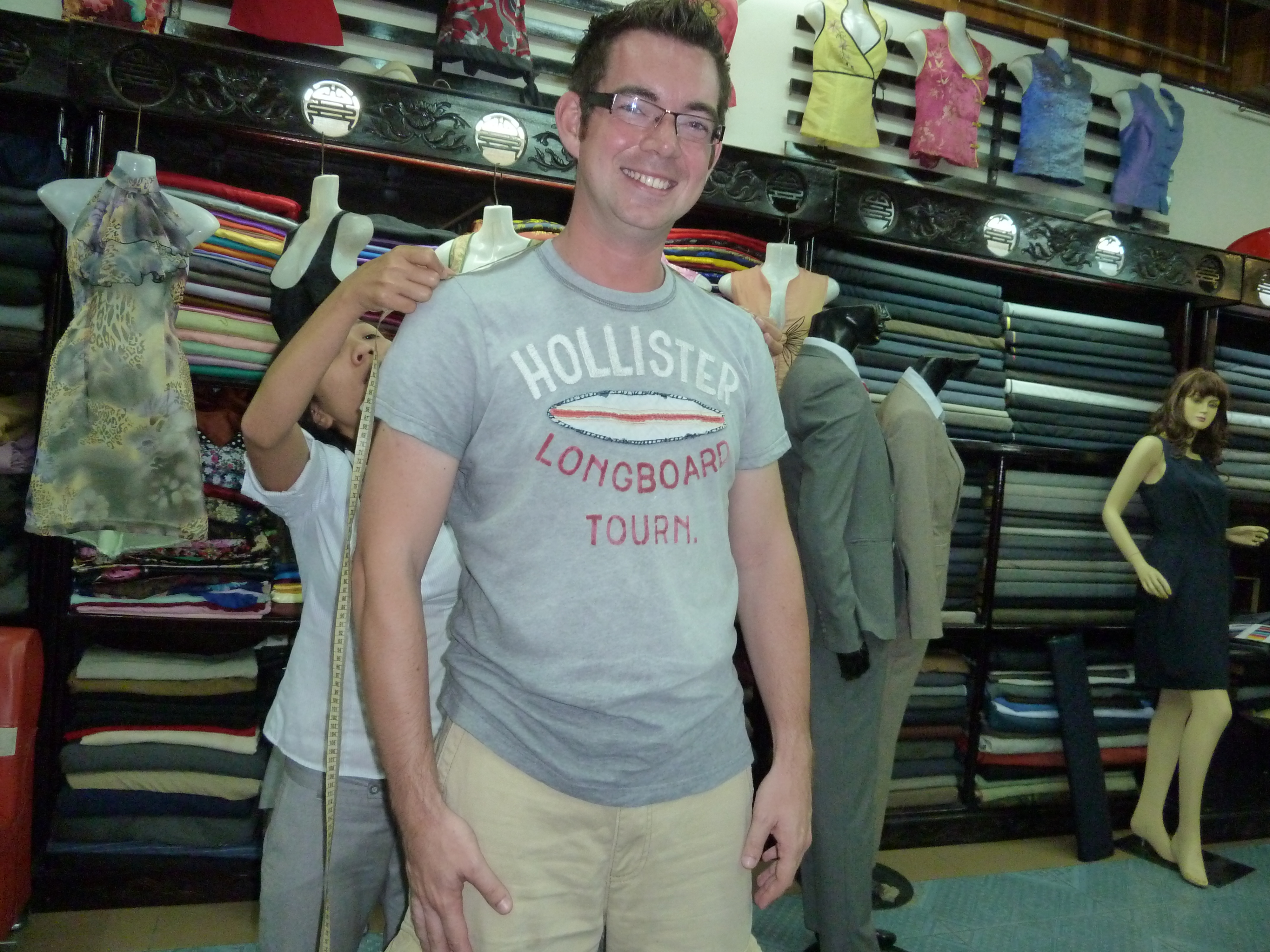
I shopped around and was quoted around $160 for a suit. At £100 it was still quite a good deal, but I ended up bumping into Dirk who’d just splashed out $220 on two suits and three shirts. He took me to the shop and introduced me to Lu, and demanded she gave me a good deal. I’ve never made a suit from scratch before, and it was strange to be shown all the different fabrics and to have to choose a colour and appearance.

Measuring time

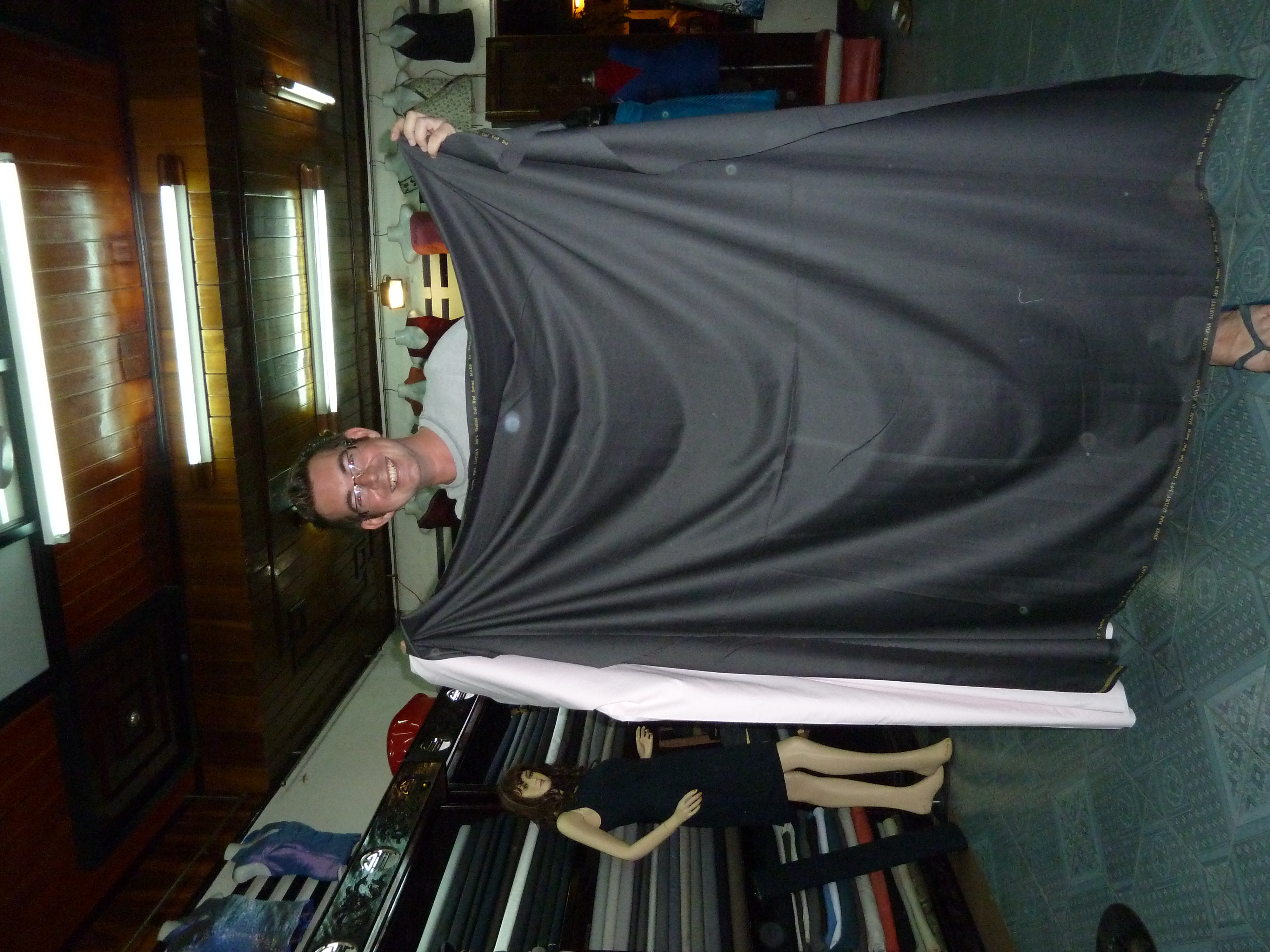
I went for a charcoal grey material, made of a cashmere wool and silk blend, and was quoted $140. I ended up knocking that down to $100, and then getting a tailored shirt thrown in for an extra $10. I was shown some design catalogues, picked the look I wanted and told to come back the following day at 11am for a fitting.

Before I’d left the shop, my material was already being cut and prepared and being laid out on the floor by Lu who was quite possibly one of the bubbliest, friendliest shopkeepers I’ve met out here. I don’t quite know how they manage to make clothes so quickly overnight, but I was about to find out.

Somehow overnight this becomes a suit and shirt!

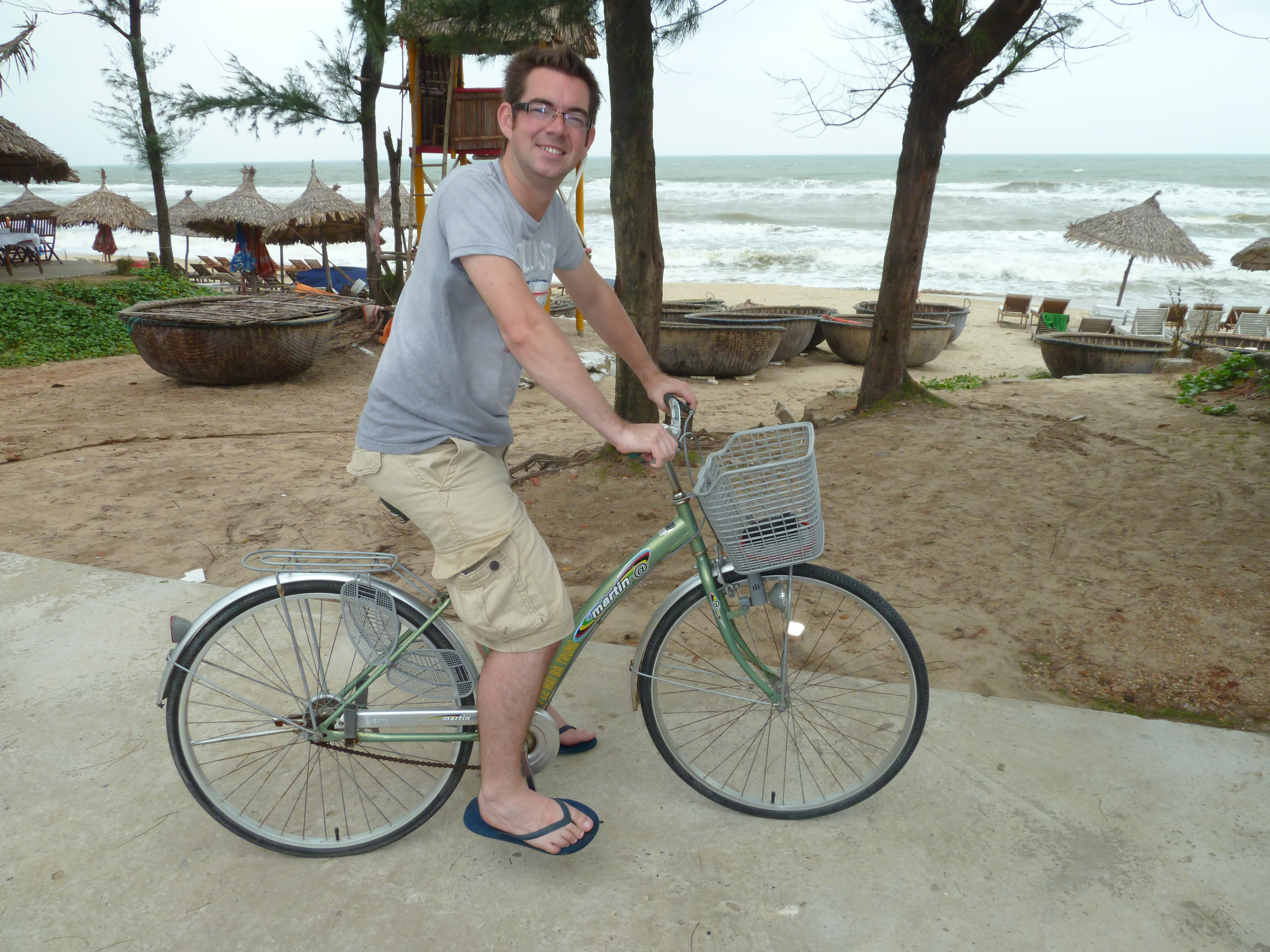
The next day Ricardo, Dirk, Malcolm and I decided to hire cycles, so at 11am I rode back to the shop for my fitting. The shirt and trousers were already hanging up waiting for me, and fitted absolutely perfectly. Its so hard to find trousers that fit me well, and they alone were worth paying the money for. The suit jacket was handed to me but needed a few alterations for it to fit properly. I was told to return at 5pm, so in the meantime we all went for a ride to a nearby beach.

I want to ride my....

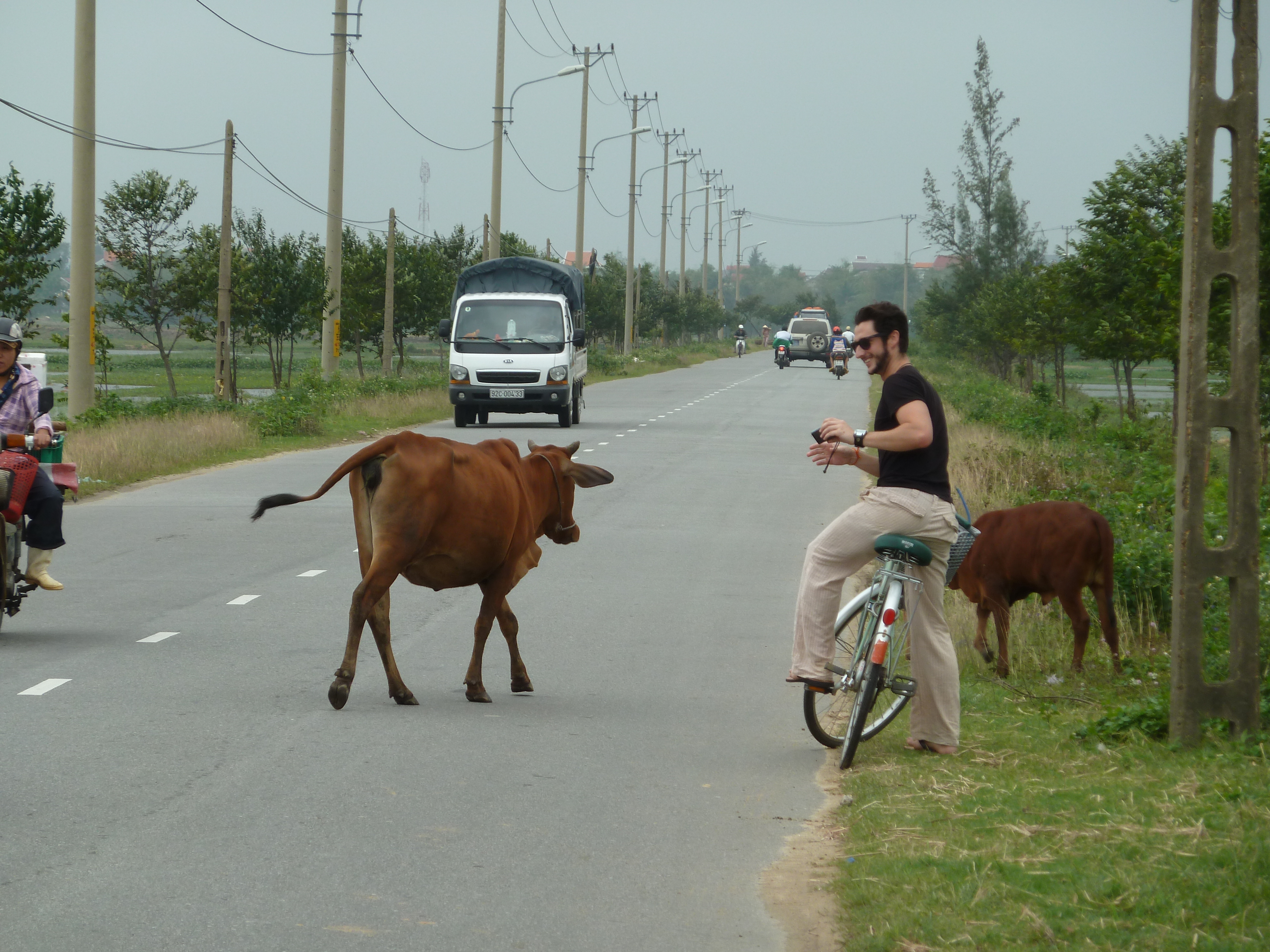
Having had plenty of experience of watching cyclists dicing with death through the windows of various buses in the last few weeks, I had a fair idea of what to expect, although thankfully the roads around Hoi An are relatively quiet.

On my bike

It was nice to take to two wheels and make our way through the countryside, with fellow tourists giving us a wave and a smile as we passed by. It was only a dollar to hire a bike for the day so it made sense to see a bit of the region while we could, and after a few Larue beers over the last few days, it was some much needed exercise.

It was about 8km to the nearest beach, and as we entered the village we got flagged down by someone at the side of the road with a whistle. Thinking it was the Vietnamese police, we pulled off into a shed, where someone was waiting with tickets. Apparently, no bicycles were allowed at the beach. It was a lie! It was only a short walk though, so we paid the 10p per bike they were wanting and headed to the sands.

Rubbish beach

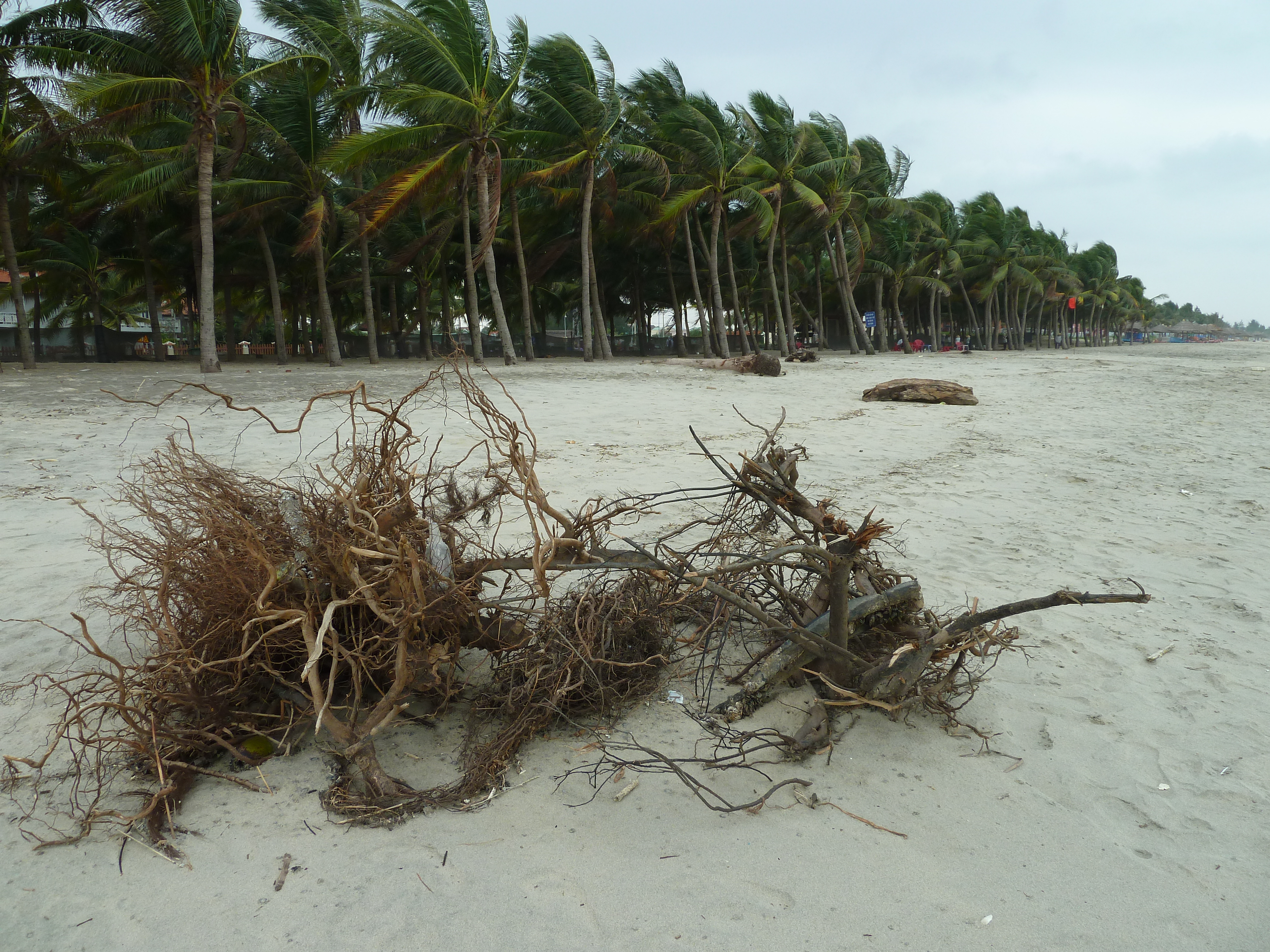
We needn’t have bothered. As Ricky said, it was ‘probably the worst beach he’d ever been to,’ and I had to agree. The weather had undoubtedly battered the coast – one of the locals told us it was the tail end of a cyclone – and the waves were still rough. Along with some washed up palm trees, there was rubbish everywhere, and on closer inspection it soon became clear where it was all from – China.

The message was missing

The horizon we were trying to see through the mist and spray was over the greeny-coloured South China Sea, and all the tins, plastic bottles and glass containers washing up on the Vietnamese shore would indicate tonnes of the stuff is being thrown into the sea further up the coast and ending up littering what would otherwise be, on a calm and sunny day, a beautiful bit of coastline.

We carried on up the coast to see if it improved, but it didn’t. Instead, we headed back towards Hoi An for some lunch, but taking time to get photos of local farmers and fishermen working in the surrounding paddy fields, while some of the local cows took an interest in us.

Meeting a few more locals

We had lunch at a bar and restaurant across the road from the hotel. It was one I’d spotted as it was advertising a free pool table on the door, and it was about time some of our competitive streak came out in us again. After a few frames, it started raining outside again – and it just didn’t stop. It was absolutely torrential, so much so the roads began to flood. Running across the road to the hotel opposite was enough to soak you through. Most of the group had taken refuge back in their rooms, but most of the group, me included, also had to get back into town for 5pm for a final fitting.

Thankfully I still had my cycle parked outside the hotel, so having dug out my Berghaus again, cycled off through the puddles to Le Loi street, where my suit was hanging on a door waiting for me. This time it was too tight – and meant another trip back at 7pm. In between, I had to return the cycle, so either way I knew it meant a drenching. Sure enough, it was still hammering down, and I arrived back at the shop with all the girls laughing at me. They sat me down and gave me a bottle of water, taking my raincoat and hanging it to dry off.

The suit and swimshorts look is in, right?!

The suit fitted really well, with sleeves the perfect length and no wrinkling at the back. It’ll probably be a different story by the time I go back to work, but within a few minutes a courier was at the shop ready to pack it off to the UK. It was $28 to send it via sea mail, but thankfully I had a brainwave and asked how much to send another kilo of belongings from my rucksack. It was $2 more, but meant walking back to the hotel.

Thankfully Lu said I could borrow her bike, so back I went on her traditional ladies cycle, much to the amusement of the hotel porter when I arrived. Twenty minutes later, I was back at the shop with the pay as you go mobile phone Dad got me when my iPhone broke, my unused electric shaver, some books and a few more souvenirs and papers. Every little helps when it comes to keeping the weight on your shoulders down!

With my first ever made-to-measure suit on its way home, dinner was, unsurprisingly, at the same bar and restaurant opposite the hotel as we had lunch, and the evening was spent playing pool as it continued to lash down outside. There’s no wonder the staff at the restaurant joined the hotel staff in waving us off the next morning – we certainly gave them a lot of business during our short stay!

When it rains, it pours - especially on the mountain pass

We headed off on a four hour journey north to Hue, pronounced ‘Huway’ due to the French influence in the area. The rain was still incessant, meaning we couldn’t take a spectacular mountain pass and instead had to travel through Asia’s longest tunnel, at about 6.9km.

It came out onto some tight hairpin bends in scenery that seemed familiar, and then Malcolm confirmed why. We’re following the same route that Top Gear did when they filmed in Vietnam, and I distinctly remembered the stretch of road we were on. After a few unnerving twists and turns, we arrived in Hue – and still the rain continued to pour.

Sleeper Bus Hell!

I’m writing this with my heart in my mouth. My good friend Colin just grabbed my arm with genuine fear. We’re travelling on what might possibly be the most frightening journey of our lives.

We’ve had to take a night sleeper bus to Hoi An, as the night train which was supposed to take us there was cancelled after the railway line was hit by a lorry last night. Travelling around Vietnam is proving to be an experience.

All smiles before the journey!

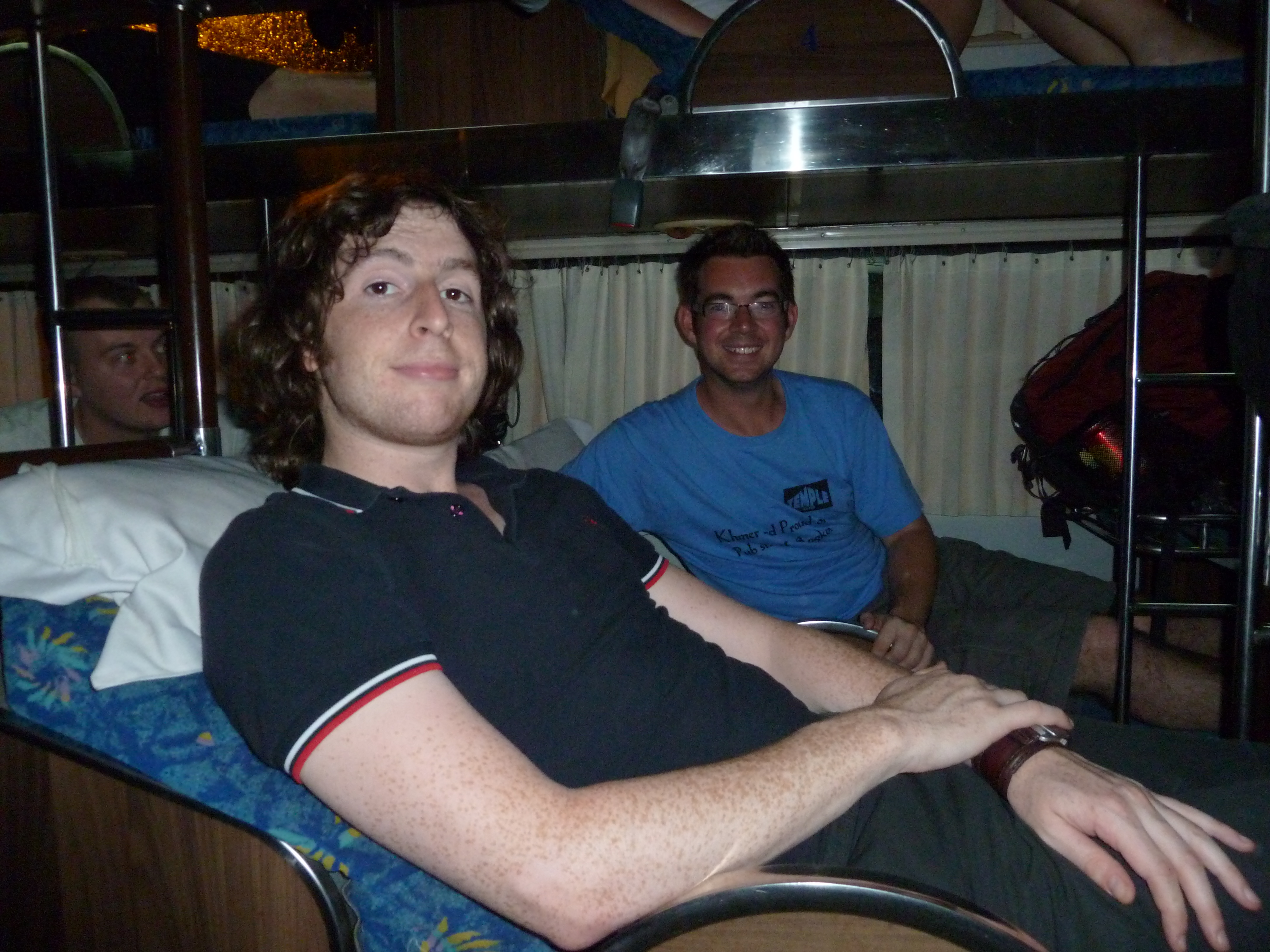
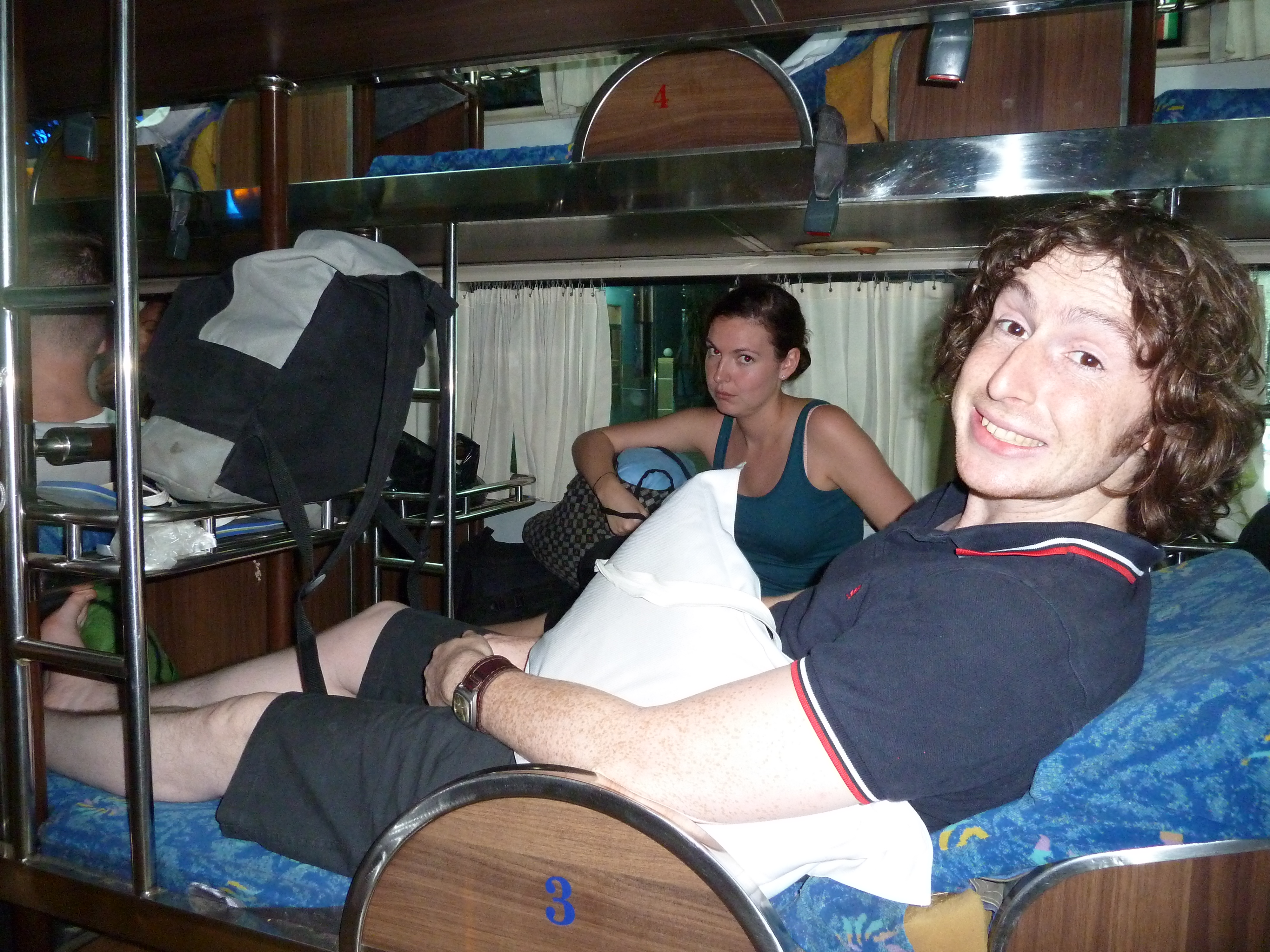
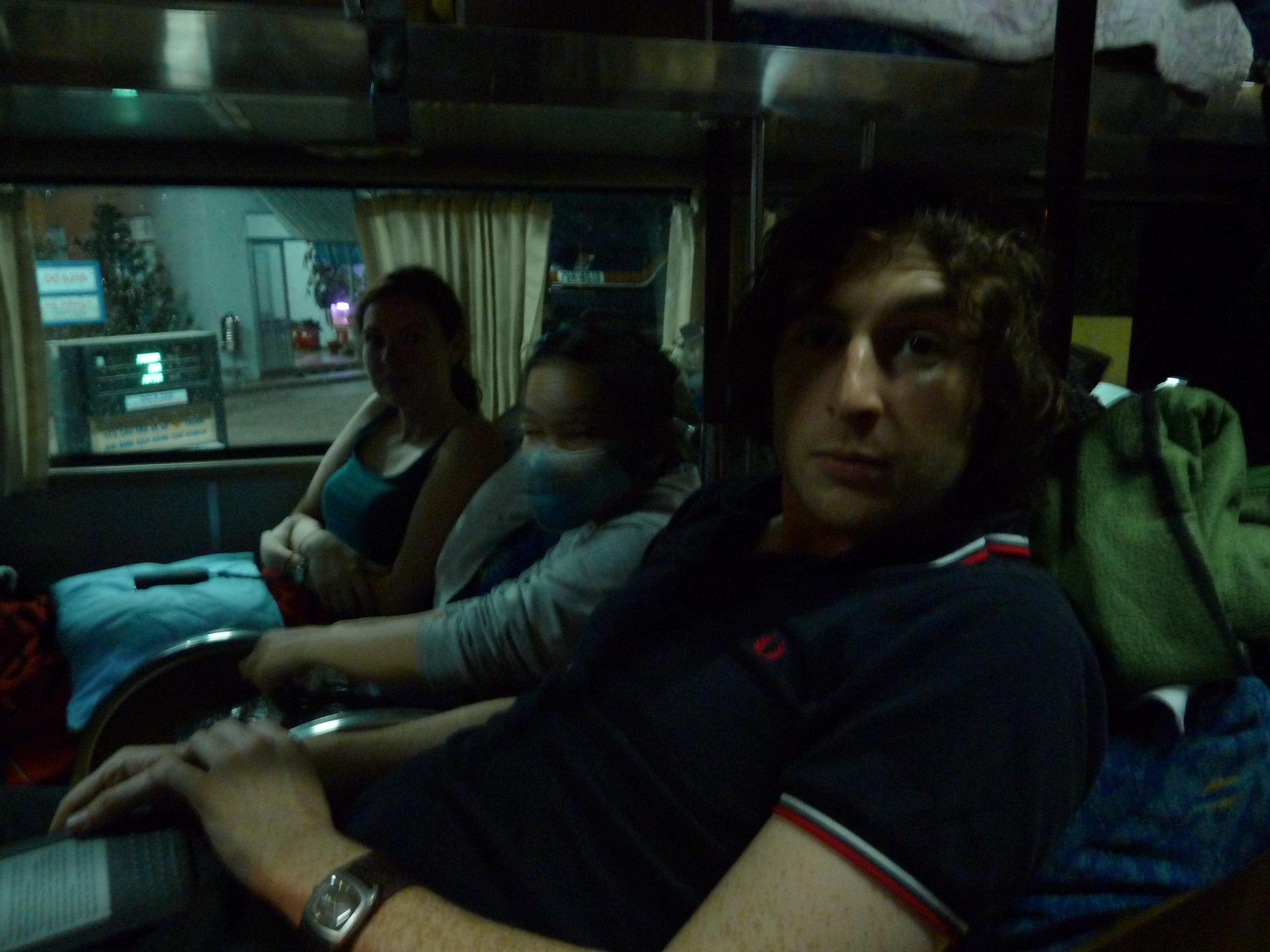
I’m currently typing as we’re climbing mountain passes above the sea in the dead of night. The lights were switched off at 7.30pm, its pitch black and I’m laying in my sleeper bunk, while Colin and Ricky are next to and behind me. Its fair to say we are all clinging on to the metal railings as tight as we can, while the driver of the bus a few metres away is happily overtaking on blind bends, talking on a mobile phone and generally swerving all over the place.

I’ll admit, writing this blog entry is partly to take my concentration away from the dramas going on through the front windscreen, partly to look back on in the future and remember just how petrified many of us are, and partly so that if this laptop is found in the wilderness below one day, there will be a record of exactly how it ended up stuck in a tree.

The news that we were to change from a comfortable sleeper train to this worrying form of transport was posted on the Gap Adventures noticeboard in the hotel lobby this morning. Its news that wasn’t particularly well received by anybody, mainly as nobody was looking forward to an overnight train ride, let alone one on bumpy roads in a tightly packed bus.

Colin and Sarah before we set off

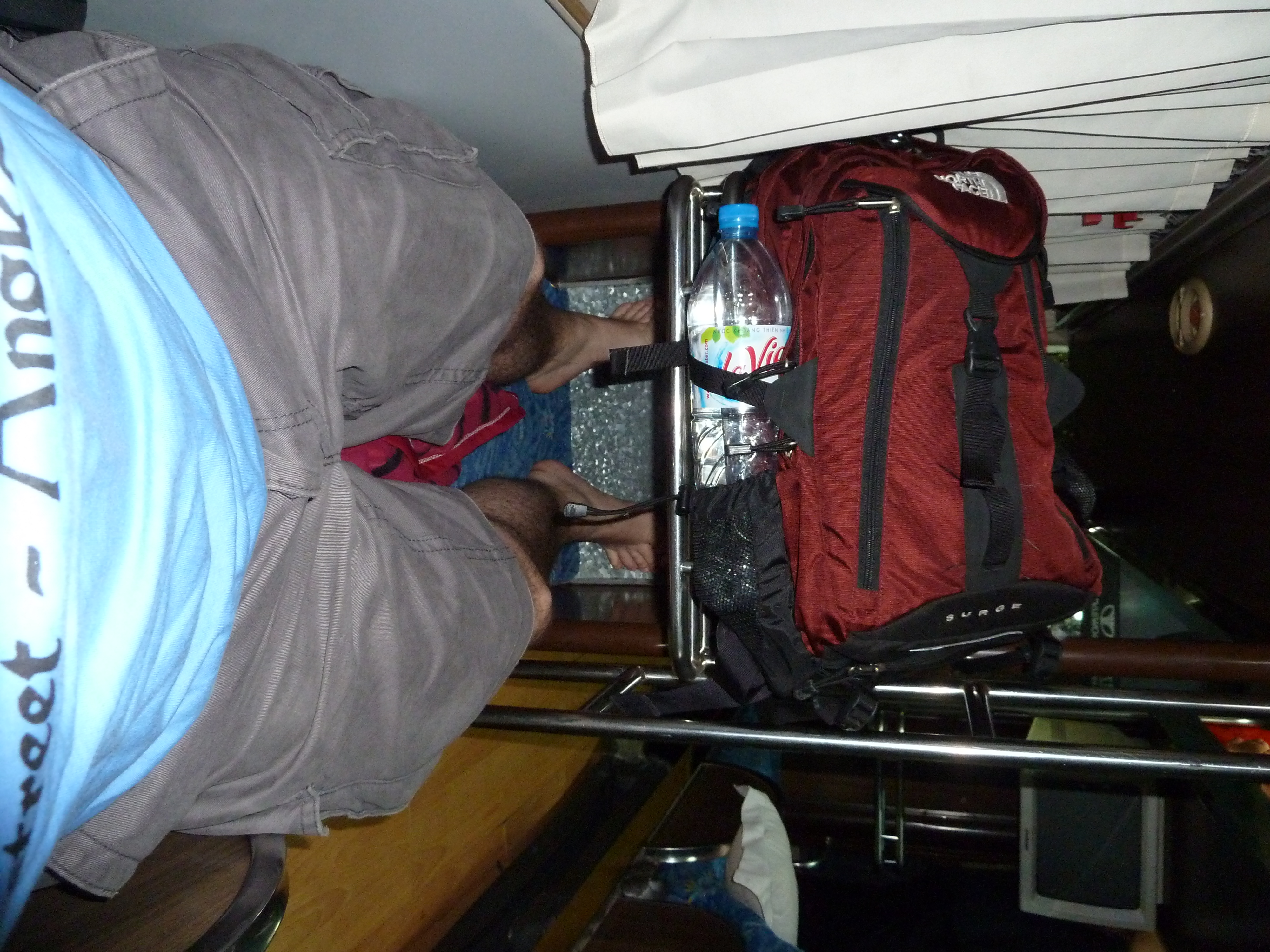
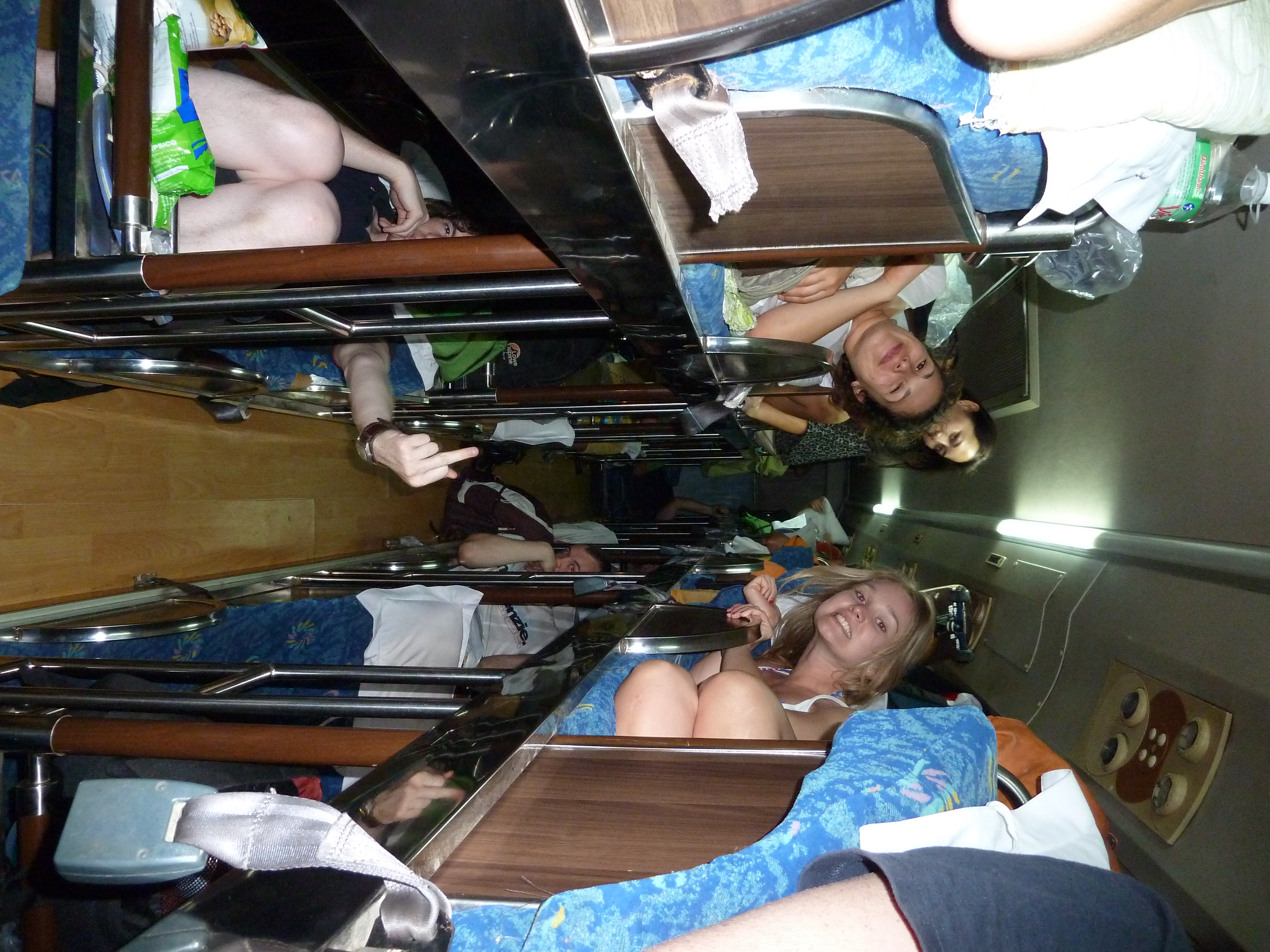
Despite our annoyance, we all got onboard when it picked us up outside the hotel at 6.30pm. For most of us it’s the first time we’ve experienced a sleeper bus, and I think for many of us it could possibly be the last. Its clearly built with shorter Vietnamese people in mind – my bed isn’t quite long enough for my six foot frame, and the three abreast formation is cosy to say the least. We all ended up laughing about the situation, apart from Colin who failed to sleep a wink on the train, and knows he’s in for another sleepless night on a bus.

I can just about straighten my legs!

The bus is laid out with about 30 bunks, which are a bit like unadjustable thin hospital beds. Your feet tuck under the head of the person in front of you, while there’s a little rack to balance snacks and bags. I chose a bed on the bottom left near the front of the bus, offering a grandstand view of some of the ‘oh my God’ moments that were about to unfold in front of us.

The bus was full when we left the second pick up in Nha Trang, but that doesn’t seem to matter here. If you have money, you can have a seat, even if that does mean you’re on the floor inbetween everyone else who has a proper seat. Soon we were picking up Vietnamese locals needing a lift, until we got to a point where all the aisles were full of people. I had one man right next to me – invading my ‘personal space’ territory, happily watching as I tapped away on my laptop, giving me a cheeky smile every now and again.

Poor quality picture, but you can just see Colin's new friend in the aisle!

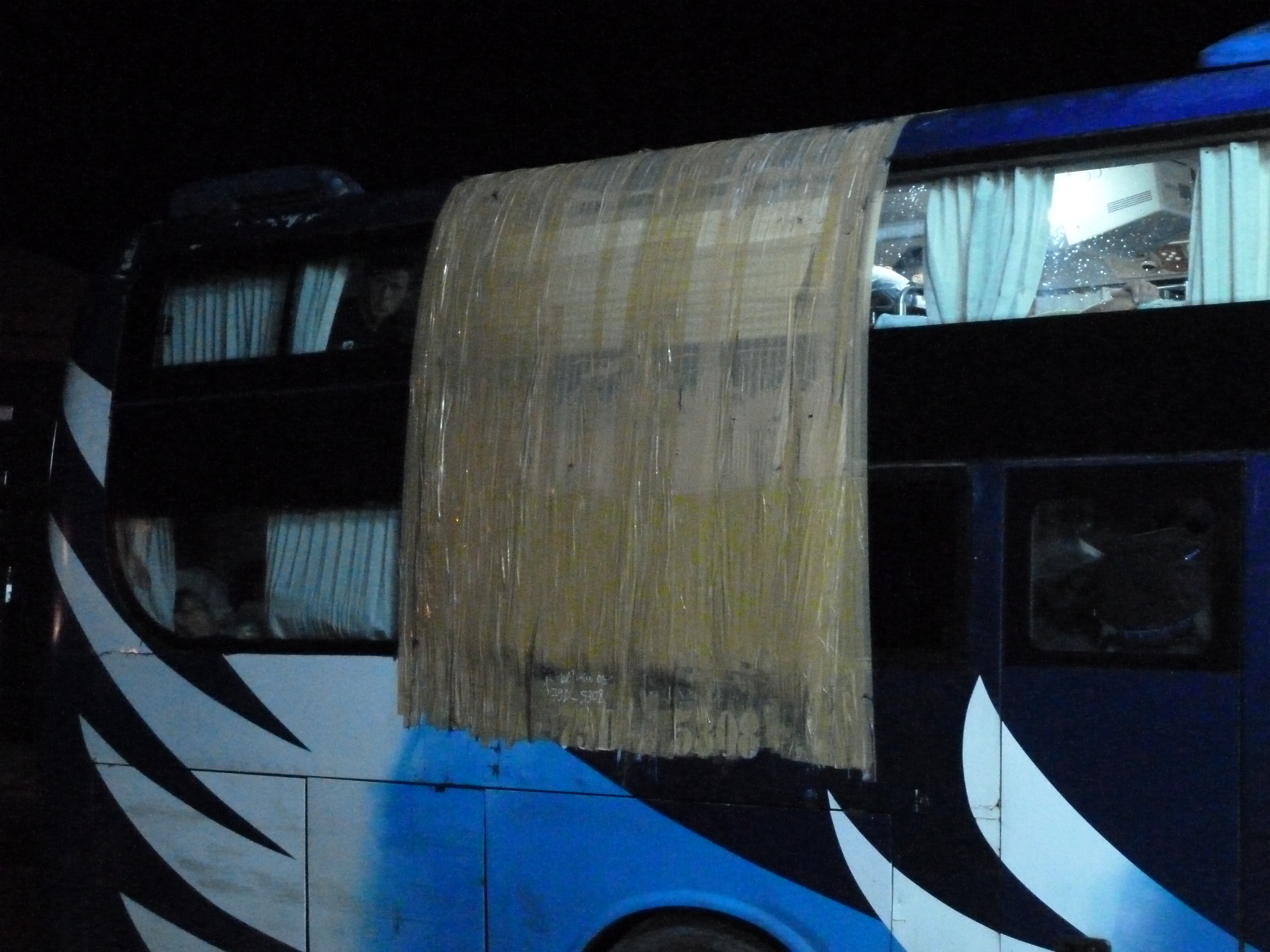
The next eye-opener was when we stopped for fuel on the outskirts of Nha Trang, when many of us noticed that a large portion of the bus appeared to be held together by parcel tape.

Sellotape had a field day

It was a fact confirmed by Dirk, our German tour mate, who was unfortunate enough to be placed at the back of the bus, squashed between Vietnamese families and under a dripping skylight that was covered with tape. The bottom of the bus was also full of holes.

Our holy bus!

The main eye-opener was the driving. While Mongolian roads a few weeks ago were scary for their general lack of rules and order, Vietnamese drivers do at least tend to stick to traffic lights and speed limits. But it’s the increased number of mopeds without lights and a need to overtake anything in the way as quickly as possible that causes problems here, while braking is only to be done at the last moment, if indeed it’s done at all.

With no proper motorways, the end result is motorway-style driving on a grand scale along a road with more twists than the A46, and more potholes than the moon.

Quite often our bus is driving along the wrong side of the road, oncoming drivers keep flashing their full beam at us, the sound of a loud horn is so frequent it just becomes background noise. The feeling as we career around a blind bend, overtaking a van or lorry, only to see headlights suddenly appear, is quite hard to explain. And every few minutes, his stupid mobile phone ringtone goes off, to which he answers and has a cheery natter with someone.

I know road rules and driving standards vary in different countries, but this is in another league!

Colin donned his special hat for luck

Its only 10pm and for those of us still awake, our nerves have pretty much gone. As we climbed up a mountain pass, with a sheer drop into the sea below us, lorries roared past with just an inch or so clearance. Slower, more careful drivers were just an irritant for our driver, who made it his mission to overtake as quickly and as dangerously as possible.

At one point, the whole bus rolled to one side after he misjudged a bend, making many of us think we were heading for the roadside barrier and a bit of a swim. That’s when Colin grabbed my arm, thinking the end was near.

“This is honestly the most terrified I’ve ever been,” he said.

Ricardo said he was genuinely contemplating getting off and hiring a car for the rest of the journey.

“The oncoming lights just keep getting bigger and nearer,” he laughs, nervously.

I keep telling myself the driver must know what he’s doing as he drives this route for a living. But theres still a nagging feeling of doubt hanging over me.

Some of the others have nodded off, blissfully unaware of all the drama around us. Maybe I should do the same. Hopefully I’ll write more tomorrow.

Smiles from Victoria, Tamsin and Cindy. Colin reached breaking point!

We survived! Thankfully, I’m able to write more – we made it to Hoi An almost three hours later than scheduled somehow. We were all just glad to have made it in one piece. Most of us actually got some sleep, although there was one moment in the middle of the night where there was a huge blast of horns, the brakes were slammed on and in my slumber I remember a swerving feeling before the distinct rumble and bumpiness of going off road.

I didn’t actually open my eyes – I didn’t want to see what was going on and decided if it was the end, I’d rather be asleep!

I did open my eyes at about 4am though, with the feeling of something crawling over my feet. It didn’t feel too small either, and with the help of my camera display screen being used as a torch, examined the area where I had my feet.

A cockroach.

I tried to shoo it out but it wandered off somewhere, so I went back to sleep. I’m obviously getting used to living alongside the bugs here now!

This was all combined with quite possibly the angriest bus driver I’ll probably ever meet, who ironically demanded we take our shoes off before getting on to his cockroach infested vehicle. There were a number of occasions where his face scrunched up and he yelled something in Vietnamese, and with a flick of his hand yet another person had been reprimanded for taking one footstep too far in a flip flop.

It all ended in a playing field somewhere in Hoi An, where our luggage, if it wasn’t soaked already from the hold of the leaky bus, was thrown into the mud. We were dumped without any onward transport to our hotel. Someone from the bus company was shouting at our tour leader Fon, who by now was looking exasperated. I could tell it hadn’t been the easiest of journeys for her either – it’s the first time she’d had to take a sleeper bus too.

Hoi An in one piece - just!

It turned out Gap Adventures had been promised a transfer to the hotel, but once the money had been taken and we’d reached the destination, the bus company and angry driver decided otherwise. We trooped around the town to our hotel, and then on for some breakfast at a lovely French café by the river.

Fon said she wasn’t too hungry.

“I had two cockroaches in my bed last night, and they weren’t there this morning. I think I’ve eaten them…I’m full of cockroach,” she joked.

It was certainly a journey few of us will forget.

Good Morning Vietnam!

On the road again!

After a long week of driving across Cambodia, it was nice for my feet to finally wade into the Gulf of Thailand.

We’d stopped off at Sihanoukville, a resort on the southern coastline which boasted beautifully soft white sands, blue sea and cheap beer. It was the perfect tonic after a long few days on the road, but a good opportunity to recharge batteries before more long drives to Vietnam in the next few days.

Much of the arrival day was spent in a beach bar, sipping cocktails, eating pizza and playing pool. The evenings were spent dining on the beach with yet more chicken amok and good company. Everyone has really clicked now on the tour, but the sad news is that theres quite a few leaving us in the next couple of days.

Dinner on the beach

In the meantime there were plenty of laughs – John the Aussie providing plenty of them, particularly when he was sent sprinting along the beach, chased by a Cambodian kid who was launching fireworks at him.

The next day was spent lounging around the pool, writing and uploading my blog and generally relaxing. I worked out it was the first day I’d had without any travelling, sightseeing or deadlines to meet for around two months, and I felt much better for it. It was nice to sit and do nothing for a change. It might sound strange, but travelling like this is very demanding and takes its toll – you are constantly on the go and always against time.

Dusty, sandy landscape turned into this

Rested up, and after six days working our way across Cambodia, it was time for some serious long-distance road trips to the next country on our list –Vietnam.

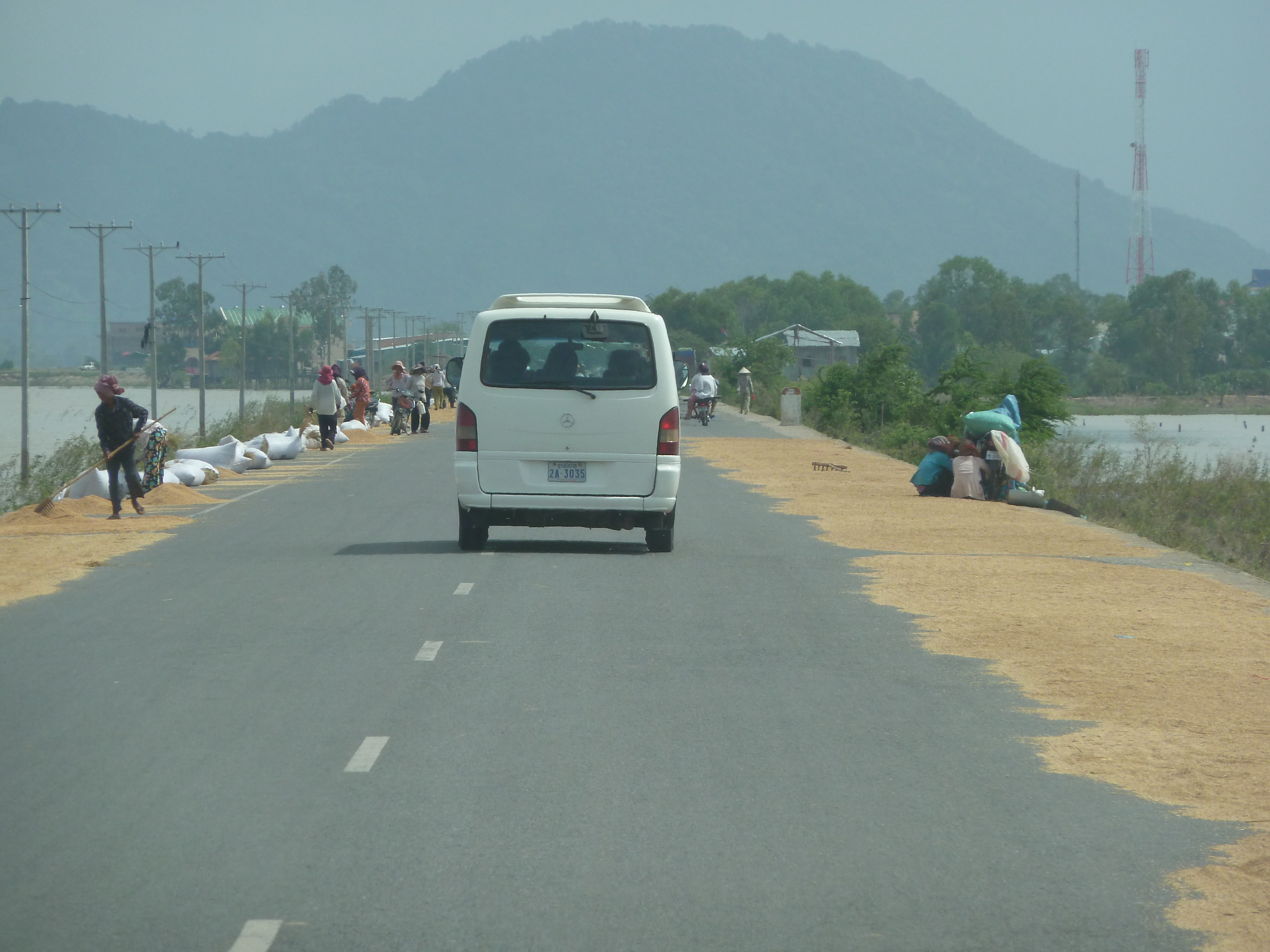
We left Sihanoukville early, destined for Chau Doc, a Vietnamese town just inside the border. It was a four hour journey to the border through lush green countryside and paddy fields. Along long stretches of the journey, farmers were drying rice along the side of the road. Children would wave as we passed through, spotting the Western faces smiling back through the windows.

A stop at some services a few hours into the drive brought the latest culinary discovery: the delightful sounding Special Flossy Pork.

Mmmmm!


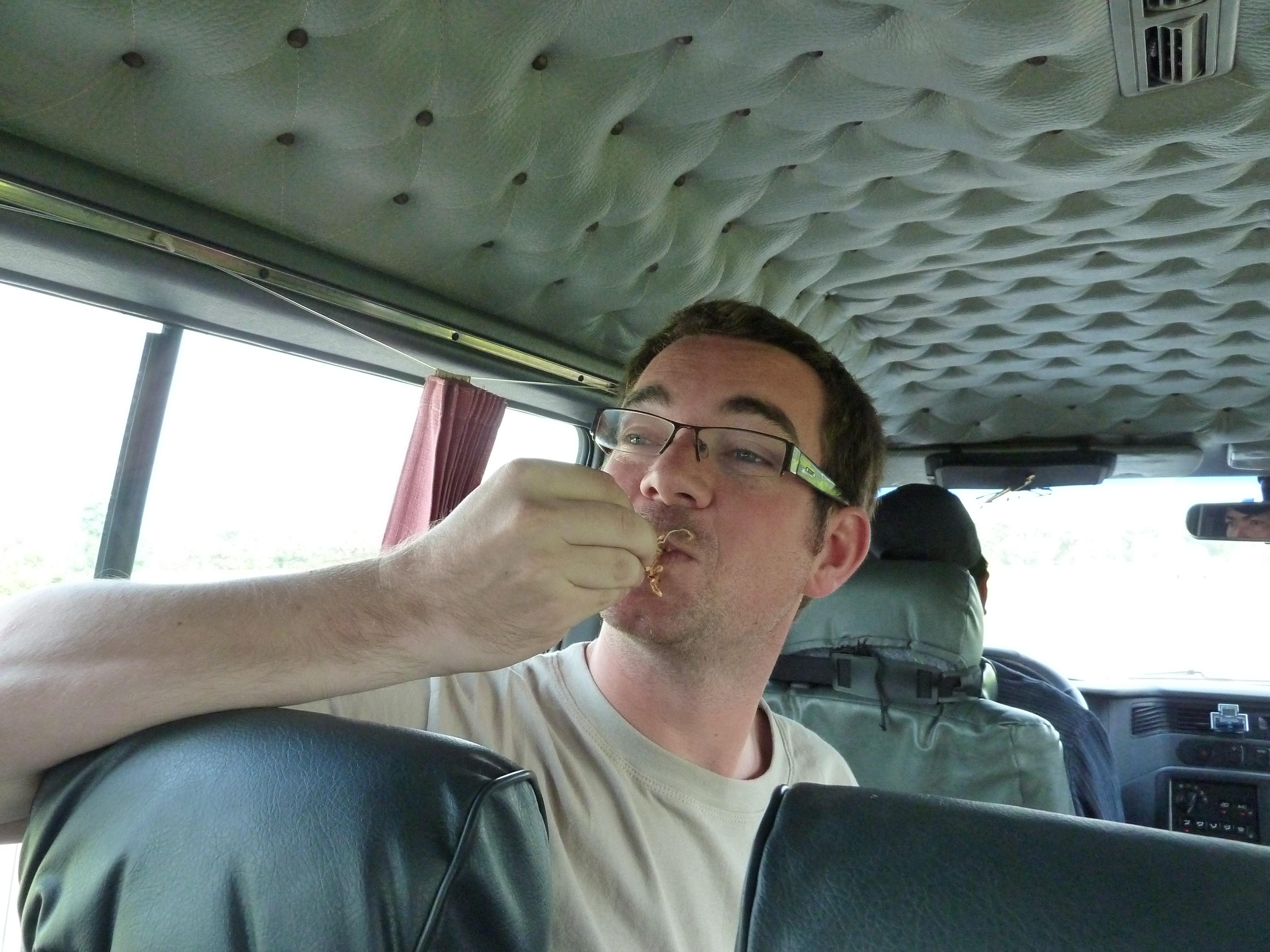
Not happy with just taking a photograph of the odd foodstuff, at $1.50 it was worth buying just to give it a try. There were lots of ‘ughs’ and ‘yucks’ as the packaging was opened to reveal something that wouldn’t look out of place stuffed into a mattress. After teasing some apart – it had the consistency and feel of wool – I put it in my mouth.

Tasty flossy pork!

Its strangely good – so much so I had a bit more to make sure. It tasted a bit like bacon, but with the consistency of a Hessian sack until it works itself into a chewy lump. By now, others were interested – Ricky had a try and wasn’t a fan, while Canadian Alissa decided it was so good, she too needed second helpings.

I don’t think it will feature on a Gordon Ramsey menu anytime soon, but Special Flossy Pork is certainly something we’ll think twice about laughing at in the future!

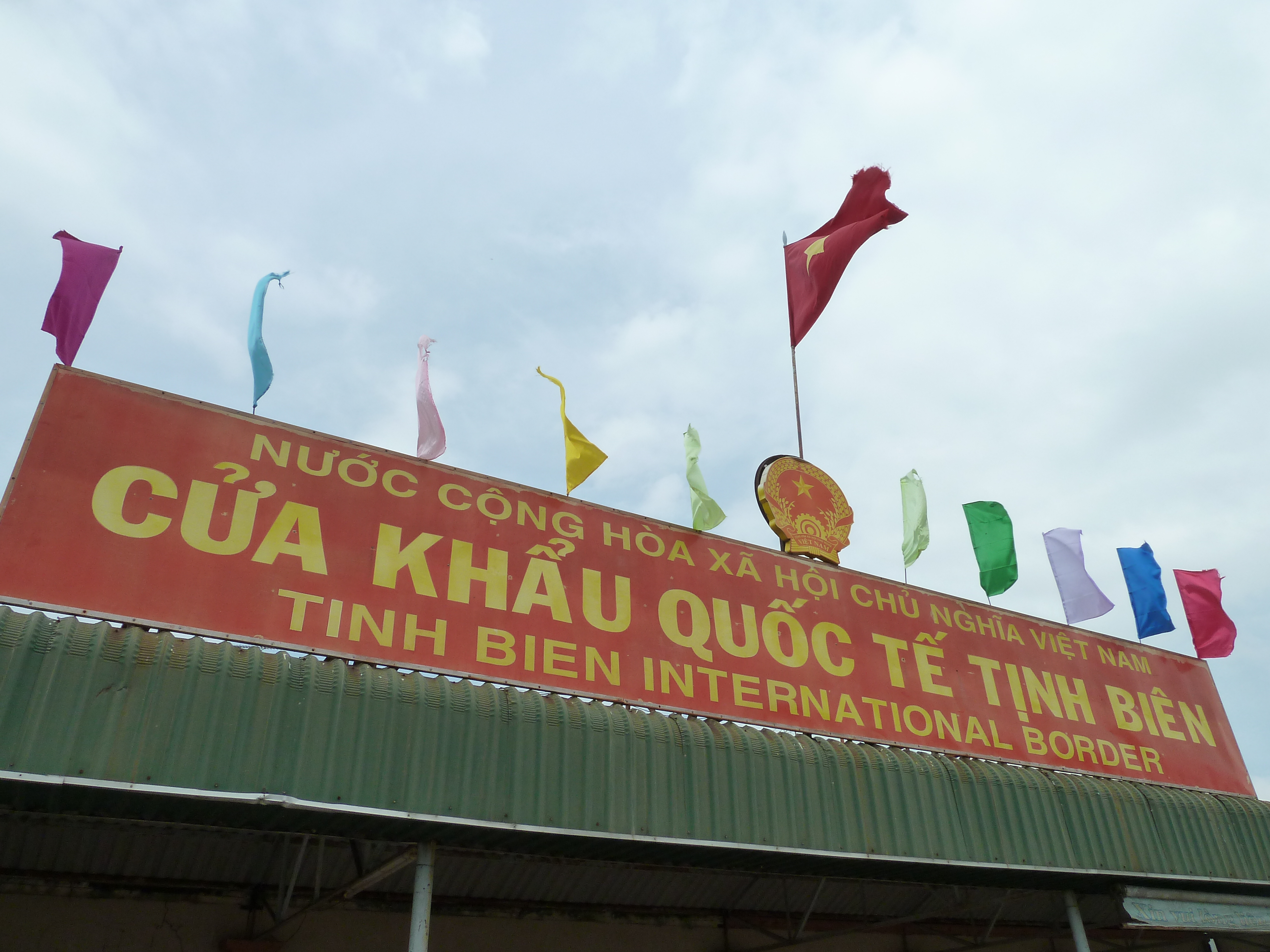
We were still pulling strands of stringy pork from our teeth when we arrived at the Cambodia-Vietnam border, where we had to get off the bus, grab our bags and walk through no-mans land to the other side. Its always a strange feeling walking through a border – a few steps taking you from one country into another – but its my fourth such crossing in a month now and you get used to the practice.

Crossing the Cambodia/Vietnam border

A few Cambodian flags and a border control post marked the end of my stay in a fascinating country, while teams of police and dozens of red, star-emblazoned Vietnam flags marked the start of almost two weeks in this communist land.

Welcome to 'Nam!

It marked the start of a noticeable fascination with motorbikes in quite a spectacular way. There was a steady stream of riders making their way through the border having loaded an almost unbelievable amount onto two wheels. In some cases you could hear the tiny engine struggling with the weight, as the hapless rider struggled to keep balance. Many smiled as we took photographs of them. Their main load was empty rice sacks, heading back to the paddy fields and drying sites to be refilled.

Get the man a trailer!

It wasn’t long before the landscape changed again, and you could tell straight away that this was a richer and far more developed country. Its still poor by Western standards, but the wooden shacks changed into more developed, permanent buildings.

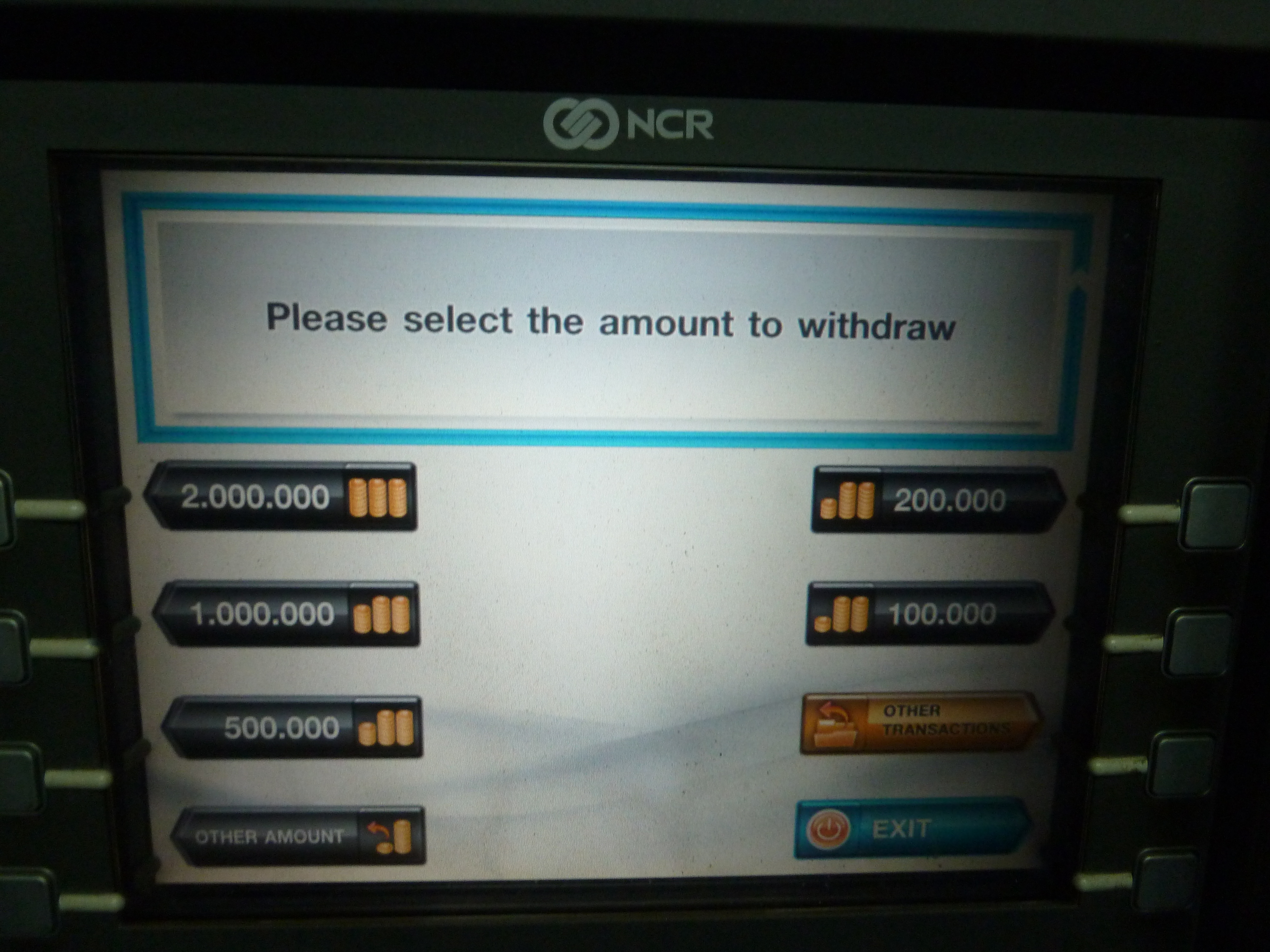
After a long day of travelling, we stopped for the night in Chau Doc, providing an opportunity to look around the local market and get our heads around yet another currency, with another comedy name. The Vietnamese Dong takes some getting used to – theres 32,000 of them to the pound, but most prices are worked out for comparison in US Dollars. Its my seventh currency to use within a month, and its taking its toll – I’m bad at maths anyway, but even buying a can of Coke results in a tough mental arithmetic test these days! I did become a double millionaire though – with yet another Deal or No Deal-style option list on the ATM screen, I took out two million Dongs – about £62.

Thankyou Mr Banker but...No Deal

It was another long slog to Ho Chi Minh City, or Saigon to give it its historical name.

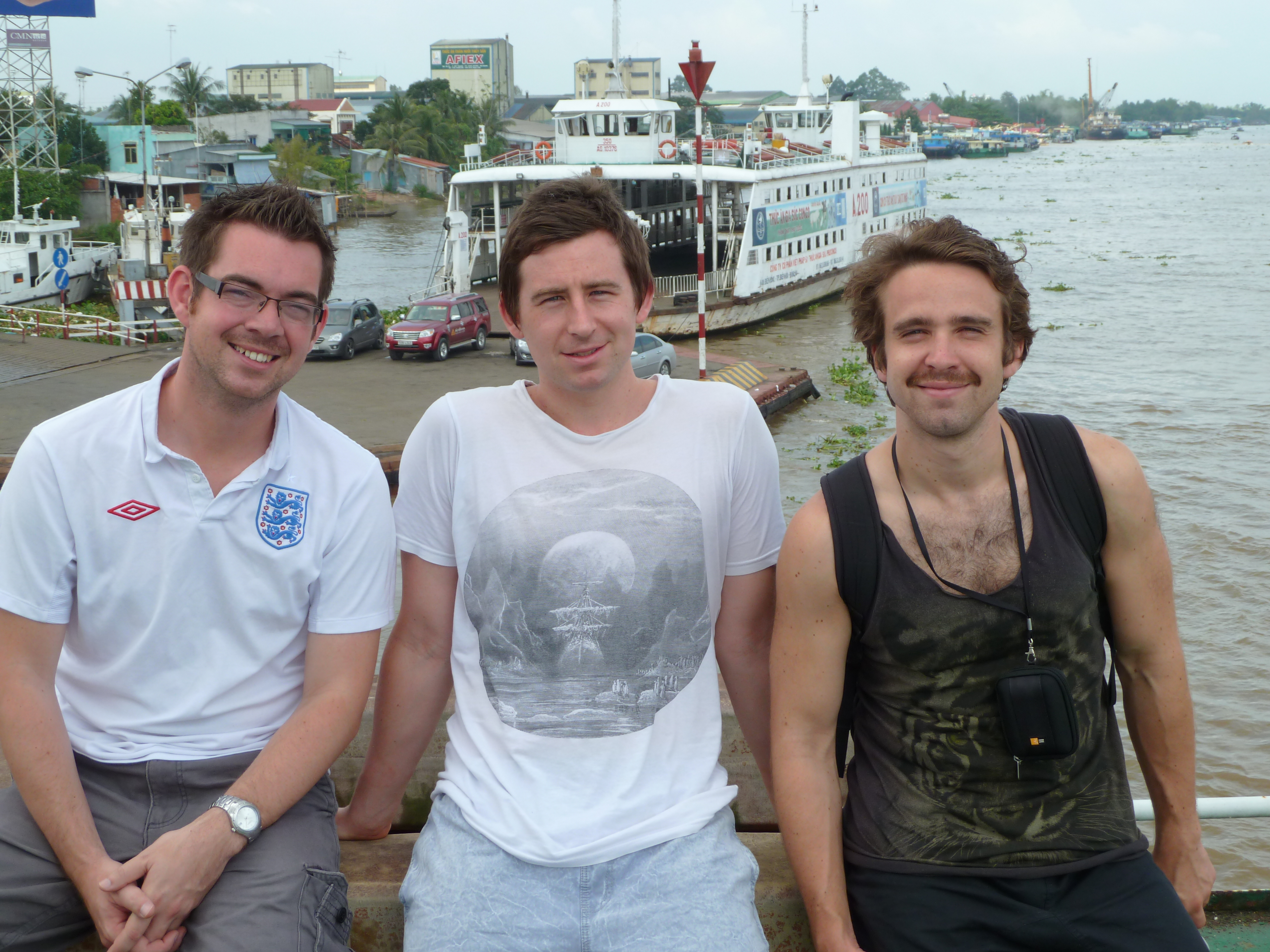
Waiting for the ferry

An eight our drive broken up by a few stops and a river crossing on a ferry. It was an interesting trip across the river, mainly dominated by an impromptu catwalk display from Asata, our American companion who went all New York on us with her struts up and down the top deck of the ship. Nobody quite knew why, or what prompted it, but it was entertaining all the same!


With John and Ricardo on the ferry

The ferry was full of locals, mainly attached to mopeds and scooters. They may be the transport of choice around here, but it was fun to watch them trying to brave the drop and gap over the water from the ship’s ramp onto the shore.

A few hours later we arrived in Saigon. For me it was my first major stop in the country, but for some it was the end of their trip. My 30-day tour is broken down into week-long sections, so for Aussie John, New Yorker Assata, Scottish Darren and Londoner Louise, the two days here would be the last we’d spend with them.

As we arrived late in the afternoon, there wasn’t chance to do much before dinner, so a few of us browsed around the local market. To get there you had to cross about four major roads. Normally, that’s not a problem, but when there’s no observed pedestrian crossings, and a city where motorbikes are the main transport for its population, crossing the road becomes an unnerving challenge for Westerners.

Help!

The advice we’d been given was not to look or listen, and to just walk across –  the general idea being that everyone else will see you and work around you by anticipating your walk. They get on their way, you reach the other side of the road.  The golden rule is not to stop, as that just confuses everyone and causes chaos.

Putting that into practice is not easy – it goes against everything you ever learnt with the Green Cross Code, and laughs in the face of almost every human instinct programmed into us to avoid instant death. But it seems to work.

Stepping into free-flowing motorbike traffic, flying past at up to 30 mph, is a strange feeling. Horns beep, occasionally people shout, but it’s the only way to cross roads. After a while you get used to it, the only unnerving part being on the odd occasion when you look up at dozens of faces and mopeds heading straight at you when you’re in the middle of the road. Somehow, and its down to millimetres at times, everything manages to miss you, and miss each other!

Two wheels rule the roads here!

We reached the market to find a lot of bargains – this is definitely the place to come for cheap clothes and labels, particularly if you need a new rucksack. North Face bags can be had for as little as a fiver, and they are not necessarily fake. I’m currently using one I got in Thailand earlier in the year, and its holding up very well and excellent quality. Many of the labelled goods are made in factories nearby, and the theory is that many of them with small imperfections, or even excess stock, gets released to the locals to sell on.

Farewell meal in Ho Chi Minh City

That night was changeover night, so we met our next tour buddies and had to give those leaving a good send-off. Two of them had become really good friends – fellow journo John from Australia, and London auction house valuer Louise.

With Verena (right) sending Louise (left) back home with a few vodkas!

Louise was only on a week long trip, but told me she’s reached a point where she wants to travel more, afraid she’d look back and regret not doing more. It’s a similar thought to my own, and it wasn’t the only thing we had in common – it turned out we were both at Southampton Institute together, and even in the same faculty group!

For three years, I was studying Journalism and Louise was studying Fine Arts Valuation, culminating in us both graduating on the same day and at the same ceremony. For much of those three years, we would have been in neighbouring classrooms, as many of our classes were in the same building. We probably passed each other many times in corridors, unaware that in ten years time the paths of our respective lives would cross again thousands of miles away from home.

Sending John back to Oz

John was also on a short trip, having had time off from work but unable to travel anywhere with his girlfriend at the same time. He’s one of life’s good guys, giving and taking great banter, able to lift a mood when its needed, and able to pull off some of the best impressions of people on the tour, including our lovely leader Fon. We knew we’d all miss the British/Australian banter, and we made sure we gave him a good send off. We ended up in some bars around Ho Chi Minh, watching a bit of live Premier League football between Manchester City and Newcastle, drinking cheap Saigon beer and having plenty of laughs.

So many, that my 5am arrival back at the hotel ensured my next day tour was written off, but it turned out that the following day had some great highlights.

John, Alissa and Ricky and respective cyclos!

With a raging hangover thirst, and the need for something other than rice or noodles, we headed to Pizza Hut. John pulled off some of the best impressions yet, that had Ricky, Alissa and I laughing so hard we were very nearly on the floor. Particularly funny was his line “I am not bus company,” referring to Fon’s explanation that we couldn’t be late for the bus as it wont wait for us. His breakdown of breakfast and pricing, complete with hand movements, was exceptional.

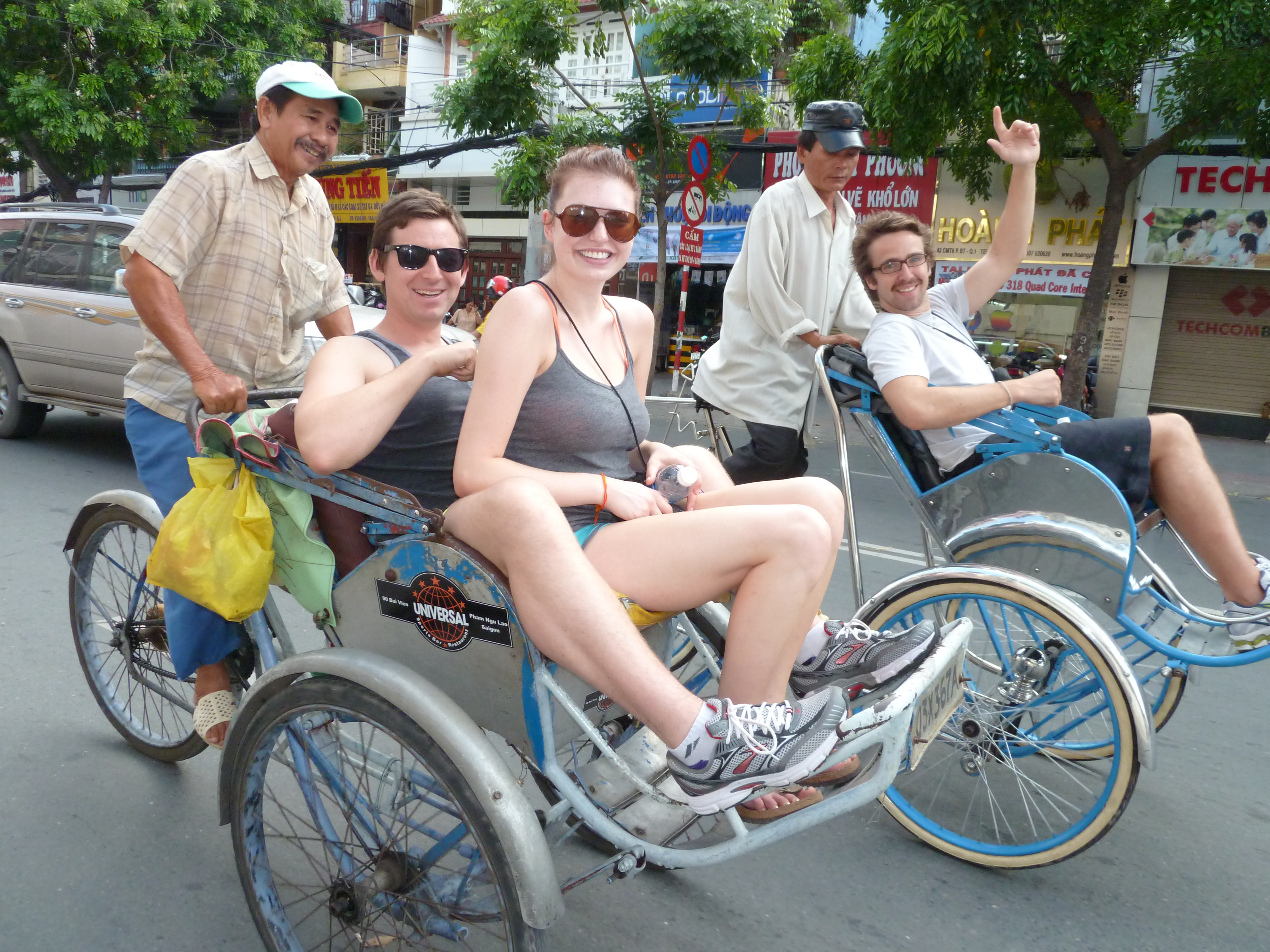
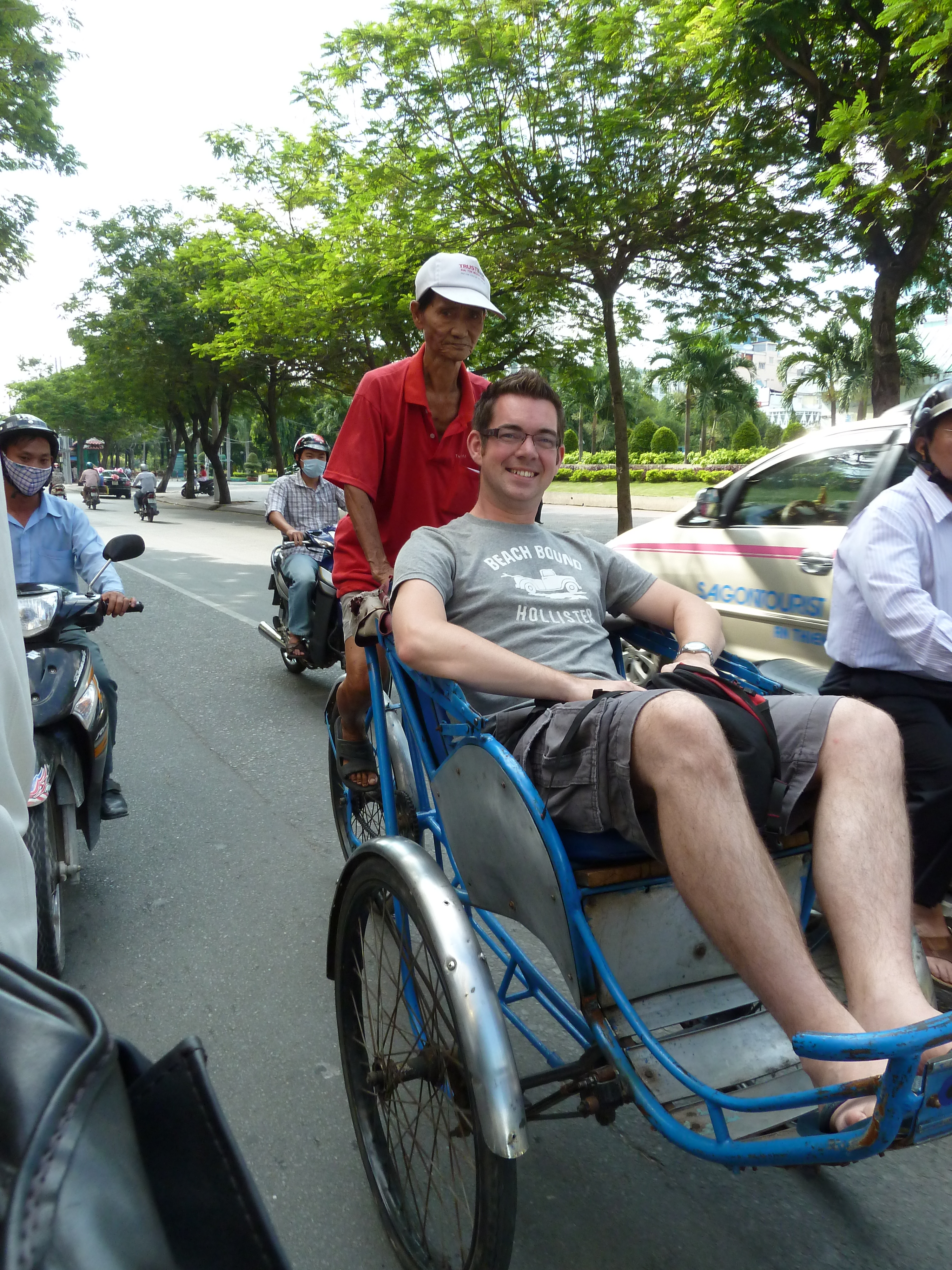
Hangovers cleared, we needed to get to the war museum to meet the rest of the tour group. We decided to take some of the cyclos, a kind of bike with a pram-style basket on the front that you sit in. It’s a taxi service, and proved to be one of the best decisions of our stay in the city.


A great way to travel!

John got placed with Alissa, while Ricky and I got given our own, and soon we were weaving around all over the roads and through the thousands of motorbikes that make this city such brilliant fun. It took about 20 minutes and the equivalent of just under £2 each for the ride, but it was money well spent. The laughs continued, and it was a brilliant way to see the city.

War Remnants Museum

The laughs soon stopped at the War Remnants museum however, a collection of photographs, images and stories about the Vietnam War and the effects caused by some of the American weapons used on the Vietnamese people.

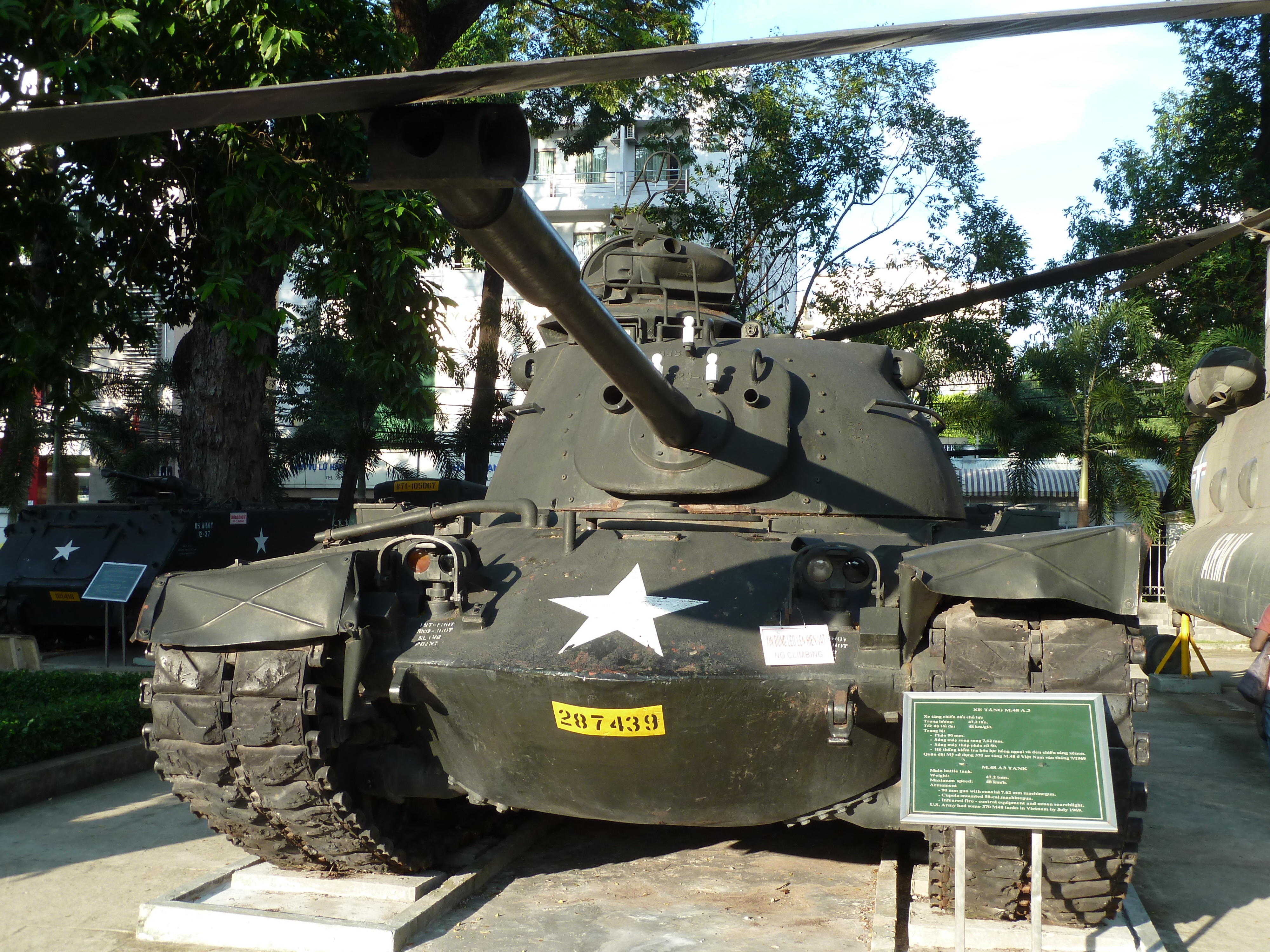
Captured US tank

I had no idea just how much damage is still caused by some of the poisons dropped on the country, particularly Agent Orange. Some of the photographs of people and children still being affected, or born disfigured as a result, were particularly hard to look at. So too were the images of war and some of the stories of what happened to whole villages under American fire.

American bomb and shell fragments

There were collections of crash wreckage, bomb fragments, guns and mines which were left behind by the fighting, while the outside area is dominated by aircraft and tanks that belonged to the States.

A goodbye from Louise and Darren as we leave them behind

Before long, it was time to say our goodbyes to the rest of the group that was leaving as we headed to the main railway station for an overnight train to Nha Trang. It was sad to leave our friends behind as the bus continued on without them, but we shared some great times together and good friendships were made. I’d like to think we’ll meet up again sometime, and Ive already promised John a pint in Melbourne when I arrive.

On a train again at Saigon station

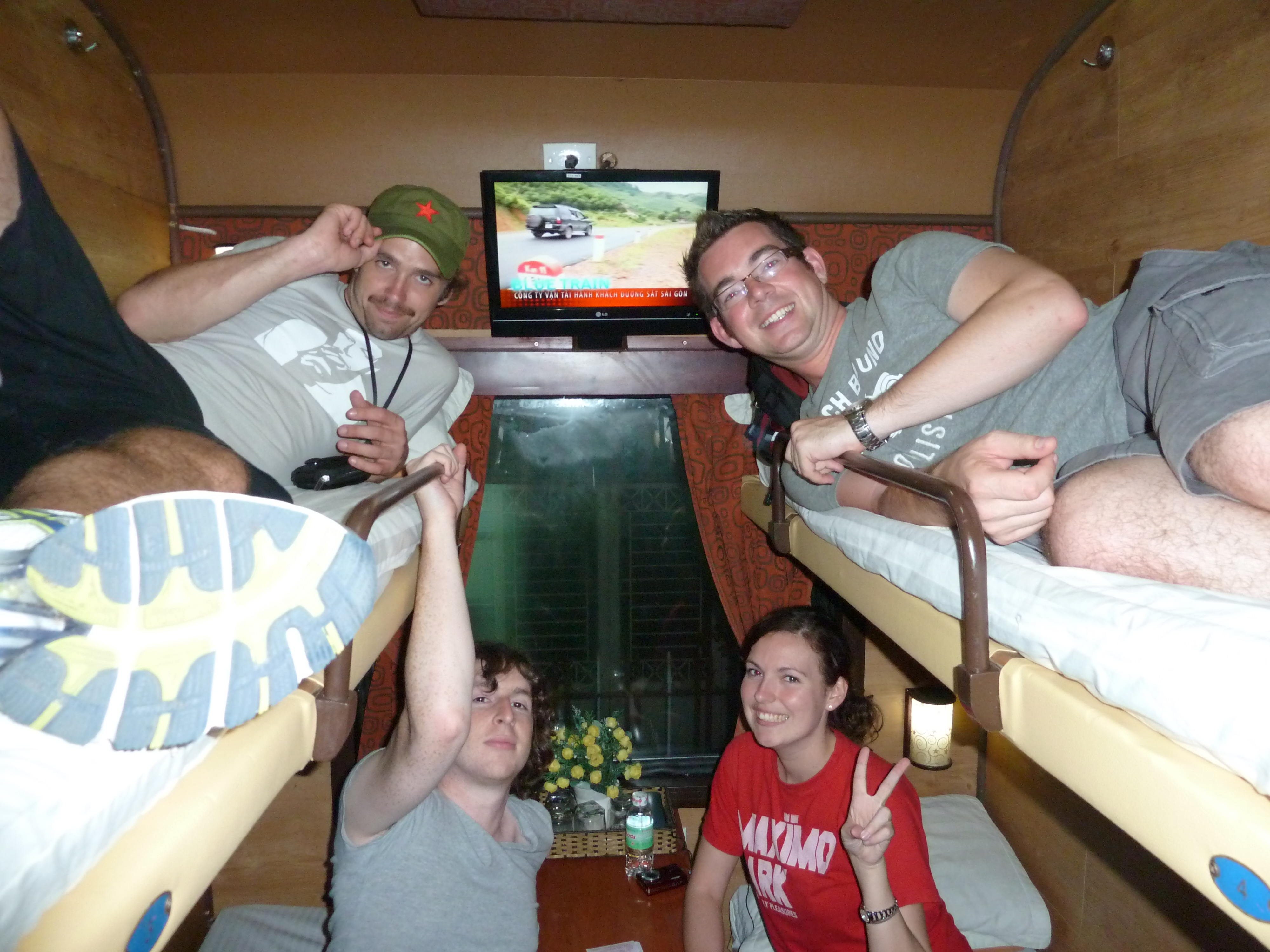
That night we were on the train to the coast once again, sharing a compartment with Colin, Sarah and Malcolm. We raised a beer in tribute to those who had left, and looked forward to the next part of the trip with some new friends in tow.

With Ricky, Colin and Sarah on the train


The Killing Fields, Cambodia

When you look around in Cambodia, there are very few old people. There’s a reason for that – just outside my lifetime, almost half of the population was wiped out by the Khmer Rouge.

It’s a staggering fact. The population dropped from more than seven million people to three million people as communist Pol Pot and his army systematically murdered the middle classes in the mid 1970s. Anyone who was educated, who could possibly question him and his regime, was sent to one of hundreds of killing sites and buried in one of more than 10,000 mass graves.

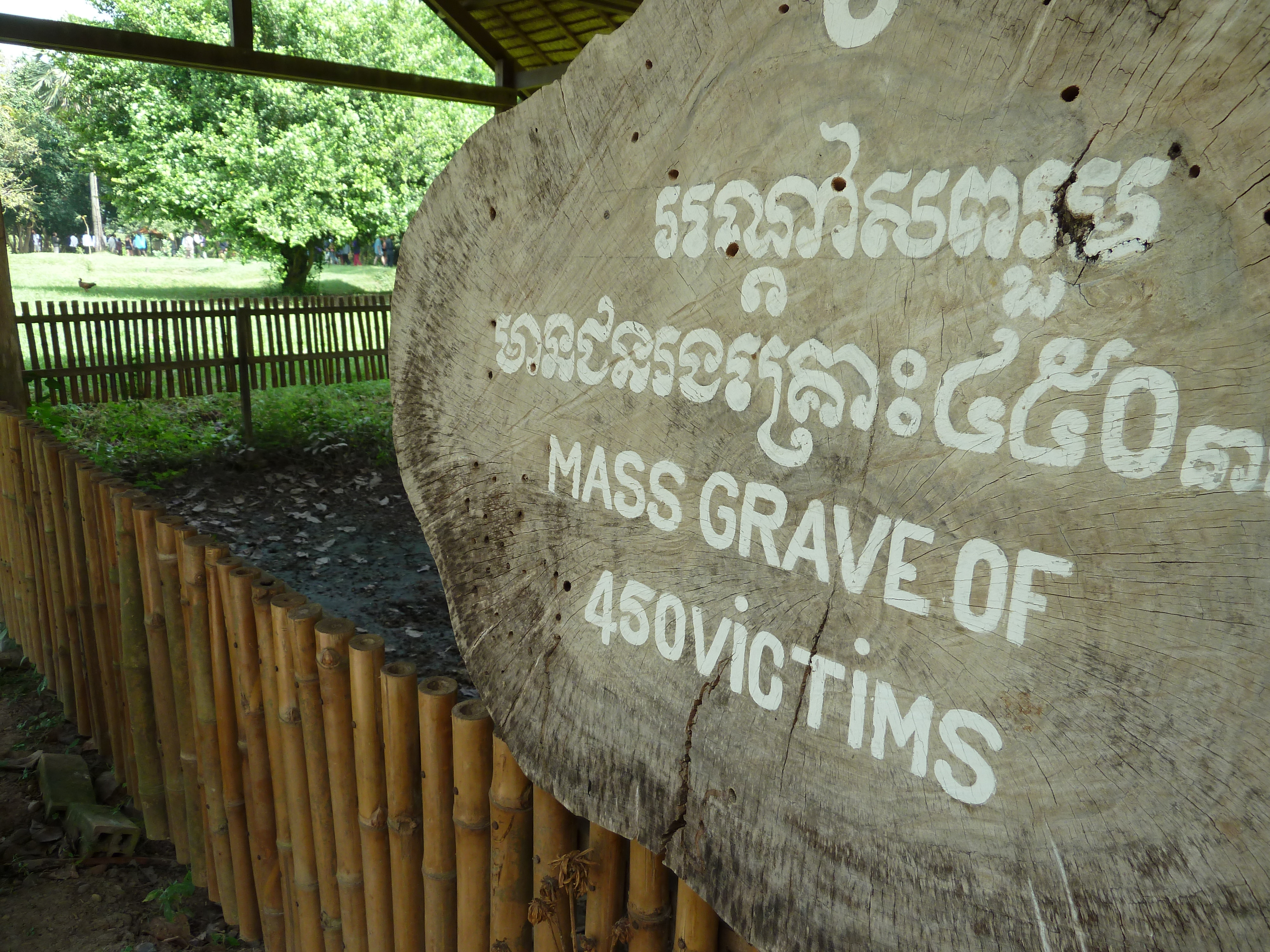
Mass graves near Phnom Penh

I knew a bit about what happened – I remember hearing about the Khmer Rouge and Pol Pot on the news as a kid, but I had no idea about the full scale of the genocide, how many people were killed, the reasons why or the brutality behind it.

The visit to Cambodia’s killing fields, and the capital’s main prison, was harrowing.

One of the reasons for travelling is to broaden the mind and to educate, and today that certainly was the case. I knew it wasn’t going to be a day by the seaside, but its hard to fully prepare for what you are about to learn about and see.

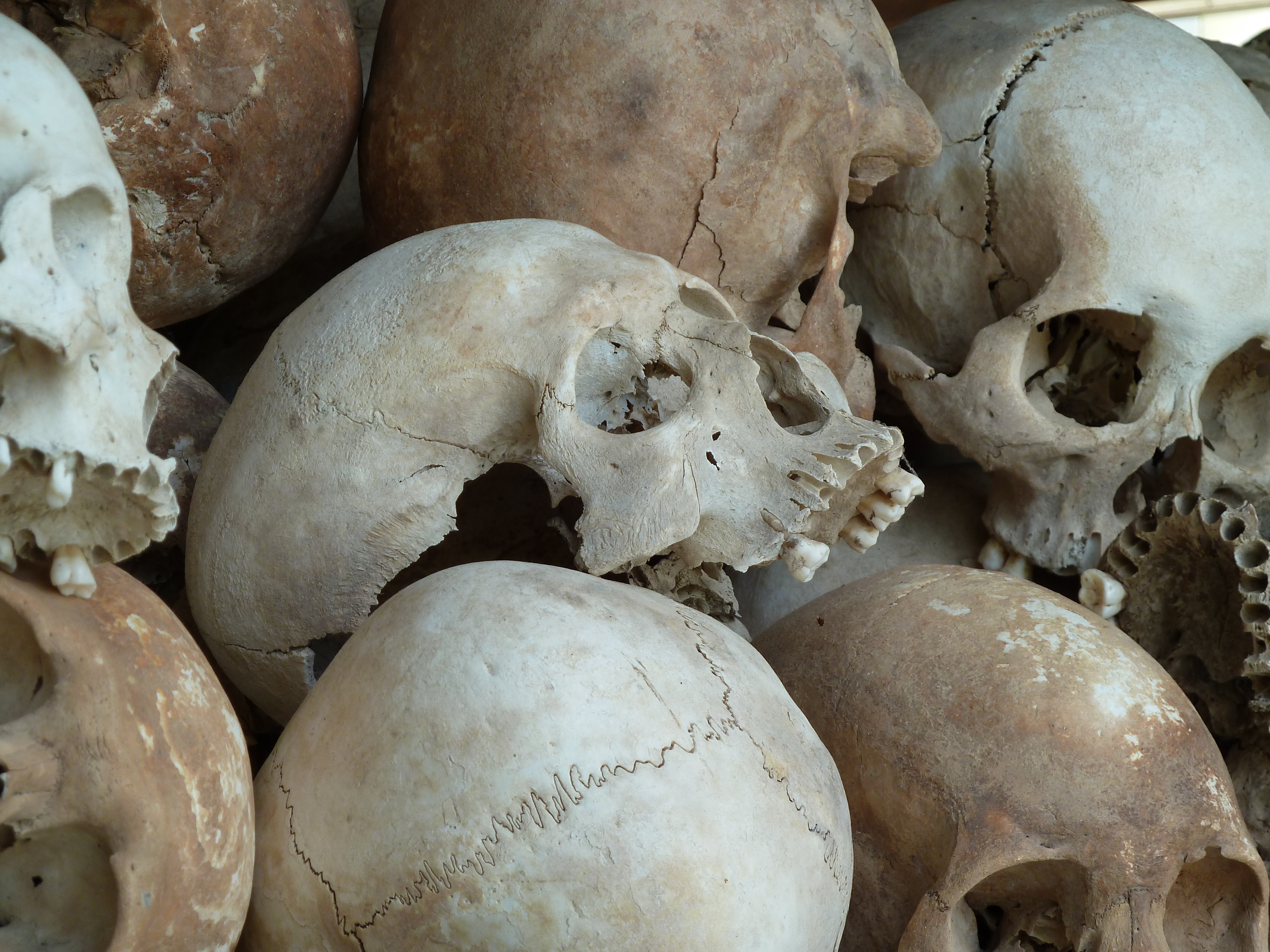
Some of the tour group had decided to miss the visit having heard about how gruesome it can be – after all, the main memorial to those who died is a monument filled with the skulls of those whose bodies were found in the grave.

For me, learning about atrocities and what happened in the past is important, nomatter how hard it can be to take in. I visited the D-Day beaches in Normandy last year, and struggled to take in the utter waste of life caused by war on the sand in front of me. I had a similar feeling in Cambodia, except these were not people who were fighting for a cause – they were completely innocent people, who shared a similar will to live a normal life like me, but yet were dragged from their homes and murdered for no reason other than they’d tried to give themselves a better life through education and work.

Skulls of victims in the memorial

Pol Pot’s regime aimed to bring a single class to Cambodia – city dwellers were sent or forced from their homes to work the fields in the countryside. Nobody was allowed more than just a few grains of rice a day. Khmer Rouge soldiers patrolled and killed anyone who breached rules.

We travelled to Choeung Ek – one of the sites chillingly known as the Killing Fields – and our guide was a man who was born during the regime. His father and brother were killed by the Khmer Rouge, while his sister died of disease due to the poor conditions in the country. All the doctors had been killed as they were educated, and so healthcare was non-existent.

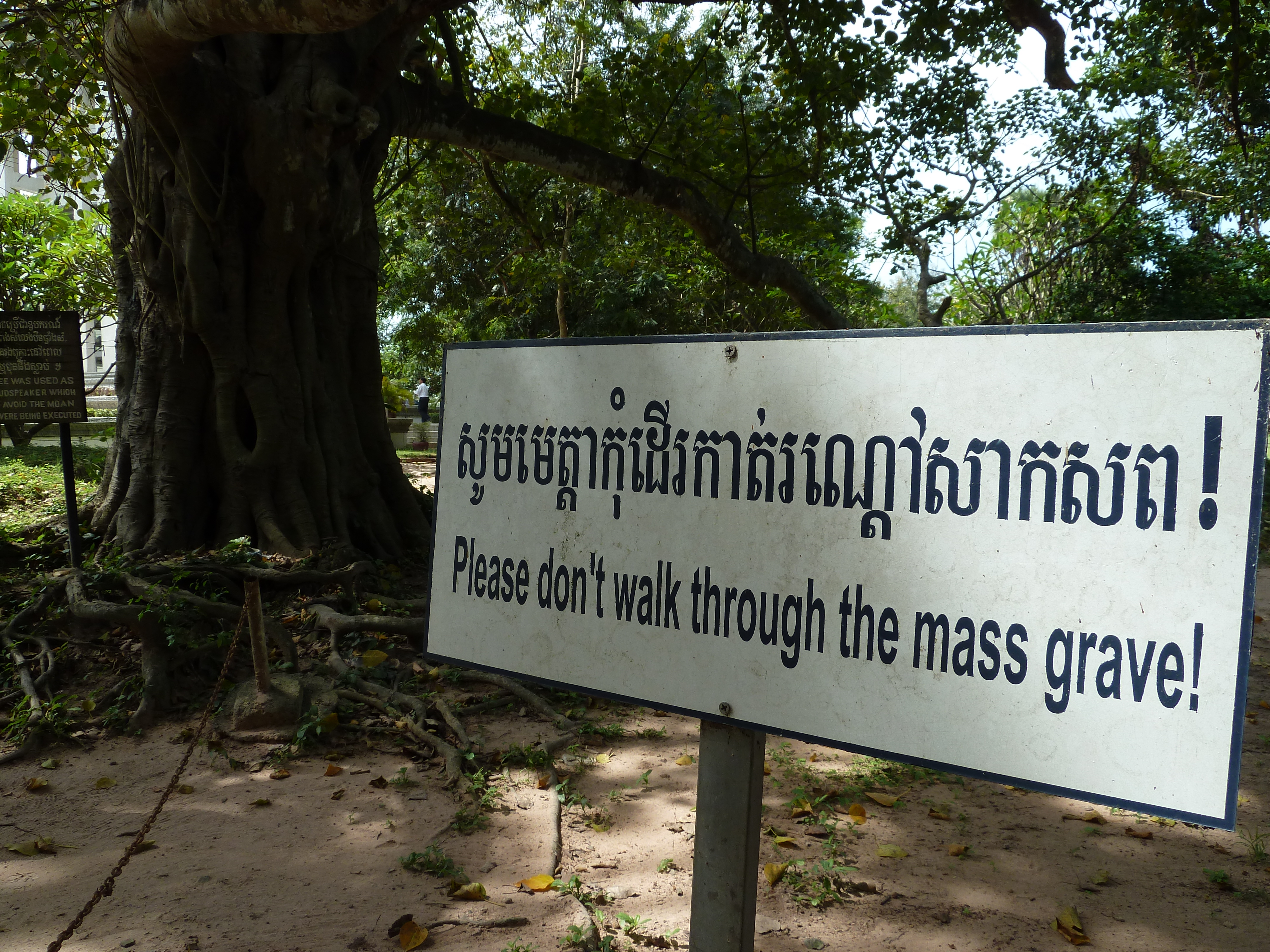
The site is one of the main memorials to the more than 1.7million people who were murdered – and its also one of the main mass grave sites. There are still hundreds of bodies buried beneath the soil, while thousands more have been exhumed.

We stood by one of the largest graves where blindfolded prisoners were led to, tied around the necks with rope to prevent them running away, hands tied, before being told to kneel, bow their heads and sing along to patriotic Khmer Rouge propaganda songs blaring from loudspeakers. One by one, they were hit over the back of the head with axe handles or spades – to save ammunition – while razor sharp palm branches were used as spears and knives to ensure any signs of remaining life were snubbed out.

It was truly barbaric. Our guide, despite doing this tour probably hundreds of times, took no pleasure from relaying to us what happened. Instead, he’s just glad that people will go and listen to him. The Cambodian government actively encourages tourists to visit the sites, learn about what happened and take photographs. It ensures the outside world is reminded of the atrocities committed here.

“I warn you, you may find some bones or teeth on the ground, still coming up from below, but don’t worry, you don’t need to feel bad about walking over them,” our guide tells us.

“Those who died, and their spirits, are just glad you have come to remember them and to tell others of their loss,”

Many of the group had a tear in the eye.

Teeth of victims still being uncovered

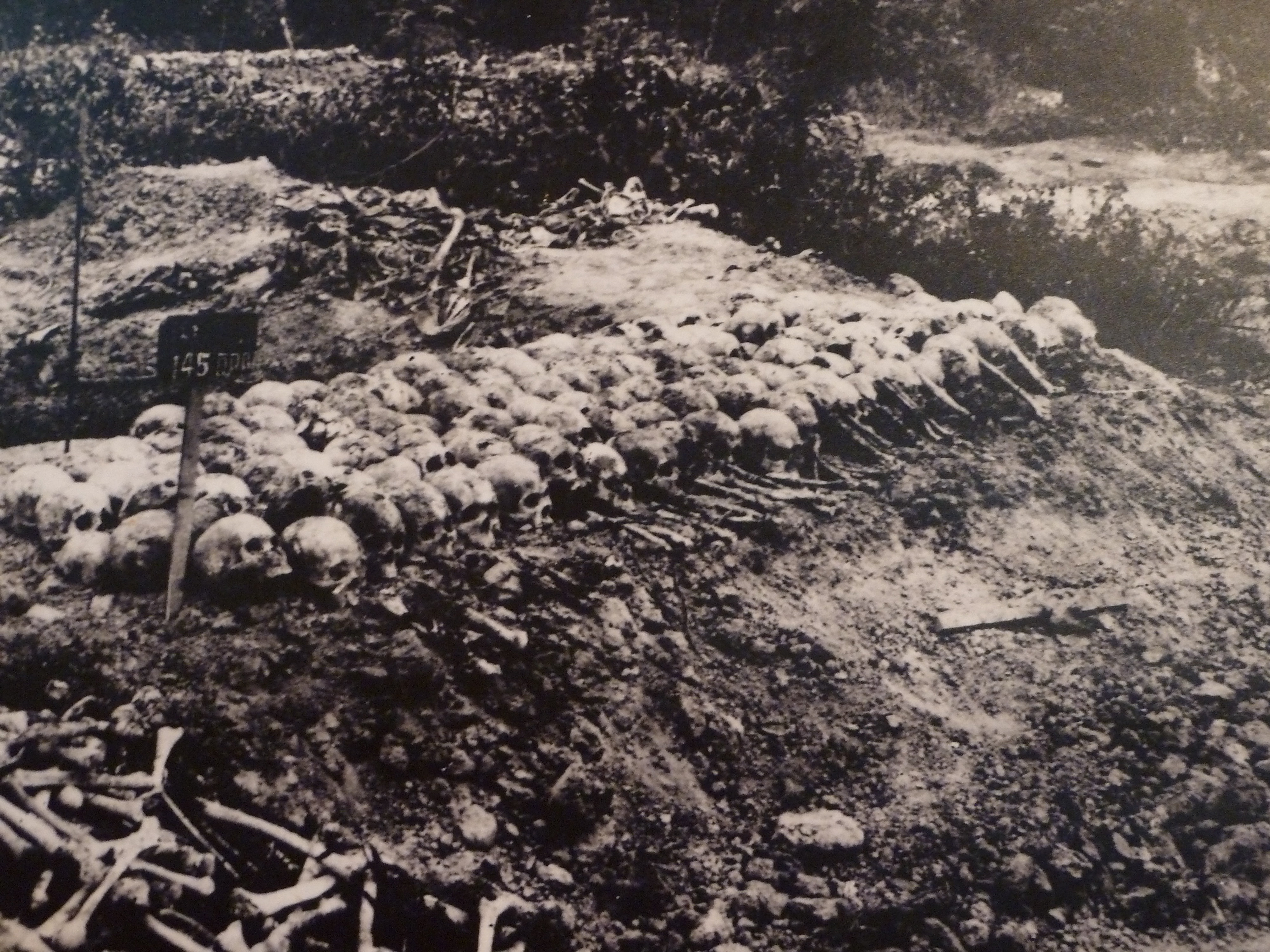
Sure enough, as you walk around the site, there are small piles of teeth and bone fragments, brought to the surface by heavy rains and flooding from the nearby river. The ground has hollows, dropping around three feet below the surface, where attempts have been made to recover bodies, but the simple fact is there are far too many here to fully recover them all.

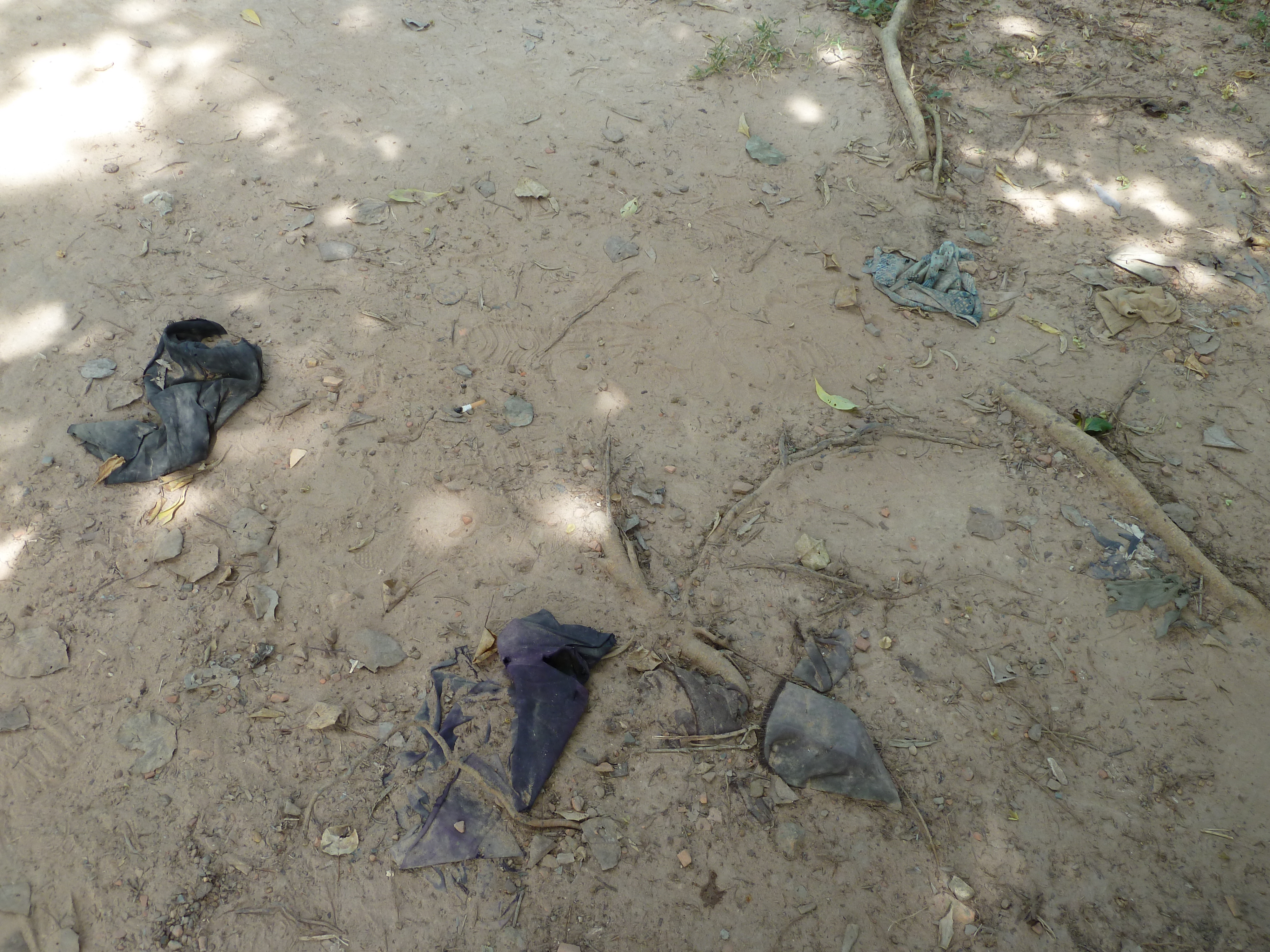
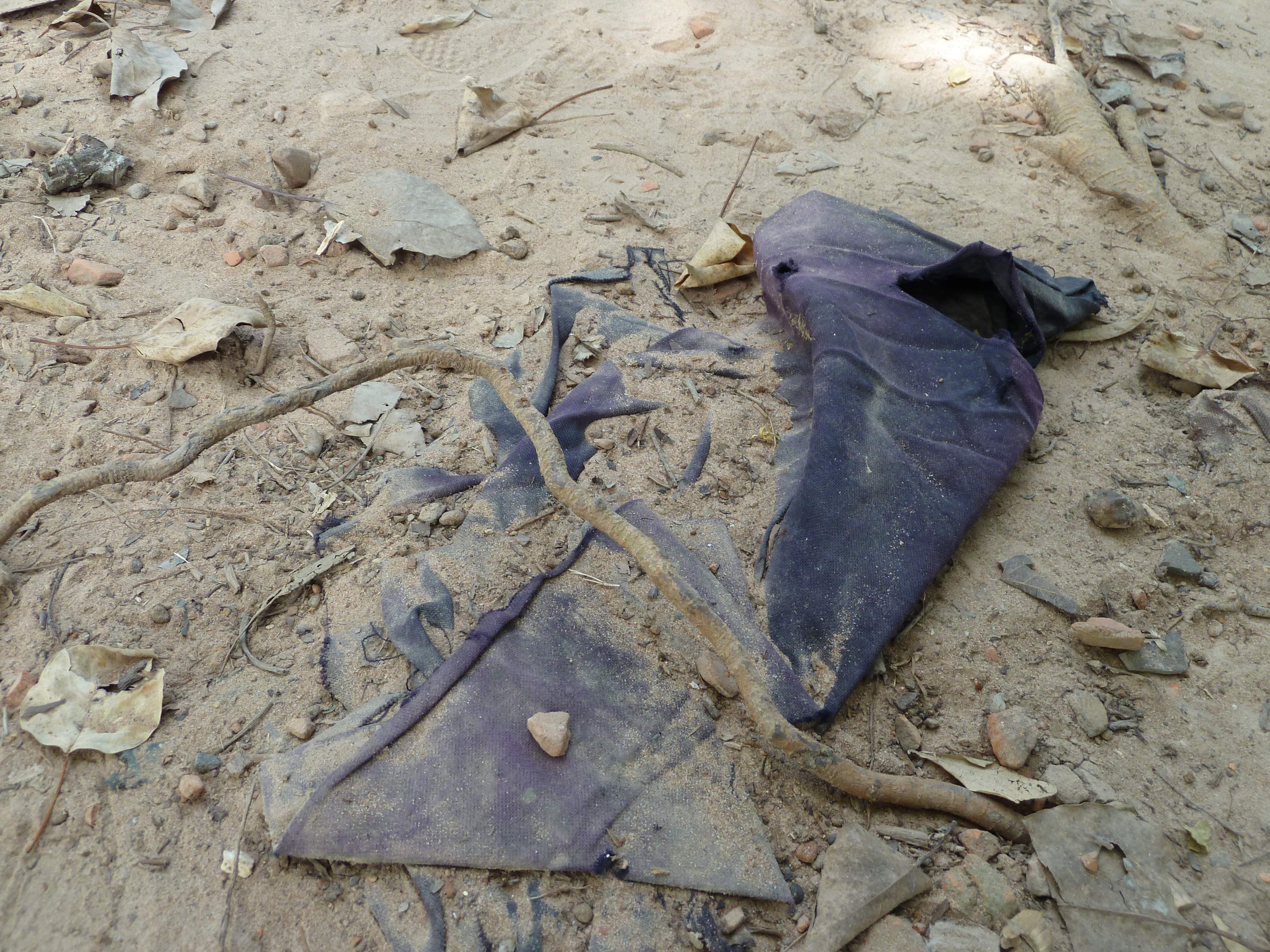
All around there is cloth and pieces of rag on the dusty surface. Its only when you look closer that you realise its not rubbish or old rags – they are victim’s clothes.

Victims' clothes

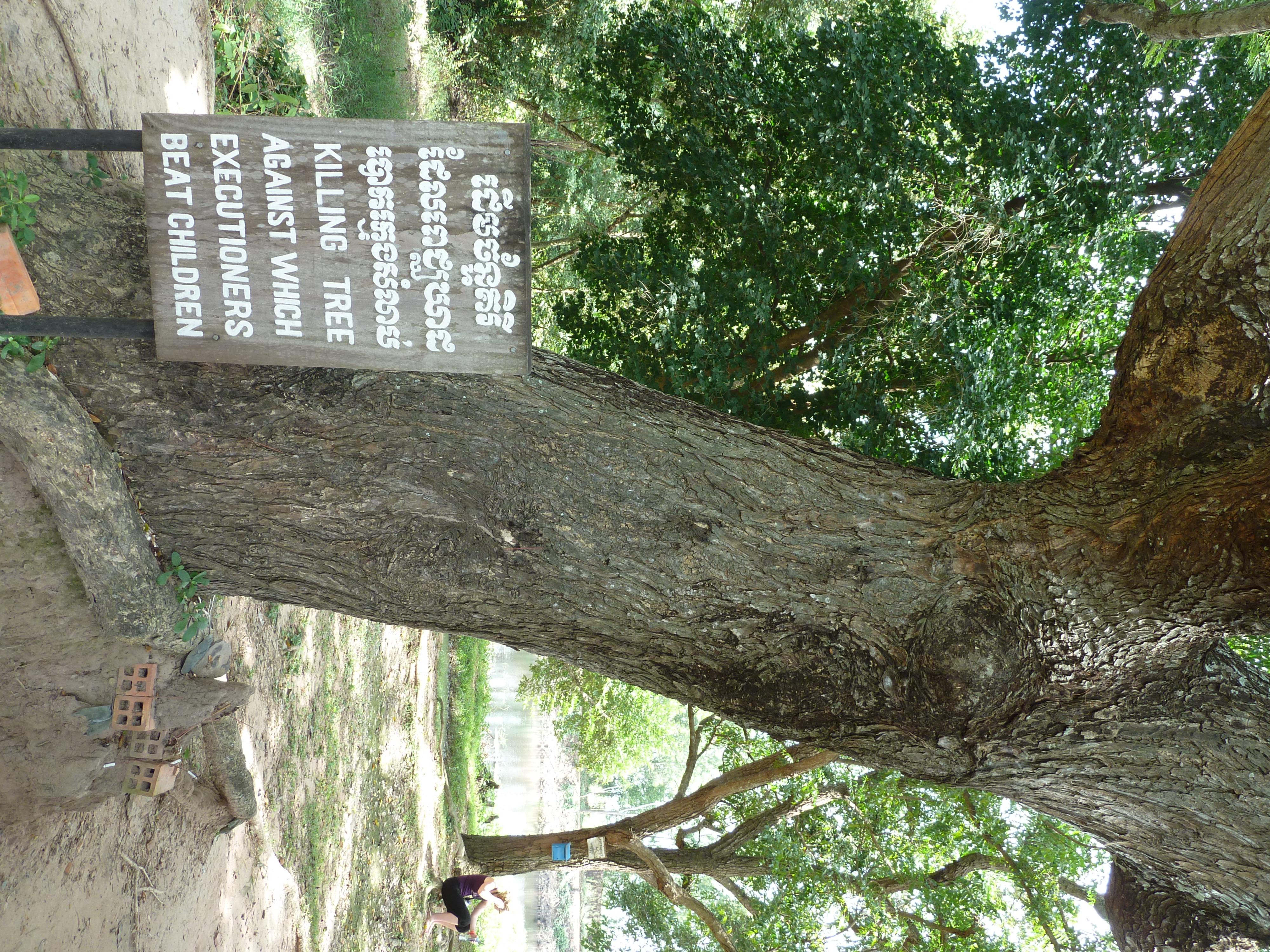
There was no escape from the Khmer Rouge – even babies were murdered, bludgeoned against a ‘killing tree’ that still stands next to their mothers’ mass grave. Their theory was it would prevent an uprising in late years when the angered children grow into adults and seek revenge for what happened to their parents.

It was the sort of place where you need to spend some time, even to sit in silence for a while, just to take in and appreciate the depths humanity can sink to.

Photograph showing the site being exhumed

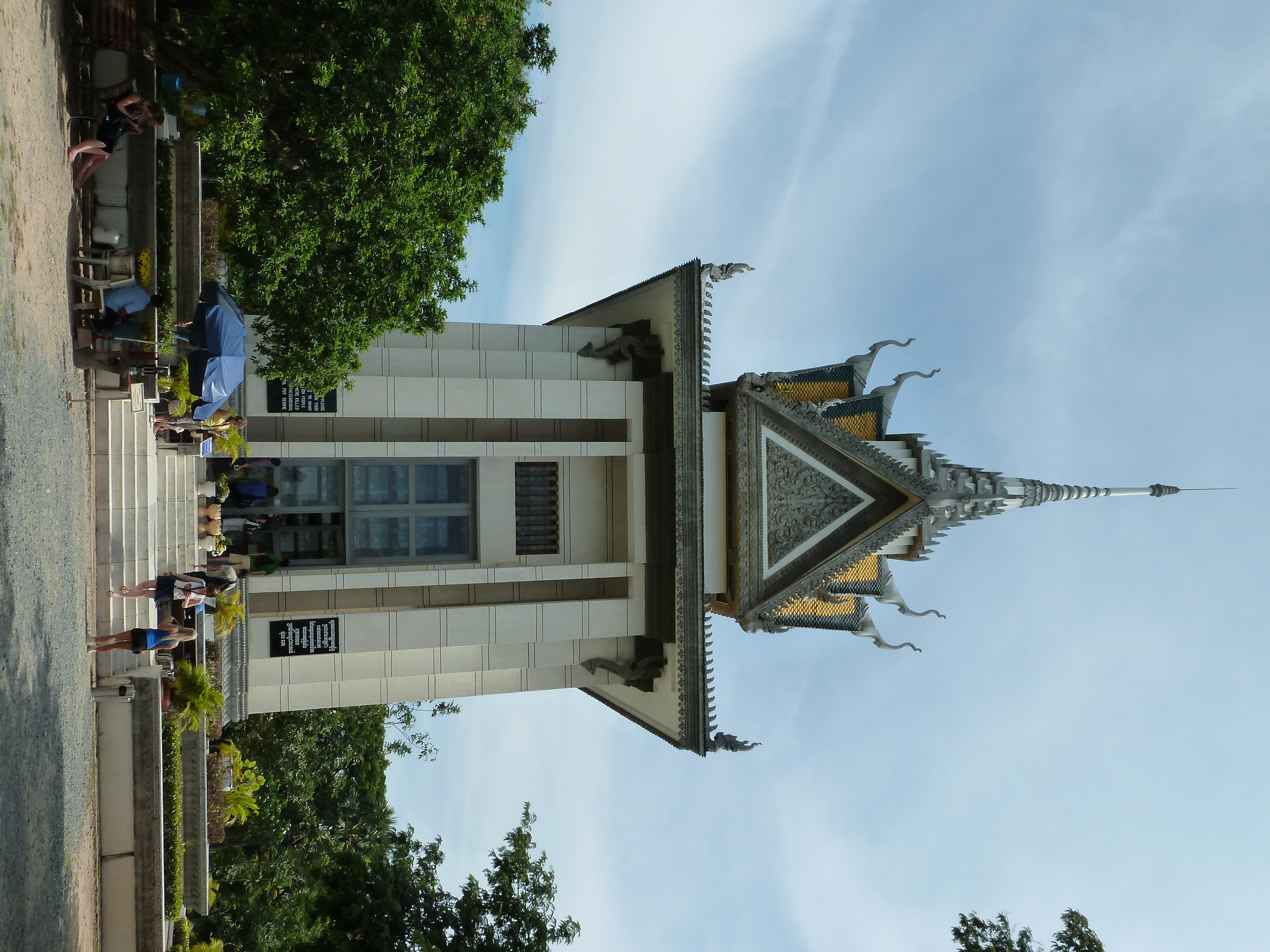
The walk around the graves ends at the memorial Stupa, filled with some 8,000 skulls of those whose bodies were recovered. They are arranged into groups – young women, older women, older men, children.

Memorial

Its always hard to explain how you feel at moments like that, looking at the remains of so many innocent people. Like any other decent human being, I felt anger and sadness at such a loss of life. There was almost a sense of guilt – that somehow you wanted to apologise for what other fellow humans had done to those whose skulls stare hauntingly back at you.

They are long since absent of eyes and features but yet somehow seem to be looking back at all of us who visit. I quietly paused and looked at some, trying to imagine what they may have looked like, the families they had, the jobs they did in this far flung land.

“Take photos, its important that people know,” one man said.

At just this one site, there are 129 communal graves. Only 86 of them have been exhumed, revealing the remains of 8,985 people who were exterminated here. Across Cambodia, almost two million people met their end at terrifying fields like this. It was hard to take in.

Sadly, our guide seemed to be in a bit of a hurry, and I was soon wishing I’d made my own way to the site to take it in at my own pace. Instead, we headed to Tuol Sleng, the main prison in the capital Phnom Penh, where most prisoners were taken by the Khmer Rouge before being murdered nearby.

Tuol Sleng prison

Until 1975, Tuol Svay Prey High School was filled with the sound of children and teachers. That was until Pol Pot’s henchmen turned it into Security Prison 21 (S21), the largest detention centre in the country. Between 1975 and 1978, more than 17,000 people were taken there and tortured before being sent to Choeung Ek. Those who died under their brutal treatment were buried in another mass grave at the site.

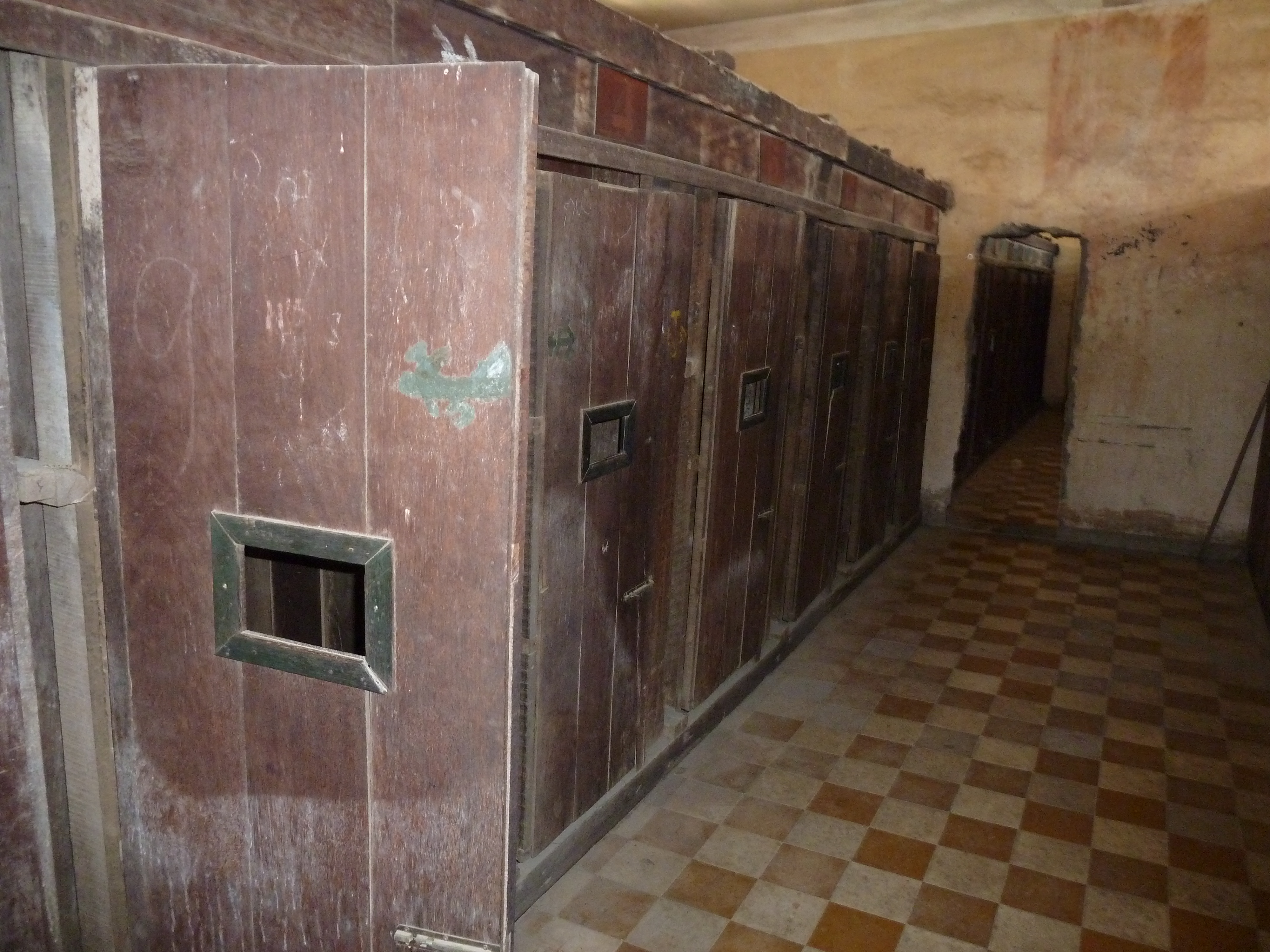
Small wooden cells

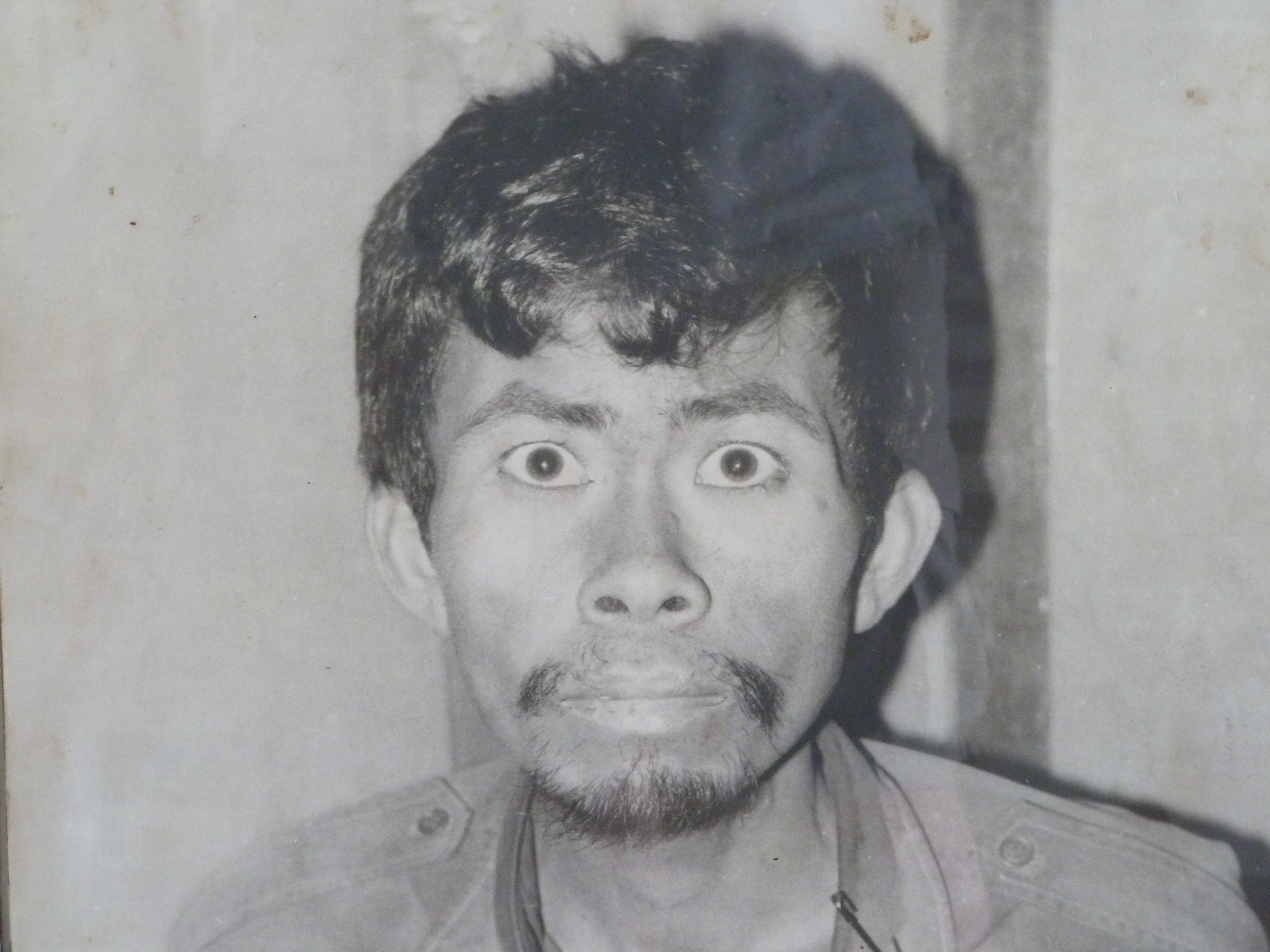
Every prisoner was photographed, and their images stare out from huge boards all around the site, in former classrooms that went on to see unimaginable horror. Many are photographed wearing a number – a tell-tale sign that they faced certain death within the next few hours.

Photographs of victims

One of the main questions I had about the regime was how it was allowed to happen – why the Cambodian people went along with such a horrific regime. The simple reason is that most, out in the countryside, had very little knowledge of the death camps. After years of civil war, they believed the Khmer Rouge would bring stability and peace, even celebrating when they first gained control of the capital. But it wasn’t long before many were sent for ‘re-education’, often duped into believing better jobs were on offer or that they had been headhunted by Khmer Rouge leaders because of their exceptional skills. Instead, they were being sent to prison, and ultimately, their deaths.

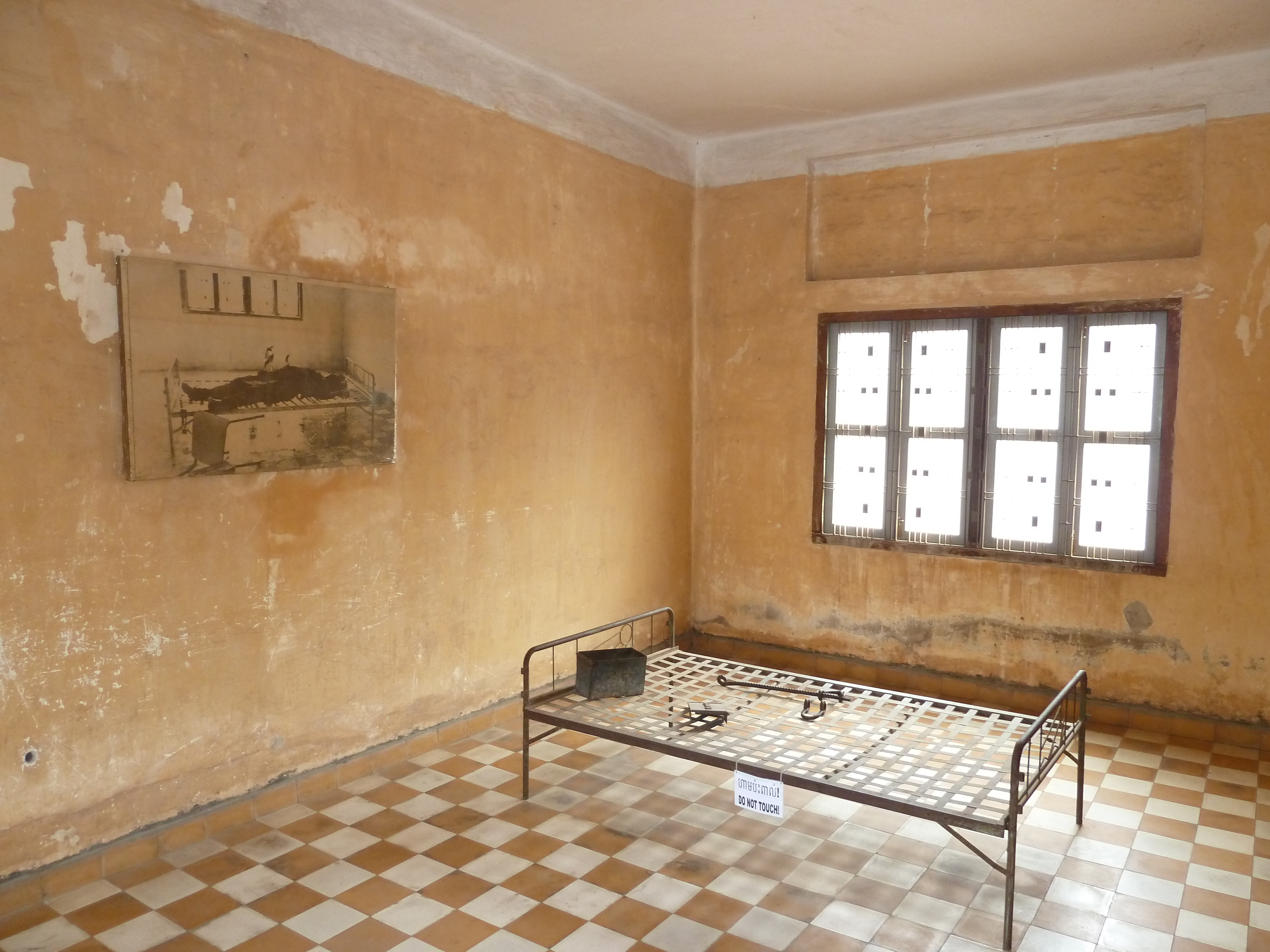
Torture cell and image of how it was found

The prison’s torture cells were particularly grim, having been left almost exactly as they were when the Khmer Rouge fled – often killing the inmates before leaving. Blood stains could still be seen on floors and ceilings, around the bed that an inmate was once strapped to.

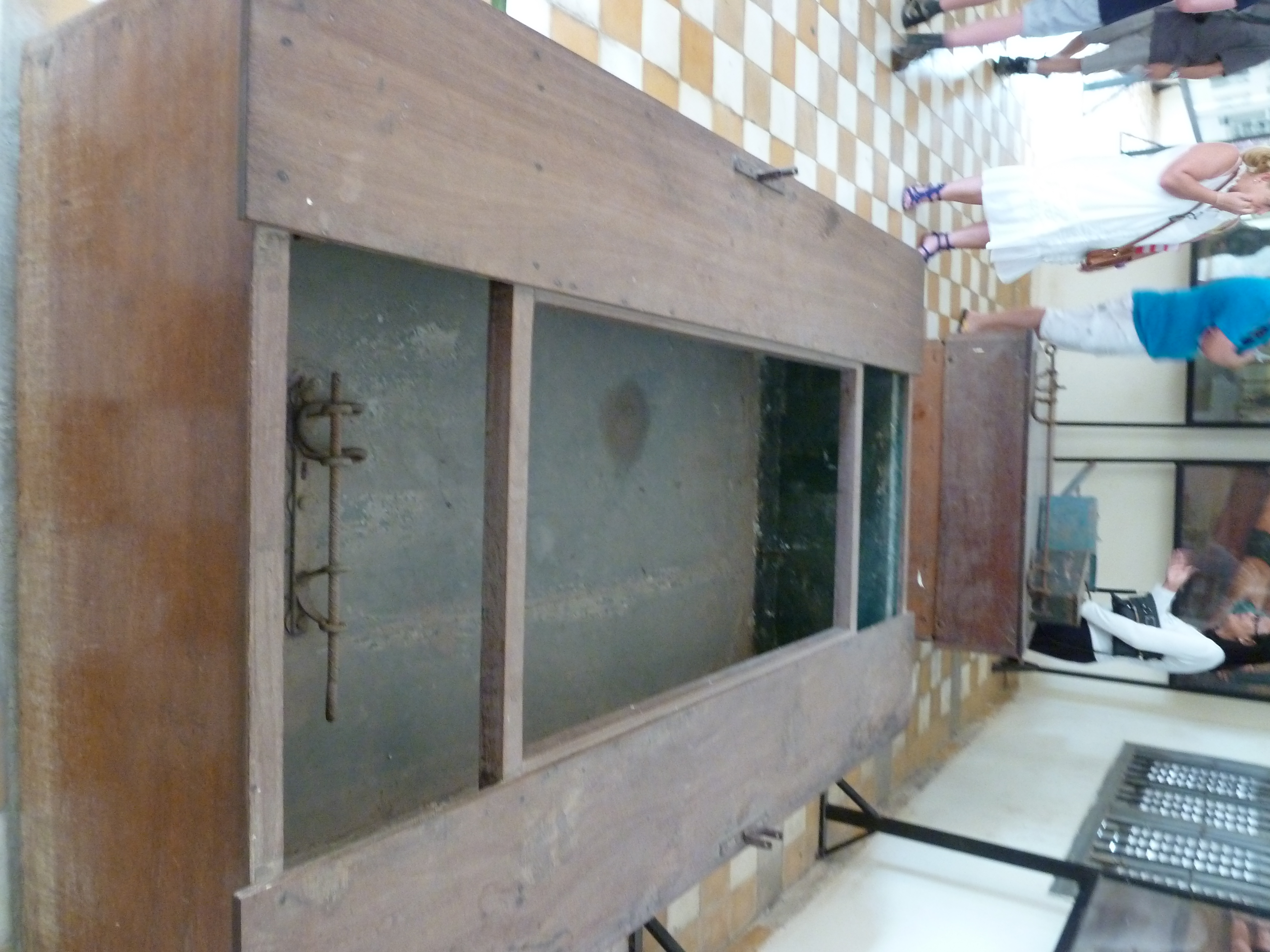
Water torture bath found at the prison

Elsewhere, the tools and machines of torture, such as a water torture bath and shackles and chains, were still in rooms surrounded by depictions of what life was like.

It was graphic, but it was also real life- something that happened just five years before I was born. With the Second World War, you visit sites and learn about what happened in the knowledge it was sixty or seventy years ago, and that history had supposedly learned lessons. Yet somehow, years after the Beatles had risen to fame and Concorde took to the sky, this horror took place. It wasn’t the first of its kind, and by no means the last, but it was worthwhile going to learn about it and gave me a fuller understanding of what happened and why.

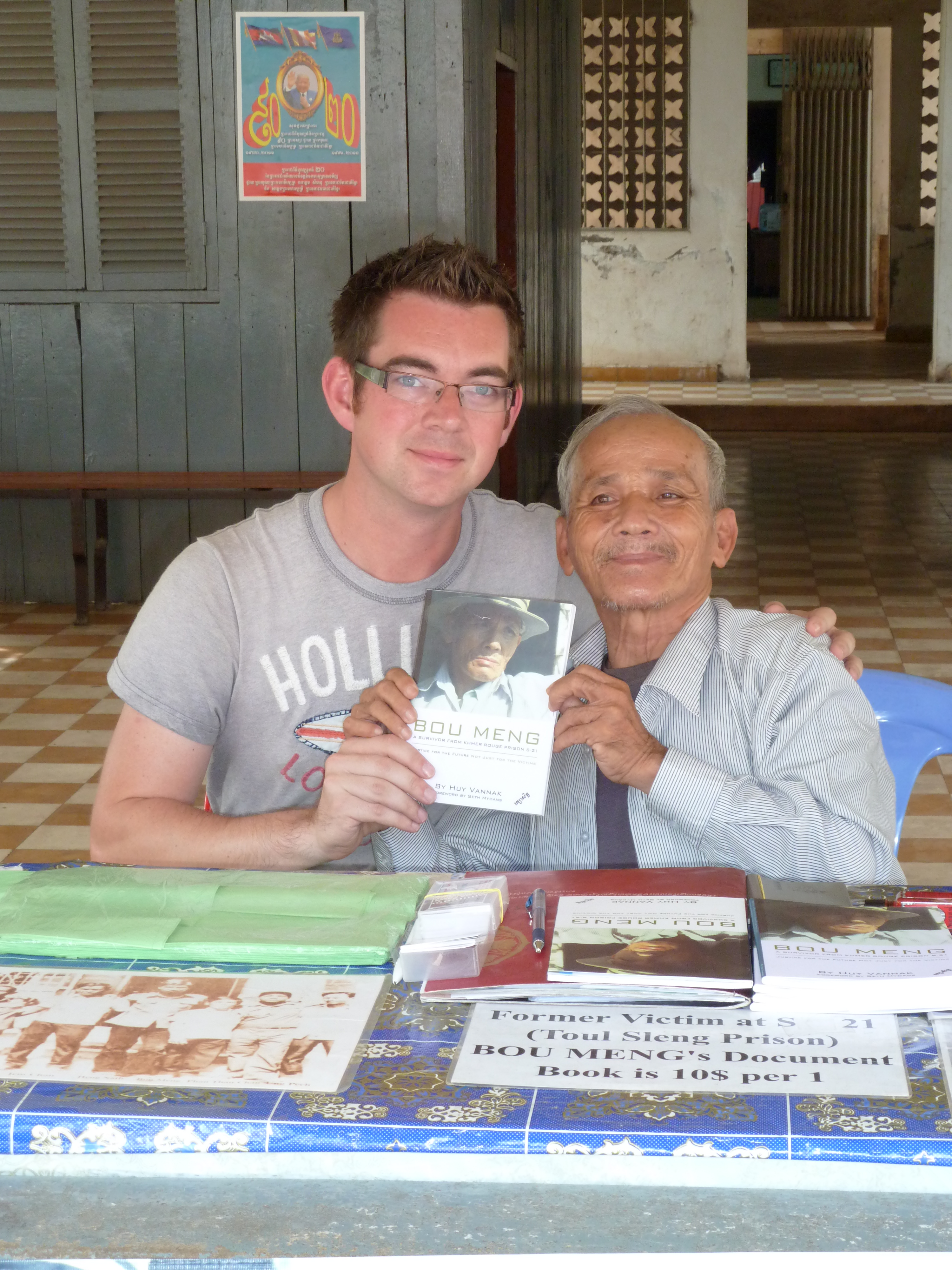
Only a handful of people made it out alive, among them Bou Meng, who managed to survive the prison until the Vietnamese liberated the area. His wife was murdered in the nearby killing field after also being held at the prison. He was busy signing his book, which tells of his life before and after he was captured, under a canopy near the cell he was held in.

With prison survivor Bou Meng

Incredibly, he was spared because he was an artist, put to work by painting pictures of Khmer Rouge leaders.

“I am a victim of Pol Pot,” he says

“And I was able to survive because of pictures of Pol Pot.”

I bought a copy of his book, which he signed and dated, before gratefully shaking my hand and posing for a photo.

He seemed a nice man, who had moved beyond a need for personal revenge by finding peace in educating others, in the hope similar atrocities can be avoided in the future.

“I want everyone to hear my story and the misery of other victims of the genocide. Demanding justice for the victims of the Khmer Rouge regime is always in my heart and soul.

“I will not give up my efforts in demanding justice. Even though justice cannot compensate the victims, it will prevent the atrocities from happening again.”

Bou Meng faced his tormentors by giving evidence at the Khmer Rouge Tribunal. Five top Khmer Rouge leaders are held for crimes against humanity. Their trials have just started.

Siam Reap and Angkor Wat, Cambodia

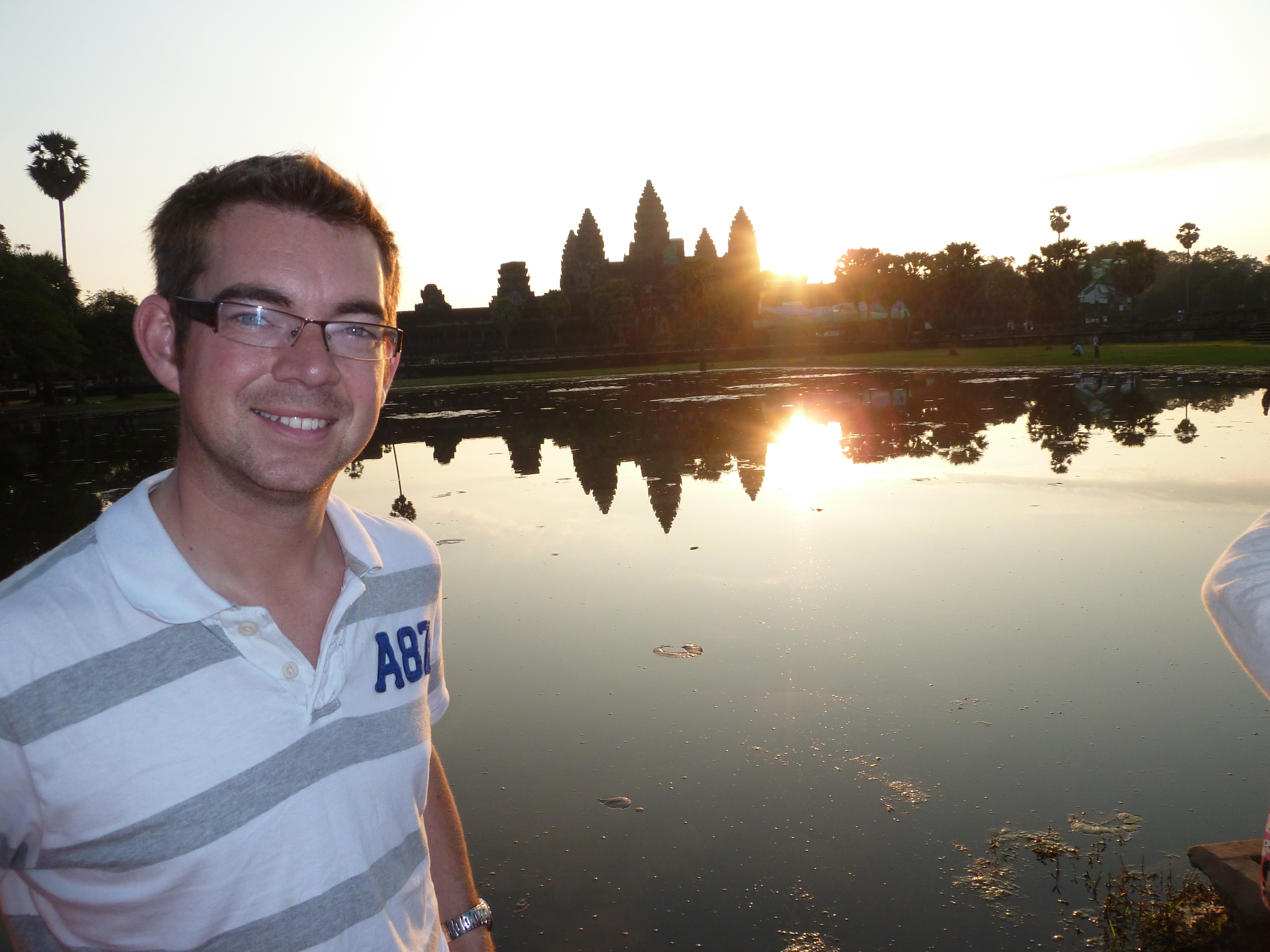
Angkor Wat, Cambodia

I don’t really know too much about Cambodia – to me its one of those countries I’ve only heard of as it was featured on the news for all the wrong reasons when I was younger. But it’s the first stop on my tour and only a few hours drive away.

With a few fuzzy heads, we set off from Bangkok split up into two luxurious minibuses, although we’d been warned not all the hotels and transport will be quite as nice as the first few experiences. After a brief stop to pick up our Cambodian visas we had lunch at a border town street market. It was an interesting bowl of noodles, with some particularly interesting ‘mystery meat’ inside, mainly in the form of a tongue-shaped black lump. I hid it under a spoon and pretended I hadn’t seen it.

Interesting mealtime addition

With border formalities over in around an hour, we arrived in Siam Reap in the early evening. It’s clear that Cambodia is a much poorer country than Thailand – its dusty streets are lined with shacks made of wood and corrugated metal.

Welcome to Cambodia

Many streets are potholed and littered with rubbish. Begging is a part of life here, and its never too long before a young child approaches asking for a dollar for some postcards or a bracelet.

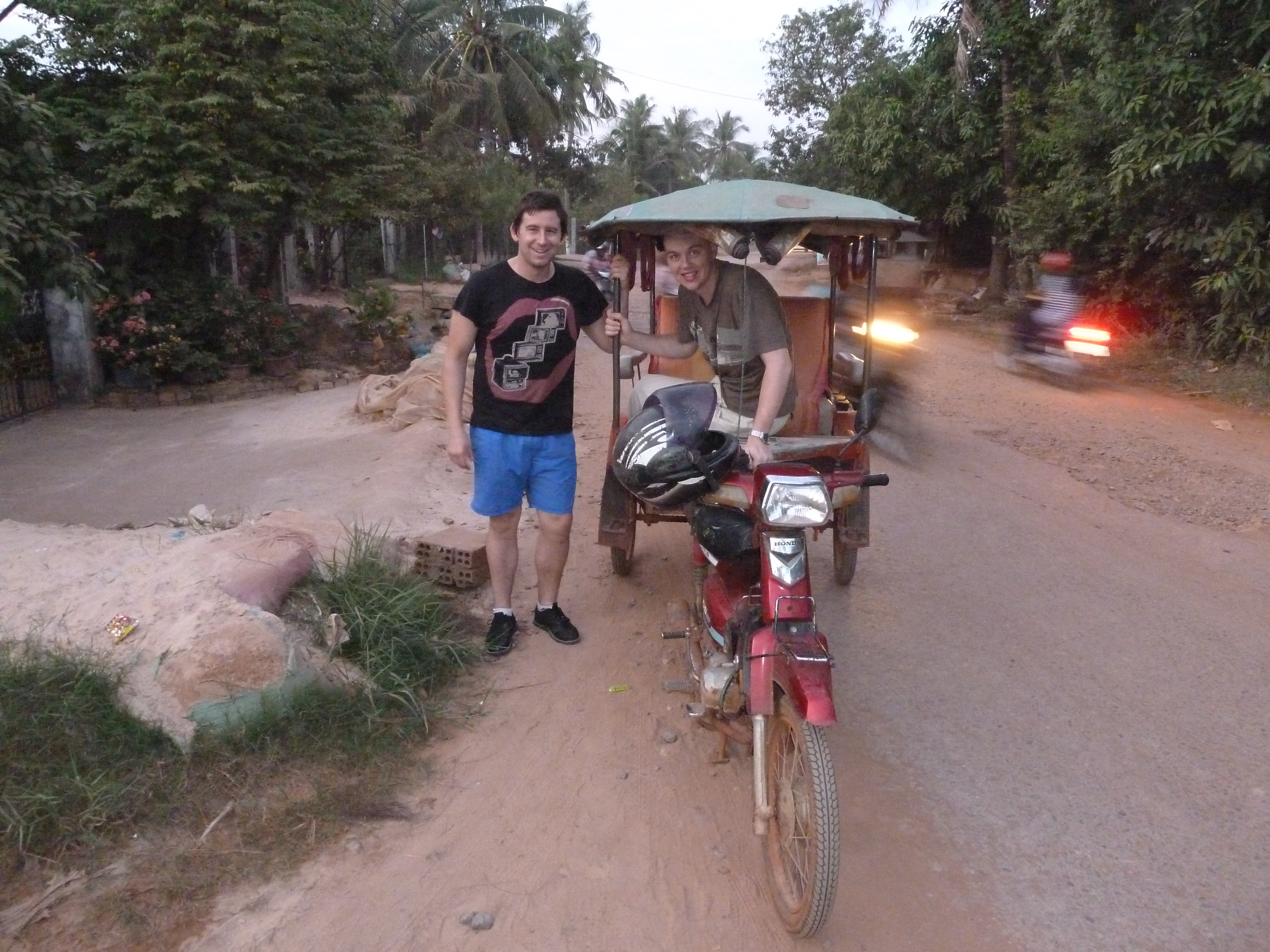
Tuk Tuks are also a major part of life here, and infact the main way of getting from A to B in towns due to the poor roads. They are slightly different to the nimble, wheelie performing speed demons of Bangkok, as it’s mainly a trailer attached to a motorbike, but they are surprisingly comfortable.

At the Thailand/Cambodia border with Assata from the tour

A tuk tuk was our mode of transport to a meal with a Cambodian family on the first night, and we left the hotel in a fleet of four. The journey was going well until we hit a particularly dusty stretch of road which had been badly potholed by recent flooding. Gradually, the motorbike started to sound like it needed a breather, before eventually deciding that enough was enough and it had one on its own accord. Incredibly, we’d broken down in a tuk tuk in the middle of nowhere. We considered a call to the AA.

John, Malcolm and our broken down tuk tuk

After about 20 minutes of frantic kick-starting by the driver, he got it going again long enough to limp to his friend’s house, where the motorbike was swapped over and we were off again.

Stuck

We couldn’t go all of the way to the house by tuk tuk as the road was still partly flooded by the heavy rains, but after a 10 minute walk we were greeted by the really friendly family in the village of Spean Chreav.

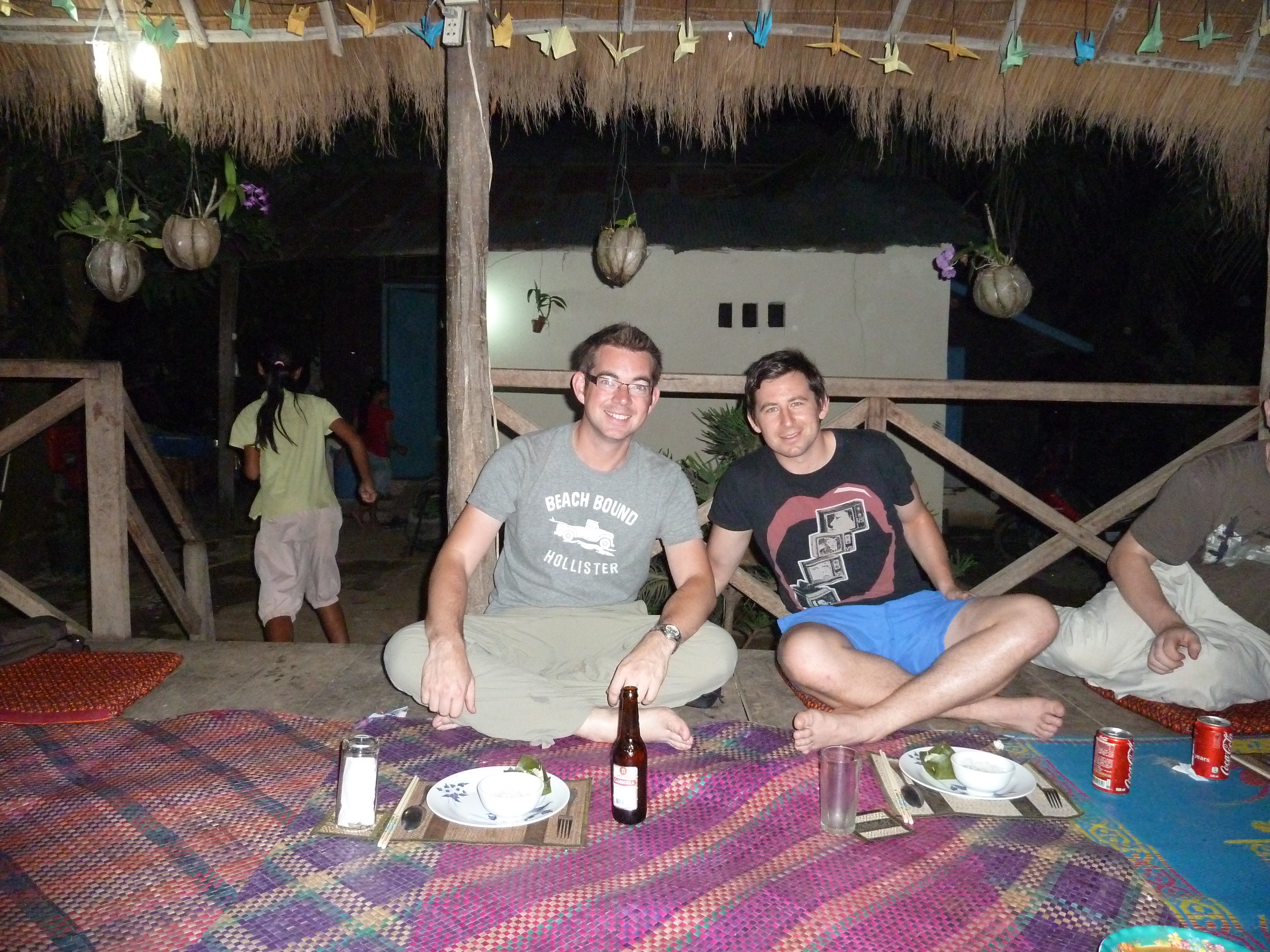
It was a shoes-off, sit around on the flood together affair, just how the Cambodians enjoy mealtimes, but I was introduced to something which suddenly rocketed up my favourite foods list.

Typical Cambodian meal

It’s a Cambodian dish called Amok, and comes along with various ‘run amok’ jokes, but its one of the best things I’ve eaten from this region. It came in a folded banana leaf, and was a creamy, fragrant taste a bit like a Thai green curry but thicker and sweeter.

Chicken Amok with curry and rice...beautiful!

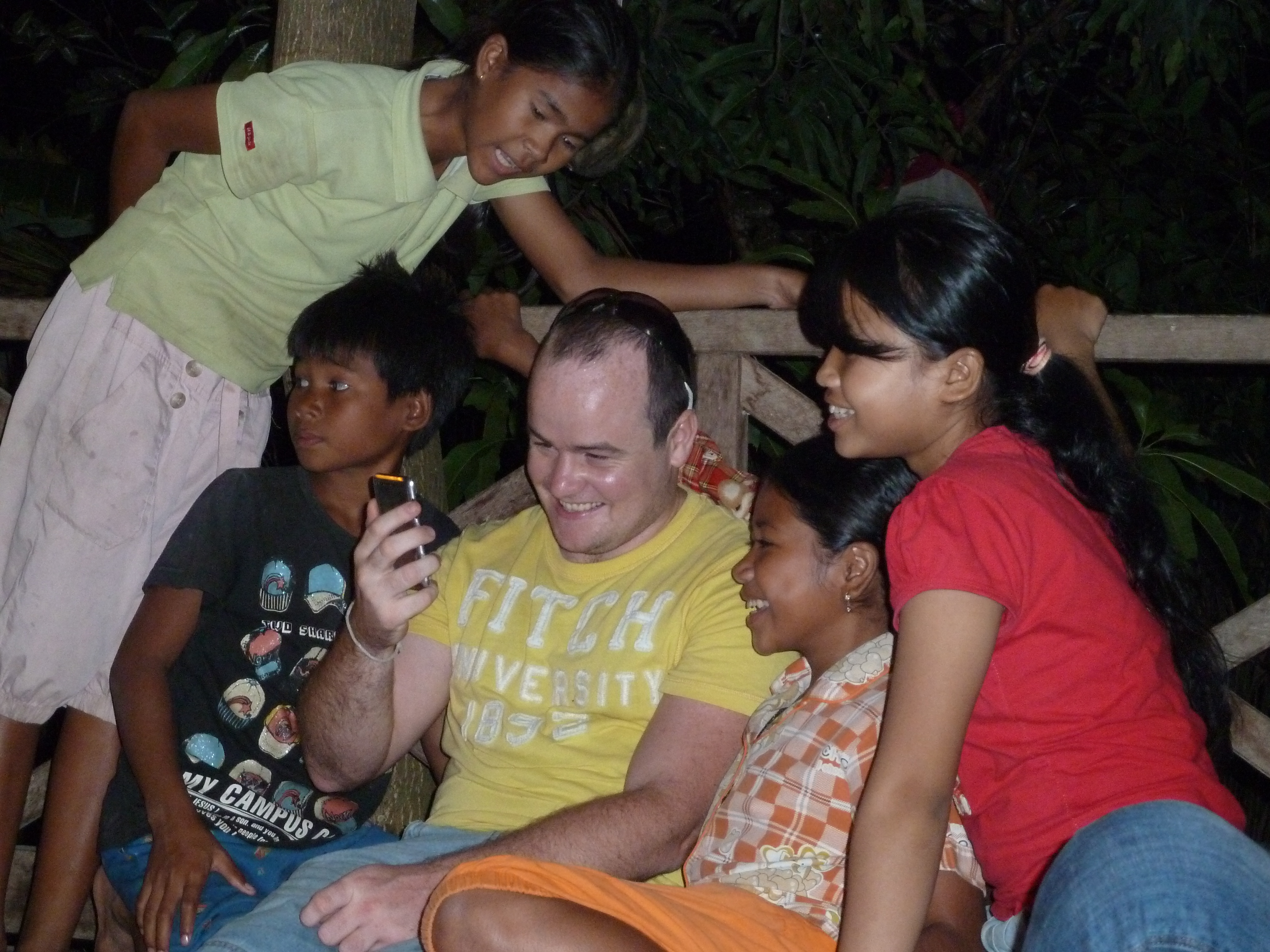
Everyone ate really well after the slightly off-putting lunch, before the children of the village were allowed to come up and play with us.

The village kids join us

The place where we had been eating was being turned into a community school for the village by the family, who had taken it on themselves to promote education and encourage youngsters to get good jobs and a good future. But one of the surprising factors of the evening was just how much modern technology has reached into some of the poorest, most difficult places to live.

Having been asked what games one of the boys like to play, and expecting an answer along the lines of football or basketball, we were quite surprised to hear ‘Angry Birds’! Incredibly, the kids here are all big fans of the totally addictive game that started out on the iPhone, where you have to twang little birds into bricks to kill little green pigs. Its all cartoony and quite harmless, but the kids could do great impressions of the actions and noises the birds make.

Darren with his iPod touch suddenly became very popular!

I had a chat with the woman who is setting up the school. She told me the whole village had been under water for two months due to the floods, but that now it had started to dry out she could start planning activities for the kids again. She told me how they loved going to the shopping centre as a treat, purely to spend hours going up and down the escalators and lifts. She said the children have one dream: to see the sea.

Our tour group with the village children

She’s trying to save enough money to take them next year, but it’s still a humbling thing to hear. Living on the coast of an island back home, I take the seaside for granted. For the children here, it was as much a dream to see it as it is for us winning the lottery. She went on to tell me how she’s gaining support and helping to organise events among parents in the village – on Facebook! It seems wherever you are in the world, apart from those places its banned, there’s no getting away from its usefulness!

It was an early night back, as at stupid o’clock in the morning our alarms were all going off. It was 4.20am, still dark outside, and there was a tour bus waiting outside reception. It was to take us to Angkor Wat, a series of huge ancient temples just outside the town. We’d been asked if we wanted to go for sunrise, and however much the temptation was to say I’d give it a miss, this was one early morning start I was glad I made.

Sunrise at Angkor Wat

It’s such a famous sight, but to see the sky changing colour behind it as dawn breaks was spectacular. We arrived to see a feint silhouette of the main temple looming ahead, and as we moved into position around the pond in front, gradually the sky changed from a deep blue, to purple, to red and through to orange as the sun rose from behind one of its famous towers.

Sunrise

It was difficult to know when to take photos, as with every passing minute the incredible scene in front of us changed for the better – the mirror image reflection on the perfectly still water got clearer, and there was genuine excitement among the hundreds of people who had got up so early to watch the spectacle. I wasn’t expecting to be taken aback by it quite as much as I was – it truly was one of the best sunrises I’d seen in such a beautiful and famous setting.

After a quick trip back to the hotel for breakfast (and in my case, a much needed powernap) we headed back. Angkor Wat, built around 1150, is perhaps one of the most incredible buildings mankind has ever made.

From the back

But there isn’t just the one temple-it’s a massive site, built for the king Suryavarman IIin the early 12th century as his state temple and capital city.

People still live and work around the temples

Its estimated that Angkor had been the largest pre-industrial city in the world, with an elaborate system of infrastructure connecting an urban sprawl of at least 390 square miles. There were around 1,000 temples of various sizes, a huge manmade moat and the biggest swimming pool ever constructed at the time – although only to be used by the leader and his people.

We first went to a place known as the jungle temple, where the native trees have done their best to wreck the place. Everywhere you look, huge trunks and roots weave their way around the huge stone blocks. The belief is that the temples came from nature, and so if nature wants to take them back, then so be it.

Big roots!

The end result is a great sight – huge ‘spung’ trees, hundreds of years old, growing through the roof in various locations, and intricate roots searching around the giant stone blocks for a water source. Many parts have been renovated and pieced back together following collapse, rivalling the Terracotta Warriors for the title of most difficult jigsaw puzzle.

Our group

Next we went on to another temple which involved a death-defying climb up the side. The steps were incredibly steep, and almost as vertical as ladders. A good group of us made it to the top and took in the views.

The view was great

The main temple of Angkor is the star here though – it was the centre of the huge site that was constructed. Its unbelievably huge, regarded as the largest single religious building ever made.

Tiny detail

But apart from its size, the detail of the carvings is hard to take in. Almost every piece of stone has intricate stonework covering the whole surface – around doorways, around windows, along walls, on floors – it must have been one of the most labour-intensive projects ever undertaken by man. The stone was brought some 100km from a quarry, sometimes floated along a nearby river on the monsoon tides. There are still holes and markings visible on most, where those who built the temple somehow managed to lift them into place.

Some of the stone carvings

Everything here is on an incredibly huge scale, from the detailed stonework, to the wall carvings, to the vast area the whole place covers. Elephants were used to move the stone around, and in many places there are carvings of elephants and trunks which protrude from the walls.

We’d all been in search of the elusive photograph of a robed monk, and while in the main temple there were a group of them walking around. We all tried to get discreet shots, but when there’s a group of tourists suddenly reaching for cameras whenever they get near, it soon became clear what we were up to. One of them came over and talked to us about his life, where he was from and how he was enjoying his visit. He then said we could add him as a friend on Facebook. It really does seem absolutely everyone is on it!

Fellow tourists!

At another temple, hundreds of faces of the Buddha look out from huge stone pillars, while we spent a few minutes walking along the main road into the site, through a stone gateway, again with more intricate detail all over it.

One of the main bridges over the moat

The sun was beating down on us all day, and the sticky heat means it’s always a relief to get into the air conditioned minibus, but as we were driving away there were some elephants at the side of the road. The bus stopped and we all took turns to stroke their trunks and feed them bananas. They are such beautiful animals, their eyes looking at you and taking everything in around them as you approach.

As a group we’d decided to make our way to a floating village, so we left the temples at about 4pm to catch a boat. The full problem of the flooding became clear as we approached the departure point – water was suddenly as far as the eye could see, with the tops of trees and bushes poking out.

Flooding

We passed villagers who were busy making dinner and going about their lives, despite the watery surroundings. While many of their houses were raised off the ground, it was obviously difficult to live and get by in such conditions,

We got on the boat for the journey to the floating village, which according to our guide is mainly made up of Vietnamese people who made their way to Cambodia but were not allowed entry.

Floating village

Instead, they took their boats and floated out into the lake they had just crossed, hooked up to a tree and made it their home. Now there’s a fairly substantial village, complete with school and a hammock bar, happily floating around six metres above land, and in doing so getting around the border problem.

Chilling!

Everyone seemed really happy as we floated by, lounging around on the roof of the boat, many were giving us waves and saying hello. At one point a faster longboat pulled up and a young girl, only around seven years old, jumped over the gap to sell us beers and soft drinks.

After watching a beautiful sunset over the lake – meaning we’d seen it rise and set in the same day – we stopped by a crocodile farm where they breed them for meat and their skins. Then there was a special treat to go with our ice cold beers – some snake meat.

I saw it rise...I saw it set

Now, I’m always willing to give things a go – its part of the fun when travelling –but having been offered snake meat kebabs along with scorpions and tarantula when I was in China, it wasn’t really appealing to me here either. But then Colin said it was actually quite nice, followed by a few more tentative nibbles.

“It tastes like bacon,” someone joked.

And sure enough, it did – I first had a nibble, blotting out the fact that it’s a snake – and then got a bit of a taste for it. It was even the same texture as bacon, looking and tasting just like when you leave bacon in a frying pan for too long and it goes all dark and chewy. It was a surprise for everyone, and nobody left it. The plate was clean in no time!

Full of beer and snake, we headed back and went out for dinner and drinks. Having had quite a bit of my new discovery, chicken amok, over the last few days, I was recommended another dish by my Thai tour guide Fon. Its fried vegetables with chilli and garlic, so I ordered it- ‘deep fried morning glory’ (stop giggling at the back!)

While it was pleasant enough, it felt a bit too much like I was eating the grass we’d seen people picking from the roadside as we passed by on the bus. It was a bit dry with the mound of rice too. I knew I should have stuck with what I knew – the amok was ‘amazing’ according to those who had it.

It was the first opportunity to have a few drinks after dinner, so we headed for pool and cocktails at the Temple bar in Siam Reap. We’d been told for just $8 you get a pitcher of cocktail and a free t-shirt.

I only did it for a free t-shirt, honest!

It was a great night – the travelling pool sharks became known (Ricardo being one, although I managed to beat him) a stage was found and a few people managed to strut their stuff – badly – despite the incredibly long day. At 2.30am, I rolled back into the hotel clutching two free t-shirts, Tuk Tuk grease all up my legs and a lot of great photos and good laughs about the shenanigans that we’d all just been part of.

Ricardos pool skills impressed the locals

I’d agreed to give blood the next morning, which added to the hilarity for some people who’d seen me somehow put away about four litres of Cambodia’s finest Temple cocktail, but sure enough when the alarm went off at 9am I managed to drag myself down to reception to meet Fon, while everyone else slept off hangovers.

Because of the floods, there’s a huge outbreak of Dengue Fever among children at the moment, and its really taking its toll. Many are dieing because blood supplies, needed for treatment, are always running low. After checking that everything was sterile and new, with no risk of infection, I agreed to go along and give a pint to the local hospital.

Appeal for blood

I’m a big believer in giving blood – I did it for years back home until my travels saw me being turned away by the NHS. Because I’ve visited malaria-prone areas, I get banned from giving blood for up to a year at a time. That currently means it will be June 2013 before I can give blood in the UK again, but somebody somewhere may as well have some of it!

Despite taking anti-malaria tablets, the hospital welcomed me in. There were three of us, including Fon’s fellow tour guide friend, and many people looked at us as we walked through. It was a sad sight to see so many poorly children, many being cradled by their mums on mats on the floor. The hospital has to treat hundreds of children every day, and if ever I needed justification for doing what I was doing, the walk through to the donation room was just that.

It didn’t take long, and aside from a brief pinch when the needle goes in, the worst bit is always trying to take the plaster off later in the day. The least I can do in such a poor country is to give something back, and I’d like to think that a child somewhere has been helped out.

Helping out with a pint

An hour later we were on the bus heading to our next stop, Phenom Penh, the capital of Cambodia. It was a seven and a half hour journey on a public bus. It was comfortable enough, but the driver had an awful habit, as most do here, of beeping every time he approaches a cyclist/motorcyclist/tuk tuk/lorry…infact, almost anything.

Unfortunately, the horn gets used that much over here it pretty much loses its effect. This was demonstrated by the two dogs that were fighting in the road as we approached. There was a horn…and then there was a thud…and then the bus jolted up and down. The Chinese passengers on the right side of the bus laughed. Assata, our American co-traveller, screamed.

“Lets just call that fight a draw then,” says John in his Aussie accent.

Its never good when an animal loses its life, let alone two at the same time, but it was certainly the main talking point as we arrived in the capital after a day-long journey.

It’s good to be back

My view of South Korea

South Korea wasn’t a country I had on my visit wish-list, but thanks to Korean Air offering the cheapest ticket to Bangkok from Xi’An, I had the pleasure of spending 90 minutes there.

Naturally, my sightseeing abilities were limited somewhat, but from the air there seemed to be a nice beach on the flightpath into Seoul, and the airport had some pretty fast wifi!

I was just glad to be heading to Thailand. I’m booked onto a 30-day organised tour of south-east Asia, starting in the Thai capital, but there’s been a few concerns over whether it would actually go ahead or not due to the flooding, and risk of further flooding, around Bangkok.

Its been caused by a wet rainy season which has seen far more water descend on the country than normal – so much so that parts of the city have been evacuated. It had meant checking with the tour company a few times in the run-up to flying out, but thankfully it was all still going ahead, albeit with a change here and there as railway lines have been flooded. Despite all the doom and gloom reports I keep seeing on the news though (you know what reporters are like!) fellow travellers were reporting it wasn’t too bad.

Landing back in Bangkok was strange. Back in May, I landed at the same airport to meet Cat, a lovely girl I’d met in Hull back in January. We went on a few dates before she left for a year long trip to travel the world in March, but I know that I probably wouldn’t be doing any of my own travelling without her inspiration.

We met at a time when my personal life was pretty tough following a relationship break-up, and the year ahead of me didn’t seem to have any direction. I had little to look forward to aside from focusing on my career, but even that was proving difficult because of the situation at work – it’s always hard when a relationship ends but you still have to work together. But in Cat I found someone who was one of the most thoughtful and generous people I’d ever met, who could make me laugh, was great company and in turn made me realise life could be fun again.

Cat was touring south east Asia herself when she got in touch and suggested I fly out for a holiday. It was a massive step- a leap of faith she called it on my part – as we hardly really knew each other. We even jokingly worked out that our sixth date was two weeks in Thailand together – but going from a few drinks on a couple of nights in a Hull bar to spending all day every day together for two weeks on the other side of the world was pretty daunting for both of us.

With Cat and other travellers at Maya Bay, Koh Phi Phi, in May

As it happens, we had a fantastic time together backpacking, island-hopping, drinking far too many cocktails and eating more green curry than can ever be good for you. In doing so I discovered Thailand, how much I loved the region and the whole backpacking culture- it was that trip that made me realise just how much I’d possibly missed out on by focussing on my career when all my other friends were doing similar year-long jaunts around the world in their early twentys.

Cat’s stories and passion for the places she had travelled to was infectious. She kept drilling into me how ‘life’s too short’ and how we have to see the planet while we can. Now I was back at the same baggage carousel at Bangkok’s main airport six months on, waiting for my backpack to appear once again, but this time it was the first month of my own world adventure, and following in Cat’s footsteps by doing exactly the same tour around the Thailand, Cambodia, Laos and Vietnam.

Suddenly the time that had passed in between my arrivals at Bangkok seemed to disappear. I remember my nerves from that day in May and seeing Cat’s equally nervous but smiling face waiting for me at arrivals. It all felt very familiar, and it was good to be back, but it was a strange feeling to be there on my own.

I’d decided to stay in the same hotel we stayed at earlier in the year, the Bangkok Center Hotel, mainly as I knew exactly how to get there and the fact my tour starts from there in a few days time. It cost more than id been paying, but felt I needed a bit of a treat – a few days of comfortable privacy, in a big bed and with my own bathroom. Already that seems like a luxury!

The MBK shopping centre, Bangkok

I’d also decided the next few days would be relaxing after a few very busy weeks. It was nice to go to sleep without setting the alarm and having a lazy morning before heading to the MBK shopping centre Cat had taken me to. This was the place I knew would be able to sort out my iPhone – there’s a whole floor dedicated to Thai whizkids who can unlock, repair and in some cases completely rebuild almost any electronic device. After almost a month without it following the Apple update which cleared everything from it, I’d got used to seeing my iPhone as a useless lump of weight in my bag.

Sure enough, after just two hours and £10, it was back in working order again, completely unlocked and with an international simcard. I got my watch fixed for £1, and stocked up on a range of suncreams and insect repellent that id not bothered packing back home, mainly as Siberia didn’t really threaten on the sunburn front.

You become an expert at sandbag hurdles

It was clear however that Bangkok wasn’t out of the woods when it comes to flooding. There were sandbags absolutely everywhere, while businesses have built makeshift walls around them to try to keep water out.

My hotel

There were scores of buses, cars – and strangely, ice cream vans – parked up along the raised motorways. Taxi drivers I spoke to told me how the floodwaters were only two kilometres or so away from my hotel in places, and that they were expecting it to eventually reach the city centre.

Dam it

Emergency flood centres had been set up all over the place, while donation boxes are in almost every shop. I donated some pencil crayons and colouring books at the airport collection, as they’d been in my bag incase I came across any youngsters at some of the poorer places I’d been visiting in Mongolia. They joined other kids toys and crayons that hopefully will cheer someone up a little. The rest of my time in Bangkok was spent uploading a backlog of photos and posts to my blog, which had been banned in China, while I also sent a box of books and souvenirs from the trans-Siberian part of my trip home to the UK.

Makeshift walls in readiness

In reception at the hotel, my name was on a list of 13 or so other names that form my tour group with Gap Adventures. When I first arrived, it was strange to look at the list knowing they were the people who would form a huge part of my next few weeks of travelling, yet I had no idea who they are. Before long it was 6pm on Friday, November 11, and the time for the reception meeting to be introduced to everyone.

The famous Khao San Road

It was a nervous start to the meeting, everyone seemed quiet and subdued. A lot of people had only just flown into Thailand and so were still getting used to both the heat and the time difference. We started with a few introductions and soon worked out who was who. There was an American, a Canadian, two Germans, a girl from Switzerland, an Australian, a Scot and six of us from England.

Neon and madness on the Khao San Road!

It seems to be a really good mix of people, and we were soon being loaded into tuk tuks for a Thai green curry on the famous Khao San Road. Before long, the banter started to get going, fuelled by plenty of large Chang beers. John, an Aussie, is a fellow journalist, working for a Fox sports network in Melbourne , so we already had plenty in common, including a shared sense of humour.

A deal being struck for Colin's hat!

We moved outside for a few more drinks, taking in the atmosphere and getting to know one another better. There was a steady stream of hawkers coming up and offering a variety of daft things to buy. We managed to keep them all at bay, until the alcohol fuelled a purchase of a daft hat for $2. It was a joint purchase by John and I for Colin, who is here with his partner Sarah from Nottingham.

'Smiles' all round

Naturally, Colin had to wear it, and he particularly enjoyed his close encounter with the sales lady and her pretty nifty dentistry.

'Gis a kiss Colin?!'

Ice firmly shattered, we headed back to the hotel in another fleet of tuk tuks. Somehow, despite three biggish blokes being in the back, our driver managed to pull off a number of wheelies along some busy Bangkok streets. It was all highly entertaining until he managed to wheelie off into the distance with around four quid more than we’d agreed in his pocket. Still, it had been a great end to a good first night on the tour.

It’s great to be back in this part of the world, and already i’m realising exactly why it inspired me to come back and to see and experience more of life over here. Tomorrow we head to Cambodia.

Tuk Tuks: A wheelie good ride!

Xi’An and the Terracotta Warriors, China

Terracotta Army

I’d been looking forward to flying out of Shanghai. Not because I was glad to be leaving the city –quite the opposite infact – but because it meant I got to ride the fastest form of land transport in the world.

Maglev this way...

Shanghai’s Pudong airport is more than 20 miles from the city centre, a good hour’s ride on the underground. So being a futuristic bunch, they decided to build a shuttle between the outer city centre and the airport – using magnets.

Maglev arrives

It’s a bit like a cross between the Heathrow Express rail service from London and the Alton Towers monorail – but at warp speed! An incredible 431km/h (268mph) to be precise, faster than any car on earth. Its all done thanks to the opposite poles of powerful magnets – the effect you get when they don’t stick together but push away from each other.

Some bright spark has managed to make this into a form of transport, by fixing the powerful magnets to a monorail-style train and an elevated track. The result is quite staggering – the 18 mile journey gets covered in seven minutes thanks to a complete absence of friction! Its even a popular video on Youtube, such is the speed the train reaches.

Having completed the longest rail journey in the world, I just had to add ‘fastest land transport journey’ to the list too. I had to pick up my tickets from a counter in the terminal between 2.30pm and 3pm, for my flight to Xi’An in western China at 4.45pm. I arrived at the Maglev terminal at 2.20pm – and was gutted to see it doesn’t run at full speed until 3pm. At all other times, it crawls along at 320km/h.

 Well that wasn’t much faster than the bullet train the other day, and as I watched the world fly by the window, I was annoyed that I wouldn’t experience the full speed the Maglev is capable of. It took over eight minutes to cover the distance, but all along I was looking at my watch and thinking – could I pick up my tickets and get back to the Maglev in time to ride it at full speed, back to Shanghai, and get back in time for my flight?

I soon found the ticket counter and thankfully there were no queues at check-in. I dumped my backpack on the conveyer, got given my boarding card and looked at my watch. It was 2.50pm, the flight boards at 4.15pm – surely I could make it

With all of my belongings on the way to the cargo hold of a Hainan Airlines jet, I knew it was tight and left very little room for error or catastrophe. If the Maglev breaks down,it would cause far to many problems to even think about. But I couldn’t leave Shanghai without experiencing it – after all, I might never return or have another chance!

It was a busy service...

With a bit of a quick walk I reached the ticket office and paid around £8 for the return trip. A man waved me through saying the next Maglev was leaving, and I was safely on the 3pm trip back to Shanghai. It was the first of the afternoon to go at full pelt, and what an experience. With a bit of a shudder, it pulls out of the station and picks up speed. It then takes on a bit of a feeling of a theme park ride – you can hear the engine or magnets, or whatever it is that propels it, rising in pitch and you can feel the g-force keeping you in your seat. Trees and houses start to go past quicker and quicker, before they turn into factories and warehouses as we quickly reach the outskirts of the city.

 Before long the digital display is showing 350km/h and still rising. The noise is still increasing and there’s no sign of the Maglev slowing. Outside, bridges pass overhead in a blink, with everything going by so quickly you have no real time to focus or look at anything. Cars travelling full speed on a motorway alongside the track appear almost at a standstill. By now the carriages are shaking a little, a gentle vibration as we hit 400km/h. We’re already going almost twice as fast as an airliner at take-off, and still the speed counter climbs. As a bit of a speed freak, it was fantastic – and people onboard realise it, with so many passengers looking at each other and smiling in amazement, taking photographs and filming the scene outside the windows. It was the sort of speed that makes you think ‘surely this is dangerous

Top speed!!

Its so fast, we’re only at its top speed of 431km/h for a minute or so, and no sooner had we left the airport we were slowing down and arriving back in Shanghai.

I got off, ran downstairs, through the turnstiles and back up the stairs on the opposite side of the platform to get back on the same Maglev for the trip back. Seven minutes later, at 3.25pm, I was back at the airport – in plenty of time to join the other tourists taking photos of this brilliant piece of engineering and get through security in time for boarding.

For £8 return, the journey should be a tourist attraction in its own right – I imagine many people have already done the same as me judging by the smiles of staff acknowledging what I was up to. It was money well spent – it would cost a heck of a lot more to be taken for a spin in a Bugatti Veyron to get anywhere close to that speed, and even then the Maglev is faster.

Noodles and blog!

There was time for some beef and noodles before the flight, where yet again the locals took pleasure in watching the westerner trying to use chopsticks, while the free wifi meant time for a blog update.

It was a two and a half hour flight to Xi’An, and while I wasn’t expecting anything special for my £90 ticket, I was pleasantly surprised. A full meal service with drinks,  a lovely new plane with lots of leg room, comfy seats….and a lot of phlegm.

I’d been holding off writing about this, but quite simply, my patience reached its limit on the aircraft. China has to be the ‘phleghmiest’ nation in the world. You cannot walk the streets for more than 90 seconds without hearing one of the locals, shall we say, ‘clearing their throat’. It’s always very loud, very visible, and to be honest, quite disgusting. It got to the point where it makes you shudder. It doesn’t matter where you are – I saw it happen on trains, on platforms, in shopping centres, at museums, and now planes

First plane in a while!

.Across the aisle from me was possible the largest, sweatiest Chinese guy I had seen during my stay, and for me, also the most disgusting. We’d just taken off when I heard the familiar noise come from him…and immediately wondered what he would do with the ‘deposit’. Well, in China, airsickness bags have another use

From Shanghai to Xi’An it felt like absolutely everyone was at it. There was a phlegm chorus at one point, so bad I almost had to cover my ears to switch off from it. Even through the meal service there was no respite. Its revolting, and apparently there has  even been a government campaign to try to cut down the level of spitting.

It hasn’t worked.

Xi’An was a real highlight for me though. It was a bonus visit that I hadn’t scheduled in, so the fact I was seeing anything there was great, let alone one of the greatest discoveries in this part of the world

The Bell Tower, Xi An

.I only had one full day in the city, but decided against an organised tour to see the Terracotta Warriors. My Lonely Planet I had ‘borrowed’ from the Beijing hostel said it was easy enough to get to on a public bus, and it’s always nice to be free from time limits and ‘shopping stops’ that the tours so love.

As I wouldn’t see Xi’An by day, I decided to walk through the city to find the railway station. It’s a very old place – it was once the centre of the Chinese empire – and there’s a huge city wall which still survives. It’s a busy city built up around one of its main landmarks, the Bell Tower.

Xi'An city wall

It took about an hour to reach the northern gateway to the city, and I was still some way off from the railway station to the east. I decided to walk along the top of the city wall, which was a great vantage point for spotting where I needed to be. The bus was easy to find, and soon I was walking through the grounds where the Terracotta Warriors were found

Mountains around the site

.I watched a film about how they were first discovered in 1974 by a villager out digging a well. Little did he know that the fragments of pottery and clay he was bringing to the surface would turn out to be one of the greatest ever historical finds. He’s done alright out of it though – he’s now got a special building near the exit to the site where he sits all day signing copies of his book

The bits of clay he’d found were parts of an estimated 8,000 full-sized, highly detailed warriors, complete with weapons and horses, and arranged in full military fighting positions

The soldiers in the main pit

They had been constructed by hundreds of thousands of people under orders of Emperor Qin, the first emperor of China (pronounced ‘Chin’ hence ‘China’) who believed that when he died, he could still be a leader in the afterlife. But if he was to be buried and be a leader underground, he needed his own army to protect him. Therefore, the terracotta warriors were built. Ironically, the emperor died while visiting the area, and so that’s where they were buried

Pit 3

.

There are three pits where the warriors were found, all fairly close to each other. I’d been advised, and it turned out to be a great tip, to tour the museum in reverse, starting with the smaller pit and building to the larger pit.

Remains in the pit

The smaller pit had very few soldiers in it, but it was still quite a special sight to see this huge hole in the ground, complete with clear marks left behind by artefacts that were found, including chariot wheels and the remains of wooden beams which protected the tombs.

Bronze chariot for the Emperor

The main pit was incredible. The sheer size of the area where the warriors were found, the rows upon rows of immaculately restored warriors standing to attention, the excavation work and restoration work that is still ongoing.

Still digging

So far around 2,000 warriors have been found at the main site, and its estimated there will be up to 6,000 of them recovered in there by the time all the work is completed.

Piecing together the jigsaw

It will take many, many years for them to be found and restored, piece by piece. Its like the world’s biggest, most challenging jigsaw – and the final result is still a long way off.

In the meantime, thousands of people visit the site. The soldiers are all different, with different features, faces, weapons and stances. The work that must have gone on thousands of years ago is hard to comprehend. It’s also amazing to look at the warriors and imagine what life must have been like for the people who made them, and to think about how, at some point, they would have all looked fully painted up and stood in formation.

I was almost the last one to leave the site, even taking in Emperor Qing’s mausoleum on the way out, which is at a seperate site a few minutes drive away on a free bus.

I had spent all day on my feet and walked for miles after a particularly tiring week, but decided to walk back through the city to the hostel to take in the atmosphere on my last night in China. I bought some street food – a bit more mystery meat on a stick, although it was a bit more ‘chickeny’ than the last one I tried; and some more of the stick haws, the little crab apples in sugar on a stick. I sat on a plant pot and ate them watching the traffic trying to negotiate the roundabout around the Bell Tower, before finding a night market and looking at just how bad some of the fake Abercrombie and Fitch fakes were. They’re quite special!

Night market

The colour and atmosphere of the Chinese night markets is always a spectacle – the atmosphere, the smells (not all good) the banter with the locals trying to sell you something you’d never need in a million years….its typically Chinese and great fun.

There was also a new thing being sold on the streets – a view of the moon. All thanks to some entrepreneur who’s managed to strap Hubble onto the back of a rickshaw…

The Nasa rickshaw!

Tomorrow I fly to the warmer climes of Thailand, but my 10 days in China had been a true experience. From arriving on the most famous train in the world and pulling into the Chinese capital with new-found friends, to seeing the famous Tiananmen Square and Forbidden City, flying around on superfast trains and whizzing up and down one of the tallest buildings in the world. It had been a packed 10 days and I felt tired, but I’d managed to see the main sights I wanted to see in this huge country. A great mix of old and new.

Shanghai, China

Shanghai by night

It was 3am on the day I was travelling to Shanghai when I finally got into bed, having had just a couple of drinks in a packed Beijing nightclub called Vics. Three hours later, I was getting up again to watch the raising of the flag ceremony in Tiananmen Square.

Chinese flag being raised at dawn

It was something that I’d seen on signs around the square, monitored by police and soldiers, and takes place twice a day, at sunrise and sunset. There’s lots of soldiers marching around, music, the flag of China being hoisted up the huge flagpole opposite Mao’s portrait, that kind of thing. I’d tried – and failed – to wake up early enough on two previous occasions, but this was my last chance as my train to Shanghai left Beijing’s South Station at 10am.

“You’ll never do it. Its crazy,” Santi said to me as we headed to bed just a few hours ago.

Plenty of early risers

Somehow, despite a slight hangover, I made it, and walked along with the Chinese public through Tiananmen Square to go and watch this most patriotic of ceremonies. Despite the early hour, there were hundreds, if not thousands of people there, all wanting their glimpse of the flag being raised. At precisely 6.45am, the national anthem began, everyone jostled for a look, and at precisely the moment the flag reached the top of the pole, the anthem came to a natural end. It was perfect timing – and obviously very well rehearsed.

And that was it – a few soldiers did a little march, but everyone was too busy heading to their flag-waving tour leader, and no doubt on to their buses, for a day of sightseeing.

I headed back to bed for an hour, wondering if it was really worth the effort getting up – it hardly gave our Changing of the Guard ceremony a run for its money!

Thankfully, I didn’t sleep through my re-set alarm, stuffed the last of my belongings into my bag and put my jacket on. I had to say goodbye to Santi and Gali here, which was a real shame as we’d become good mates, even despite the fact Gali and I could only have decent conversations through Santi acting as an interpreter!

We first met in Russia, at the backpackers in Irkutsk, so we’d spent the best part of two weeks together, with a few other people along the way. It just so happened our itineraries matched, so we ended up hanging out and booking hostels together. Sadly, they don’t leave for Shanghai for another few days. We’d had some brilliant laughs together though, and I’d like to think we’ll stay in touch.

Now, I was on my own again, for the first time since Russia which was already seeming like quite some time ago. Laden down with all my bags yet again, I headed to the incredibly modern Beijing South Station, to get onboard an even more modern Bullet train to Shanghai.

Swish!

Everything is set out like an airport. Infact, you don’t see any trains as they are all beneath you, and with the huge futuristic station, incredibly high ceiling, gigantic electronic destination board and the fact you have to ‘check in’ with your rail ticket, it does feel more like you’re at an airport than Beijing’s equivalent of King’s Cross.

But if I thought the station was impressive, the actual train was like something from the future. A long, streamlined, pointed nose stretches out, while the immaculately white and spotlessly clean carriages are constantly being polished by an army of cleaners. Whether it helps with its top speed, I’m not entirely sure – but at least you could see out of the windows.

A go-faster polish!

As it whizzed up to its top speed of 307km/hr, the world started rushing past the window. It was spectacularly quick and very comfortable – a long, long way from the trans-Siberian trains I had spent so many days on.

I took the slow train

I fell asleep for a few hours thanks to the early start and late night, but thankfully my headache had started to go away. In less than five hours – 4hrs 48mins to be precise – we had covered more than 800 miles between the two cities and pulled into Shanghai. To put that into some kind of perspective, it’s the equivalent of travelling from Cornwall to the top of Scotland in less than five hours. Amazing.

A bit different to the trans-Siberian

While on the train, I’d been looking at the calendar. I’d worked out that with a clever bit of fast sightseeing in Shanghai, I had just enough time for a stop in Xi’An, home of the Terracotta Warriors, if flight schedules and prices were kind to me.

I found the hostel quite easily thanks to some much better directions from the website, and it was quite some hostel. The Rock and Wood in Shanghai is classed as the number one ‘alternative’ accommodation in the city on Tripadvisor, and it was easy to see why – fabulous fish-filled pond, decking, floor to ceiling windows onto the terrace, free pool, cheap bar, excellent rooms. It was more like an upmarket hotel – and it was just £5 a night!

The first thing I did in Shanghai? I put a load of washing on! (it was about time!)

Posh hostel

When it was all dried, I went out to explore and headed to the Bund, the main waterfront area where you can see the famous skyline.

Shanghai skyline

My journey took me along the main shopping street in the city, but it was lit up with so much neon it put Piccadilly Circus to shame.

Shanghai at night

There were street entertainers everywhere, music, groups of Chinese people singing to some crazy man acting as a conductor, and street hawkers trying to sell you absolutely anything.

On the mile or so walk, I was offered dozens of annoying lit-up helicopter things that are constantly floating down to the ground, noisy pebbles, spinning tops, laser pens, kites, roller wheels for my shoes, some funny glasses, a dog (real), various massages, some authentic Chinese tea (not again!) about three ‘beautiful women’ and one ‘gorgeous guy’.

I declined all the offers.

Shanghai nights

I eventually beat off the sales pitches and made it to the waterfront, where there were hundreds of people relaxing and taking in the view. Low cloud was getting in the way, but it was still a great sight.

Chinese street singing party

I stayed until 11pm when I decided to make my way back to the underground station, only to find out the last train had already gone. It was a really early finish for one of the leading cities in the world, so a taxi it was.

Next day was the busy day with a plan to walk around the sights from People’s Square, but that’s where I did fall for a sales pitch. The open top sightseeing bus was only £3 for the day, and I knew it would give my legs a rest.

New motor anyone?!

In the walk to People’s Square however, it became clear how this city has earned its reputation as the playground of the rich. Upmarket car brands such as Audi and BMW are just the norm here – instead, super-exclusive car showrooms are dotted around the streets. It was quite normal to walk past a Ferrari parked up in a shop window next to your head, while Gucci and Tiffany seem to be dotted around like a Tesco Express

The local backstreet car dealer

The sights were taken in by two routes on the bus, one that did a loop around Shanghai’s older areas, while another went under a tunnel to the newer financial district and all its skyscrapers.

Bus tour

It was nice to sit for a few hours and take in all the sights, both of old Shanghai and around the modern day city, one of the biggest financial centres in the world.

It included what was until recently the tallest building in the world, the Shanghai World Financial Centre, a peculiar building that rises above all the others, sticking up with a huge opening at the top like some sort of giant bottle opener.

The Jin Mao tower, me, and the World Financial Center

It was about £15 to go up to the observatory – classed as the highest observatory in the world – and take in the impressive, if a little cloudy view (the cloud line was just above the 100th floor, so every now and again a big cloud would fly by and block the view!)

Don't look down

I’d timed it to see the view in daylight, and then hung around looking through the glass floor and trying to pick out landmarks until it got dark, and then took some night shots too.

From the 100th floor

I also did a bit of research, and found out that all the signs and posters everywhere were now wrong, as a new skyscraper in Dubai has knocked the Shanghai tower off its perch as highest observatory too. They were quite proud of their record here though, so I didn’t have the heart to break the news to them!

Room with a view!

I went down in the high-speed lift to the bottom and walked to something dubiously called the Bund Tourist Tunnel. It cost a fiver to go through, and you get bunged into a funny monorail type thing and travel under the river to the Bund. You pass through all sorts of psychedelic lights and effects, and it was all a bit weird. Some inflatable people fluttered against the windows at one point.

I was really taken by Shanghai though – its very much got a big city feel about it. I was quite gutted to have to leave after just a couple of days. It gets dubbed the ‘Paris of the East’ by tour guides. Well, ive already been to the ‘Paris of Siberia’ in Irkutsk, so ive decided its more of a ‘New York of the Orient’.

Old and new

The tall skyscrapers and busy nature of the city, combined with its old architecture and ‘new living alongside old’ is something I’d definitely go back and visit.

That night, I found a cheapish flight to Xi An and a flight from Xi An to Bangkok in a couple of days. My plan had come together – I was able to fit in a bonus trip to one of the other famous architectural sights in China. But it meant leaving Shanghai earlier than planned.

At least I’ll be able to use the futuristic and exciting Maglev to the airport tomorrow though!

Oriental Pearl Tower, Shanghai